
Red Lovegrass

Eragrostis secundiflora

Other common name(s):

Red Love Grass

Family:

Poaceae (Grass Family)

Plant Ecoregion Distribution Map

This map uses data from the US EPA. EPA  servers have been offline frequently so maps may not display. We are working on a solution.

Central Great Plains, Cross Timbers, East Central Texas Plains, Edwards Plateau, Gulf Coast Prairies and Marshes, High Plains, Southern Texas Plains, Southwestern Tablelands, Texas Blackland Prairies, Western Gulf Coastal Plain
Broken Red Plains, Limestone Plains, Red Prairie
Carbonate Cross Timbers, Eastern Cross Timbers, Grand Prairie, Limestone Cut Plain, Western Cross Timbers
Bastrop Lost Pines, Floodplains and Low Terraces2, Northern Post Oak Savanna, Northern Prairie Outliers, San Antonio Prairie, Southern Post Oak Savanna
Balcones Canyonlands, Edwards Plateau Woodland, Llano Uplift
Coastal Sand Plain, Floodplains and Low Terraces4, Laguna Madre Barrier Island and Coastal Marshes, Lower Rio Grande Alluvial Floodplain, Lower Rio Grande Valley, Mid-Coast Barrier Islands and Coastal Marshes, Northern Humid Gulf Coastal Prairies, Southern Subhumid Gulf Coastal Prairies, Texas-Louisiana Coastal Marshes
Arid Llano Estacado, Canadian/Cimarron High Plains, Llano Estacado, Rolling Sand Plains, Shinnery Sands
Northern Nueces Alluvial Plains, Rio Grande Floodplain and Terraces, Semiarid Edwards Bajada, Texas-Tamaulipan Thornscrub
Canadian/Cimarron Breaks, Caprock Canyons Badlands Breaks, Flat Tablelands and Valleys, Semiarid Canadian Breaks
Floodplains and Low Terraces1, Northern Blackland Prairie, Southern Blackland Prairie
Flatwoods, Floodplains and Low Terraces3, Pleistocene Fluvial Terraces, Red River Bottomlands, Southern Tertiary Uplands, Tertiary Uplands

Plant Characteristics

Growth Form

Grass & Sedge

Height

1
to
1.5
ft.

Spread

1
to
1.5
ft.

Leaf Retention

Deciduous

Lifespan

Perennial

Habitat and Care Requirements

Soil Type(s)

Sand, Loam, Well Drained

Light Requirement

Sun

Water Requirement

Low

Native Habitat

Grassland

Bloom and Attraction

Bloom Color

Green, Purple, Brown

Bloom Season

Summer, Fall

Seasonal Interest

Larval Host, Nesting Material

Wildlife Benefit

Birds, Moths

Maintenance

Regular watering is crucial until established; then reduce to avoid overwatering. Pruning back dead foliage in early spring or winter, and allowing it to produce seed annually, can help maintain its health and appearance. Native habitat: dunes, grasslands, beaches, and roadsides. Works well for upland wildlife plantings, roadside plantings, and conservation plantings. Red lovegrass is an early successional plant well adapted to colonizing openings and providing erosion control. Not common in plant nurseries but seeds are available commercially. Propagation: seed, clump division.

Comments

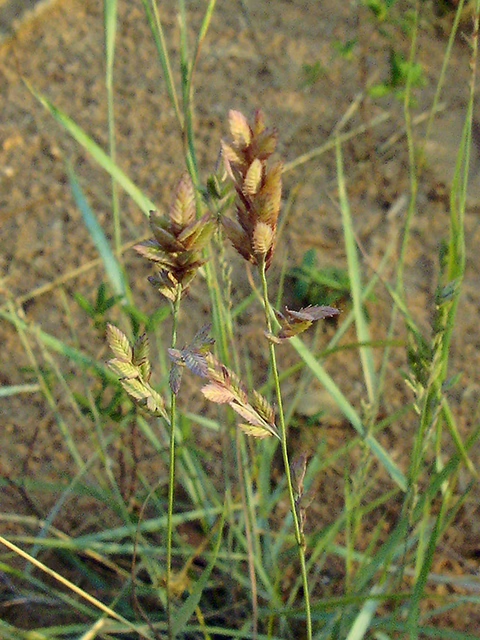
Blooms July-November. A warm season grass. It is a tufted perennial. Leaf blades are flat with long hairs above the ligule and green to blue green coloration. The spikelets are in dense clusters on branches and branchlets and are pale green or violate to reddish in color. Larval host: Paradoxical Grass moth. Popular with insect herbivores such as leafhoppers
Previous Scientific Name(s): Eragrostis beyrichii, Eragrostis compacta, Eragrostis yucatana, Poa secundiflora, Eragrostis secundiflora var. capitata, Eragrostis vahlii var. subfasciculata, Megastachya oxylepis var. capitata
Material Treatment Method Collection References
Seed Scarification Start by soaking them for 24 hours before planting. This simple step helps kickstart the germination process, which thrives at an optimal temperature of 70°F (21°C). Red lovegrass is best started using greenhouse grown transplants, planted on bedded rows. Seedlings grow and mature quickly and will produce a marketable crop in the year of planting. When cleaned to caryopses seed quality and active germination are very high (≥ 90%) because of this only small amounts of seed is needed to produce a sufficient number transplant to establish production fields. Seed harvest is possible using a variety of methods and implements. Seed ripens indeterminately, and a Woodward Flail-Vac Seed Stripper (Ag-renewal, Inc., Weatherford, Oklahoma) can collect the ripe seed crop without damaging or eliminating the ability to make subsequent harvests of the stand as later flowering florets mature. However, majority of the seed crop will hold well on the plants after complete maturity allowing for combine harvest. An additional benefit of combining is the removal of unfilled florets which increases seed harvest purity. In well managed, irrigated fields, 2-3 harvests can be expected per year. The first harvest is typically in May, with the last harvest in October. Potential seed yields per acre have been calculated at 10 PLS lbs. per acre on 36” bedded rows with a plant population of 14,000 plants per acre. 1) chrome-extension://efaidnbmnnnibpcajpcglclefindmkaj/https://plants.sc.egov.usda.gov/DocumentLibrary/plantguide/pdf/pg_erso.pdf 2) https://greg.app/red-lovegrass-overview/#:~:text=Elevate%20your%20garden%20with%20Red,reduce%20the%20risk%20of%20disease.
Bud Division Carefully separate the clumps and replant them immediately to ensure they establish well in their new locations.. The best time for this is in early spring or fall, when the plant is less stressed. https://greg.app/red-lovegrass-overview/#:~:text=Elevate%20your%20garden%20with%20Red,reduce%20the%20risk%20of%20disease. 2) https://www.picturethisai.com/care/Eragrostis_secundiflora.html#:~:text=A%20distinctive%20warm%2Dseason%20grass,its%20characteristic%20red%2Dhued%20panicles.

About the Region

Fall Symposium 2025 Logo - Teach for the Future

Salado, the location of our Fall 2025 Symposium, lies at the intersection of two ecoregions: the Edwards Plateau (Limestone Cut Plain) and Blackland Prairie (Northern Blackland Prairie).

The Edwards Plateau area is also called the Hill Country; however, this general term covers a much larger area extending farther north. Spring-fed creeks are found throughout the region; deep limestone canyons, rivers, and lakes (reservoirs) are common. Ashe juniper is perhaps the most common woody species found throughout the region. Additional woody species include various species of oak, with live oak (Quercus fusiformis) being the most common. Sycamores (Platanus occidentalis) and bald cypress (Taxodium distichum) border waterways. This area is well known for its spring wildflower displays, though they may be viewed in spring, late summer, and fall, as well. According to Texas Parks and Wildlife, average annual rainfall in the Edwards Plateau ranges from 15 to 34 inches.

The Blackland Prairie extends from the Red River south to San Antonio, bordered on the west by the Edwards Plateau and the Cross Timbers, and on the east by the Post Oak Savannah. Annual rainfall averages 30 to 40 inches, with higher averages to the east. This region is dominated by prairie species. The most common grass species include little bluestem (Schizachyrium scoparium) and Indian grass (Sorghastrum nutans) in the uplands and switchgrass (Panicum virgatum) in the riparian areas and drainages. Common herbaceous flowering plants include salvias, penstemons, and silphiums. This area has suffered greatly from overgrazing and agricultural use. Few intact areas remain, though many of the plants can be found along county roadsides throughout the region.

Our fall Symposium host chapter, the Tonkawa Chapter, includes both of these ecoregions.

Source: Wildflowers of Texas by Michael Eason