

The Boerne City Campus Natural Area, also known as the BCCNA, spans 13 acres along the Old No. 9 Trail behind the Boerne library.
In partnership with the city and other community organizations, the Boerne Chapter of NPSOT is working to restore this space to a thriving native habitat and wildlife corridor within the city.
The goal is to transform the area into a haven filled with native trees, shrubs, wildflowers, and grasses, with a functional riparian zone. This restoration will provide food, water, and shelter for migrating birds, butterflies, and small mammals, while supporting local wildlife year-round. For people, the area will offer a peaceful retreat with hiking paths for exploring the diverse flora and fauna, making it a space for relaxation, observation, and education.
Equally important, this restoration will help the environment by supporting food webs, managing watersheds, sequestering carbon, and nurturing native pollinators—essential for 80% of our food supply. As development continues to encroach on the Hill Country, projects like this are crucial in ensuring our landscapes provide these vital ecosystem services.
Click here to see the site plan, and more information, including the trees, plants, birds and mammals that will greatly benefit from this project.
Volunteer Opportunities
Volunteers are the backbone of our efforts. The BCCNA project is in need of dedicated volunteers to help support its ongoing initiatives to help restore the area. Volunteers play a crucial role in making this project a success, as they provide the hands-on assistance necessary to bring BCCNA’s goals to life.
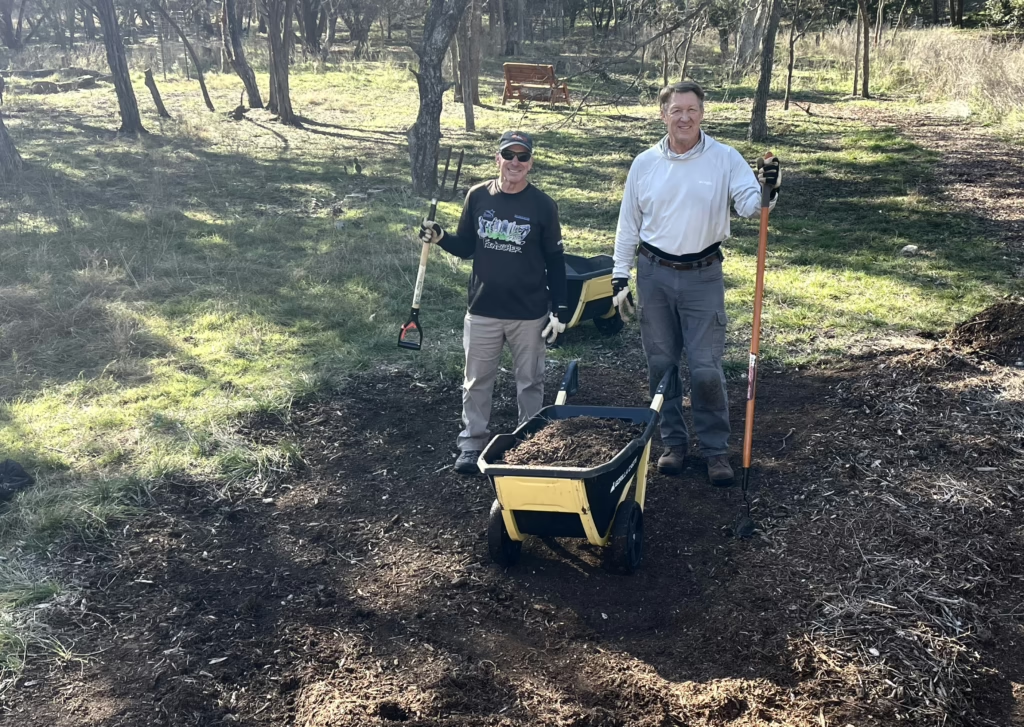
A group of volunteers, lead by Jeff Schwarz, meets every first and third Thursday of every month.
Since October 2024, volunteers have worked over 250 hours on restoration and improvement projects:
- Removed invasives (ligustrum, vitex, Chinese tallow…)
- Planted and watered more than 100 native trees
- Laid ½ mile of mulched trail
- Built wildlife micro-habitats
- Conducted monthly bird surveys
If you are interested in helping out, or would like more information, please contact Jeff Schwarz.
Recent Bird Study
During a bird study conducted on February 27, 2025, the following birds were identified in the BCCNA area:
Carolina Chickadee 8
Black-crested Titmouse 9
Carolina Wren 8
Northern Mockingbird 3
Cedar Waxwing 15
House Sparrow 3
House Finch 1
Lesser Goldfinch 14
Chipping Sparrow 7
Lincoln’s Sparrow 1
Yellow-Rumped Warbler 3
Northern Cardinal 22
White-winged Dove 9
Black Vulture 8
Cooper’s Hawk 1
Red-shouldered Hawk 1
Golden-fronted Woodpecker 3
Crested Caracara 1
Blue Jay 6
Common Raven 7
Ruby-crowned Kinglet 1
BCCNA Needs -- Trees & Bushes & Things We Don’t Have
Donations are always welcome. If you are interested in donating trees, shrubs and plants, or would like more information, please contact Jeff Schwarz.
We currently have 45 species of trees and bushes represented at the BCCNA. We are targeting 32 more. Here is a list of the trees and bushes we don’t have.
- Anacho Orchid
- Ash, Texas
- Beebrush / Whitebrush
- Crabapple, Blanco/Tex.
- Cypress, Arizona
- Cypress, Montezuma
- Elbow Bush
- Eve’s Necklace
- Goldenball Leadtree
- Hackberry, Sugar
- Kidneywood
- Locust, Black
- Madrone, Texas
- Mimosa, Fragrant
- Mulberry, Red
- Nolina, Lindheimer’s Shoest.
- Oak, Monterey
- Oak, Texas, Spanish or Red
- Oak, Lacey
- Palmetto, Dwarf
- Pistachio, Texas
- Retama
- Smoke Tree, American
- Sotol, Texas
- Spicebush
- Sumac, Littleleaf / Desert
- Sycamore, American
- Viburnum, Rusty Blackhaw
- Walnut Arizona
- Yucca, Buckley’s
- Yucca, Red
- Yucca, Twist-leaf

July 15 Flood
On July 15, 2026, the Boerne area experienced an extraordinary rainfall event, receiving nearly 15 inches of rain over five days. The normally dry creek bed that runs through the BCCNA was transformed overnight into a fast-moving river. Click here to view photos and videos documenting the flood and see how the native trees and plants weathered this remarkable event.
