


Big Red Sage – where might it be hiding? Big red sage (Salvia pentstemonoides) is common in gardens, but it is rare in the wild. Natural stands of big red sage are known today in only a few spots in Kendall, Bandera and Real counties.
From the 1940s to the 1980s, this Hill Country endemic was thought to be extinct. During the 1980s, however, Marshall Enquist and Dan Hosage discovered a few populations of Salvia pentstemonoides in Bandera and Kendall counties.
One of the two stands in Kendall County was completely lost to bank collapse. The other was almost obliterated by the flood of 1997 and subsequent deer browsing has kept it from recovering.
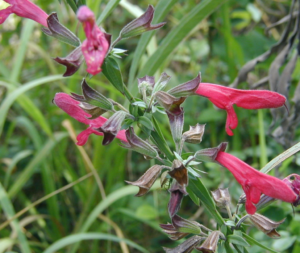
By the turn of the century, the entire known population of big red sage numbered no more than three or four dozen plants.
In 2004, Patty Leslie Pasztor discovered a “new” stand of big red sage on Cibolo Creek near Boerne. That turned out to be the largest known wild population of this salvia. There are between150 and 200 individual plants at that locality.
After that 2004 find, I wondered how many other patches of big red sage might be hidden away in limestone canyons of the Hill Country. If this fairly large population of Salvia pentstemonoides on Cibolo Creek had remained unrecognized until 2004, then chances are there are more to be discovered.
Summer is the best time to search for this plant, because the tall stalks of wine-red blooms are easy to spot. Big red sage is two or three feet tall and has large flowers and lance-shaped leaves, distinguishing it from the smaller redblooming sage, Salvia coccinea.
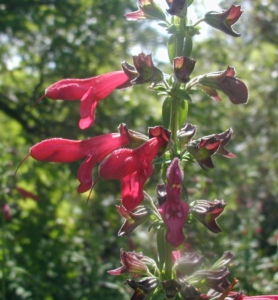
Where might someone expect to find big red sage in the wild? This plant has been found on banks and limestone ledges along streams of the central and eastern Edwards Plateau. Today its best chance of survival would be on steep cliffs inaccessible to deer.
Also, one might expect it to be growing in areas where it has been seen in the past. As discussed in last month’s column, Ferdinand Lindheimer first collected the big red sage in the upper Pedernales River Valley, probably in what is now Gillespie County. His second collection was made at Comanche Springs during June 1849.
Of course there are lots of Comanche Springs in the Hill Country, but during the summer of 1849, Lindheimer visited John Meusebach at his home at Comanche Springs just north of the present town of Leon Springs in northern Bexar County.
Another specimen of the 1849 collection was labeled “Cibolo,” which I believe must have referred to Cibolo Creek that lies only a few miles north of Meusebach’s Comanche Springs homestead. Lindheimer had to cross Cibolo Creek during his journey from New Braunfels to visit Meusebach.
Among the several specimens of Salvia pentstemonoides in the herbarium at the Missouri Botanical Garden is one collected in 1879 at Sutherland Springs, supposedly in Wilson County. I wonder about the accuracy of this location. The geology of Wilson County is unlike the geology of the other sites where big red sage has been collected.
Other places big red sage was collected during the late 19th and early 20th centuries include Turtle Creek south of Kerrville, Bears Creek in Gillespie County and Barron Creek in Kendall County.
Incidentally, there are no laws protecting big red sage (or hardly any other plant for that matter). There is no obligation of any kind for a landowner to conserve this salvia if it is found on a property, but it would be worthwhile for botanists to know the true distribution of this apparently rare plant. Look for it. It’s blooming right now.
