


Purple coneflower (Echinacea spp.) is the Operation NICE! (Natives Instead of the Common Exotics!) selection for July.
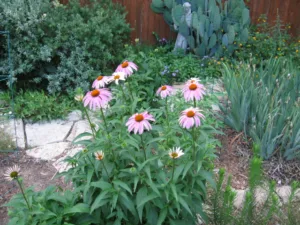
(Photo Credit: Lon Turnbull)
These red-purple to pale-pink flowers are a garden favorite. As Sally Wasowski (“Native Texas Plants”) writes, “Everyone who’s growing them is raving about them.”
The purple coneflower that is native to the Edwards Plateau, E. angustifolia, grows one to two and one half feet tall and blooms in the late spring and early summer.
The composite flower is two to three and one half inches across with a conspicuous mound of disk flowers and long, sometimes drooping ray flowers. It is a striking bloom.
The species native to the Hill Country ranges from Central Texas through the mid-US and into Canada.
Four other species of Echinaea occur in other parts of Texas, and most of these range throughout the eastern and central US.
Coneflowers typically are prairie plants. When we visited our daughter in Wisconsin, she took us to see a restored prairie that had numerous tall coneflowers, both purple and bright-yellow.
Purple coneflowers found in nurseries are unlikely to be the Hill Country native.
Several hybrids and cultivars have been developed for hearty, colorful blooms. Some of these cultivars have a longer blooming period than the native species and may flower through the summer.
Purple coneflowers do well in our little wildflower patch in full sun, and the plants are spreading as new ones come up from the seeds. Once established they don’t need much extra water.
Our purple coneflowers are tough perennials that survive the droughts and never fail to reappear in the spring. All our coneflowers grow where deer can’t browse.
This probably is the tail end of the blooming season for most purple coneflowers, and they are not as showy as they were in late spring and early summer. However, purple coneflowers are worth planting now in spots where you want to be sure to have colorful flowers next year.
The Boerne chapter of the Native Plant Society of Texas provides free planting and care instructions for purple coneflower at nurseries participating in Operation NICE! (Hill Country African Violets and Nursery, Barkley’s Nursery Center and Maldonado Landscape and Nursery).
WHAT’S BLOOMING THIS WEEK
In the interest of showing the continuously changing color that native-plant gardens provide, I promised to report once a month which Texas native and native-compatible plants are blooming in our backyard, which, by the way, is fenced off from browsing deer.
Red: Salvia darcyi (Mexican), flame acanthus skullcap, and red yucca, few standing сypress.
Yellow: Common sunflower, bush sunflower. greeneyes, zexmenia, esperanza, water primrose, Mexican hat, gumweed, and yellow butterfly vine (Mexico).
Purple: purple horsemint, common wild petunia and Mexican oregano.
Pink: purple coneflowers and evening primrose.
Blue: mealy sage, shrubby blue sage and Salvia guaranitica (South American).
White: blackfoot daisy and Mexican poppy. In an adjacent area where deer browse, only Mexican hat and Mexican poppy are blooming.
