
Bracted Passionflower

Passiflora affinis

Other common name(s):

Family:

Passifloraceae (Passion Flower Family)

Plant Ecoregion Distribution Map

This map uses data from the US EPA. EPA  servers have been offline frequently so maps may not display. We are working on a solution.

Edwards Plateau
Balcones Canyonlands, Edwards Plateau Woodland, Llano Uplift, Semiarid Edwards Plateau

Plant Characteristics

Growth Form

Vine

Height

3
to
6
ft.

Spread

1
to
2
ft.

Leaf Retention

Deciduous

Lifespan

Perennial

Habitat and Care Requirements

Soil Type(s)

Limestone, Well Drained, Moist, Dry

Light Requirement

Sun, Part Shade

Water Requirement

Low

Native Habitat

Grassland, Woodland

Bloom and Attraction

Bloom Color

Yellow, Green

Bloom Season

Spring, Summer, Fall

Seasonal Interest

Nectar, Pollen, Larval Host

Wildlife Benefit

Butterflies

Maintenance

Does well in both dry or moist soil, but it is best to allow the soil to dry out in between waterings. Caterpillars may totally defoliate the vine, but if protected until it is well-established, the vine will resprout quickly. This vine likes to spread so give lots of room, or trim and pull sprouts to contain in a smaller area. Propagation: softwood cutting, stem cutting.

Comments

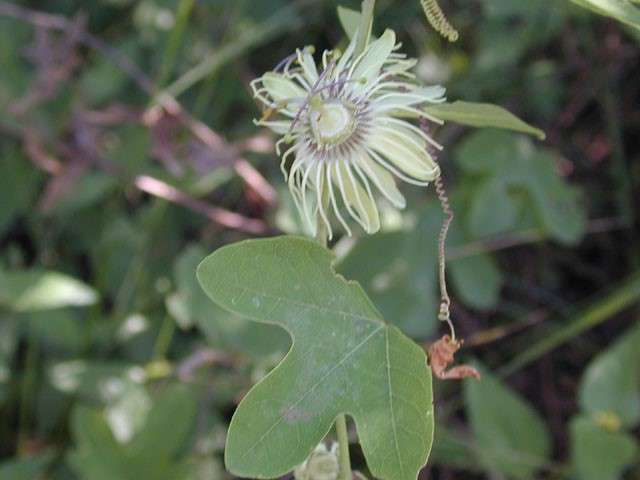
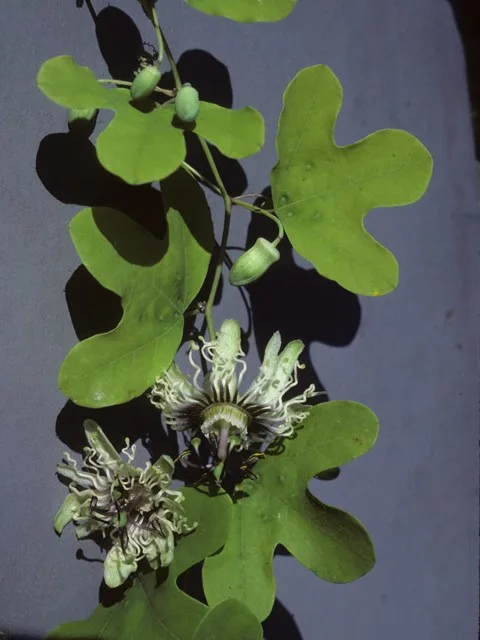
Blooms May-October. A vine that climbs using tendrils. Thin delicate stems are covered with sticky yellow hairs. Distinct 3-lobed leaves are thought to be shaped like cowboy hats. Small, pale yellow, intricate flowers. The fruit is a berry. Larval host: Zebra Longwing and Gulf Fritillary butterflies.
Material Treatment Method Collection References
Seed No Treatment Soak the seeds in warm water for a few hours to soften the seed coat. Sow the seeds in a well-draining potting mix, lightly covering them with soil. Keep the soil moist and place the pot in a warm location with indirect light. Germination can take up to several weeks. Once the seedlings develop a few true leaves, they can be transplanted into separate pots. Collect seeds from ripe fruits, clean the seeds and remove any remaining pulp from them. https://plantiary.com/plant/passiflora-affinis_21195.html
Softwood Cutting Remove the leaves from the lower half of the cutting and dip the cut end in a rooting hormone powder to encourage root development. Embed in a light, well-draining, moist potting mix, ensuring at least two nodes are buried in the soil. Provide steady support for the cutting. Maintain dampness and a warm atmosphere to stimulate root formation. A humidity dome or plastic bag helps create a moist environment. Use a spray bottle to mist the cuttings to maintain optimal humidity levels. Keeping cuttings moist but not saturated. Root development typically occurs within 4-6 weeks. In spring or summer, harvest a cutting directly beneath a leaf node from recent growth, about 4-6 inches long with at least 3-4 leaf nodes. 1) https://www.forwardplant.com/care/propagate/passiflora-affinis/ 2) https://www.picturethisai.com/care/propagate/Passiflora_affinis.html
Stem Layering Bury the wounded section of the stem in a shallow trench or pot filled with soil, leaving the tip above the ground. Secure the stem in place using a small stake or wire. Keep the soil moist and provide indirect light. After a few weeks, new roots should form at the wounded section. Once roots are established, the new plant can be separated from the parent plant and potted. Identify a low-growing, flexible stem near the base of the plant. Gently bend the selected stem down to the ground and make a small incision or scrape the underside where it will touch the soil. https://plantiary.com/plant/passiflora-affinis_21195.html
Stem Grafting Make a corresponding diagonal cut on the rootstock plant stem. Join the two cut surfaces together and bind them tightly using grafting tape or a rubber band. Keep the graft union covered with a plastic bag or humidity dome to maintain moisture. Place the grafted plant in a warm, well-lit area. After a few weeks, the graft union should heal and new growth will begin to emerge. This is an advanced method. Select a healthy rootstock plant, preferably a Passiflora species with strong root system and disease resistance. Take a stem cutting from a desired Passiflora Affinis plant and make a 45-degree diagonal cut at the base to maximize surface contact area. https://plantiary.com/plant/passiflora-affinis_21195.html

About the Region

Fall Symposium 2025 Logo - Teach for the Future

Salado, the location of our Fall 2025 Symposium, lies at the intersection of two ecoregions: the Edwards Plateau (Limestone Cut Plain) and Blackland Prairie (Northern Blackland Prairie).

The Edwards Plateau area is also called the Hill Country; however, this general term covers a much larger area extending farther north. Spring-fed creeks are found throughout the region; deep limestone canyons, rivers, and lakes (reservoirs) are common. Ashe juniper is perhaps the most common woody species found throughout the region. Additional woody species include various species of oak, with live oak (Quercus fusiformis) being the most common. Sycamores (Platanus occidentalis) and bald cypress (Taxodium distichum) border waterways. This area is well known for its spring wildflower displays, though they may be viewed in spring, late summer, and fall, as well. According to Texas Parks and Wildlife, average annual rainfall in the Edwards Plateau ranges from 15 to 34 inches.

The Blackland Prairie extends from the Red River south to San Antonio, bordered on the west by the Edwards Plateau and the Cross Timbers, and on the east by the Post Oak Savannah. Annual rainfall averages 30 to 40 inches, with higher averages to the east. This region is dominated by prairie species. The most common grass species include little bluestem (Schizachyrium scoparium) and Indian grass (Sorghastrum nutans) in the uplands and switchgrass (Panicum virgatum) in the riparian areas and drainages. Common herbaceous flowering plants include salvias, penstemons, and silphiums. This area has suffered greatly from overgrazing and agricultural use. Few intact areas remain, though many of the plants can be found along county roadsides throughout the region.

Our fall Symposium host chapter, the Tonkawa Chapter, includes both of these ecoregions.

Source: Wildflowers of Texas by Michael Eason