

Milkweed species vary widely in their characteristics and milkweed selection can have a significant impact on Monarch survival. The milkweed characteristics we will address are (1) Plant toxin levels, (2) Absorption of toxins by Monarchs, (3) Leaf structure, (4) Latex flow, and (5) Plant biomass.
In Spring the return flights of monarchs from overwintering in Mexico will encounter milkweeds, their only larval food source, in the Gulf States of Texas through Florida. The greatest leaf biomass of milkweeds available to them is in the common species antelopehorn (Asclepias asperula), zizotes (A. oenotheroides), and green antelopehorn (A. viridis). Green antelopehorn is the most common species through all the Gulf States. While these milkweeds are typically late to emerge, early waves of female monarchs have an uncanny ability to find the small milkweed sprouts and lay eggs.
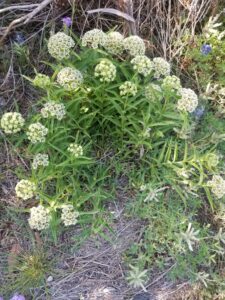
photo by Sue Lilley
The odds are much against a monarch egg becoming an adult monarch. Predation of eggs and caterpillars by ants, spiders and other invertebrates will be high. Even the choice of milkweed species for egg-laying has an impact on the survival of caterpillars. The 37 species of milkweed included in Identification of Texas Milkweeds offer a wide range of characteristics important to caterpillar survival. Among these are leaf structure, quantity of toxins, latex and biomass.
Toxin Levels. Toxins in plants generally serve as protection from herbivores; however, toxins in milkweeds are beneficial, affording monarchs life-long protection from many invertebrate and vertebrate predators. The toxins are acquired by caterpillars during consumption of milkweed leaves and many of these are retained through the adult life stage. The toxins in milkweeds are cardiac glycosides (cardenolide steroids) and their levels vary between and within species. Some species have very high levels which can kill young caterpillars, but these do not occur in Texas.
Absorption of Toxins by Monarchs. Each species of milkweed has a unique mix of cardiac glycosides that permits a fingerprint-like identification of the plant species. Caterpillars consume the cardiac glycosides with their food and retain some unchanged, modify some, and excrete some. With some limits caterpillars are also able to control the amount of retained cardiac glycosides, retaining more from low level milkweeds and retaining less from high level milkweeds. Using chromatography and spectroscopy, researchers have determined levels and the identification of the cardiac glycosides retained in Monarch butterflies and can identify the species of milkweed that was the food source.
Leaf Structure. Milkweed leaves are typically smooth on top and hairy below, the latter serving as deterrents to invertebrates feeding on the leaves. The hairs are one of the features of the leaf trichromes, characteristics that vary in size and quantity among the Texas species. Young monarch caterpillars (first few instar stages) are challenged by species with higher density of hairs and must overcome this obstacle by grazing a patch of hairs and then eating the shaved leaf area.
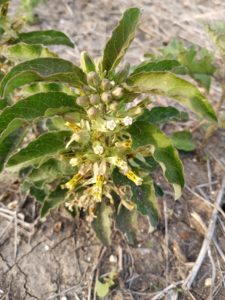
Latex Flow (exudation). Latex serves plants as another protection from invertebrate and vertebrate herbivores. Latex in various Texas milkweeds vary considerably in quantity, toxin content, and viscosity. The first instar (young) monarch caterpillars are in great danger of being trapped by the latex and hairs. To avoid latex traps, caterpillars attempt to feed by dodging latex which typically flows from severed leaf veins and stems. Some successful caterpillars feed by cutting an arc in the leaf and/or partially cutting the stem to divert the latex flow from going downstream in the leaf.
Biomass. The Texas milkweed species vary considerably in plant size and local abundance. Some are too small even as mature plants to adequately feed a single monarch caterpillar. If there are several of these plants in close proximity in a patch, a caterpillar could move to the next plant if the first was depleted. Woe be the caterpillars whose mother laid many eggs on small biomass milkweeds.
To summarize, the best features of milkweeds for monarch survival are:
- Milkweed species with medium-low to high cardiac glycoside (toxin) content to provide the best caterpillar and adult protection (0.1-0.3% dry plant)
- Milkweed species with low density hairs (smoother) leaves (<2000/cm2)
- Milkweed species with low latex content and flow (<6.0 mg/10 sec.)
- Milkweed species with high biomass, either as individual plants or high density patches
The growth in popularity of gardening for butterflies has inspired suggested plantings for a variety of butterflies and these guides are readily available for many communities. Gardening specifically for monarchs is a relatively new interest. One of the more comprehensive efforts comes from the Bring Back the Monarchs campaign of MonarchWatch. They recommend (based on availability) several species of milkweeds for each of our national ecoregions including some for the four major ecoregions of Texas. Of the nine species on the list suggested for the South Central and Southwest regions of the U.S. only three (antelopehorn, green antelopehorn, common milkweeds) are commercially available.
Our Recommendations
Texas with its variety of habitat, soil and climate poses challenges in the selection of milkweed species. Fortunately, the Lady Bird Johnson Wildflower Center and the Texas Parks and Wildlife Department have published an excellent online resource: Identification of Milkweeds in Texas. This document describes characteristics of 37 species native to Texas, their habitat, and their range.
Home Landscaping. Milkweeds for the landscape, whether xeric or water-augmented, could include virtually all of the Texas 37. Several species of milkweeds are available as plants from nurseries and websites. These include several named varieties (cultivars) selected for attractiveness.
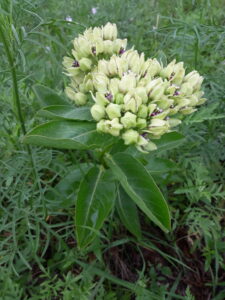
The top three Texas milkweeds for biomass (antelopehorn, green antelopehorn, zizotes) do not provide stunning and attractive landscape plants. We recommend using them among the more attractive butterfly, swamp, and red milkweeds. The higher cardiac glycoside content of the first group is balanced by showy milkweeds of lower concentration.
The expanded landscape planting of tropical milkweed (Asclepias curassavica) as a larval host plant outside of its natural range in southern Texas and Florida has become controversial in recent years. Detractors say the plant causes southward migrating Monarchs to break sexual diapause and it can be a host plant for Monarch parasites. Proponents say it can be used responsibly for both a nectar and larval host plant. These issues are addressed in detail by Monarch researchers on a Monarch Joint Venture web page. Some also question whether the milkweed cultivars developed for landscapes are the best choice for monarchs, especially when treated with systemic insecticides that linger in the plants after planting.
Acreage Plantings. Acreage milkweeds are serious opportunities to substantially increase the biomass available for monarchs. Some of the more abundant milkweed species thrive on occasionally disturbed soils of farms, ranches and roadsides. Historically “good” pasture management discouraged milkweeds for several reasons including the toxicity of hay produced with milkweeds and their presence in pastures often meant overgrazing had occurred. Our suggestions for acreage, whether 0.5 acre or 160 acres, begin with the Biomass Big 3: green antelopehorn, antelopehorn, zizotes and supplemented with broad-leaf and butterfly milkweeds, the latter especially for show.
Planting large acreages with milkweeds is generally impractical until the production of commercial seeds increases. Collecting plants and transplanting is rarely successful due to tap roots, thus seed collection and relocation is more efficient. Ideally, locating a patch and with the landowners permission, collecting seed pods on the verge of opening would be most efficient. There are published methods of harvest, seed cleaning and cold stratification methods to stimulate germination.
Our suggestions of milkweeds for acreage assume non-hay use. In pastures cattle will avoid eating milkweeds short of desperation. Roadside milkweeds are often excellent choices if herbicides are avoided and roadside mowing avoided or postponed till mid-summer or later. The herbicides sprayed on agricultural crops also can affect roadside vegetation and is an important factor in the loss of milkweed biomass in central to northern U.S. Roadside management practice should encourage roadside vegetation such as wildflowers and milkweeds and their pollinators and butterflies.
See more monarch and milkweed resources on our website.
Texas sources of milkweed include seeds at Native American Seed (www.seedsource.com). You may also buy milkweed plants at our NICE partner nurseries.
Note: This is a condensed version of a longer unpublished manuscript that contains supporting data and references. Should you wish a copy or information contained therein, please contact Ronald A. Martin, PO Box 813, Smithville, TX 78957.
