Everyone complained about the poor crop of wildflowers in the Hill Country last spring, but the lack of wildflowers was expected in the midst of our prolonged drought. No rain, no flowers. However, from my random and non-expert observations, it seems to me the reaction of many native plants to our exceptional dry spell is not necessarily so straightforward.
Last spring, after a year and a half of drought, certain trees and bushes bloomed more profusely than they do during wetter years. For example, the mountain laurels (Sophora secundiflora) in our yard were covered with blooms more than ever before, and now they are heavy with seedpods.
Some legumes, such as huisache (Acacia farnesiana) and golden-ball lead tree (Leucaena retusa), also had dense flowers last spring. Another tree that bloomed profusely in our part of the Hill Country this year is basswood or linden (Tilia americana). So did the bigtooth maple (Acer grandidentatum). The largest two maples in our yard and many in the canyons just west of Boerne now are laden with brown seedpods.
Even century plants (Agave americana) sent up an unusual number of bloom stalks this year. And at one point during late spring, it seemed this would be the “year of the antelope-horns milkweed (Asclepias asperula).” They were coming up and blooming in greater numbers than usual.
Some of my botanist friends think this profuse flowering by some plants during the severe drought probably is a mechanism for survival of the species. The dry period seems to send a message to some plants that it is time to expend their energy producing abundant seeds to increase the chance that some offspring will survive, even if the drought kills off many individuals.
Even during a drought as prolonged as the current one, many seemingly dry stream beds still hold moisture. These are stream bottoms and banks that have been left undisturbed, and their natural native vegetation has stored moisture in the root masses. Last week, Jason Singhurst (Texas Parks and Wildlife) and I visited a couple of nearby sites where rare plants grow along the banks of now-dry streams.
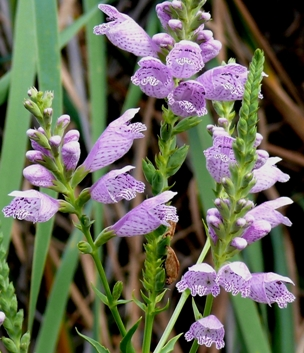
Northern Bexar County has one of the very few spots in Texas known to grow Correll’s false-dragonhead (Physostegia correllii). We were surprised to see numerous plants thriving and blooming during this second summer of drought, even more than last year. So far, the prolonged drought apparently is not making a dent in the population of that rare plant.
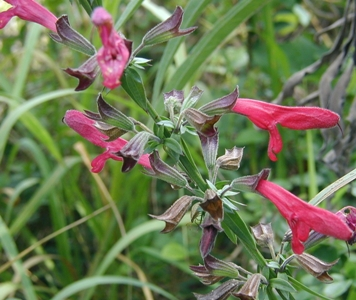
In a little canyon west of Boerne, we found a different story for the population of big red sage (Salvia pentstemonoides). We visited the second-largest known population of big red sage in Texas (the largest is also in Kendall County, southeast of Boerne). We counted 107 plants, half of which were very small rosettes. Last year there were many blooming plants at this locality, but after almost two years of drought, now there is only one plant with a bloom stalk. This is significant for a species that numbers less than 350 known plants in Texas (and the Texas Hill Country is the only place they occur in the world).
My friend Delmar Cain posed an interesting question in light of the fact that many Texas native plants apparently have evolved a way of survival by shutting down during the hot, dry summers. He asked, “Are we doing our cultivated native plants a favor by giving them water during the droughts? Is watering causing certain plants to suffer and perhaps die, when leaving them alone might be better for the long-term survival of those plants.”
Probably it depends on the plant, but some plants do seem to decline with irrigation. I can imagine that root hairs, already trying to filter out the excess calcium carbonate dissolved in our soil water, might not welcome a dousing with our alkaline aquifer water. Another good reason for installing rain-catchment tanks.