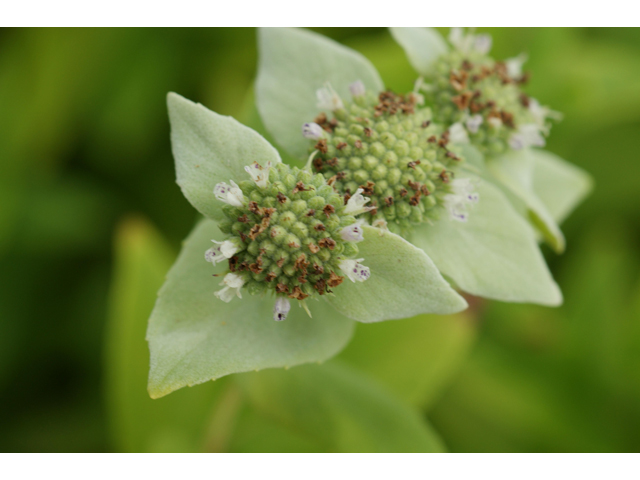
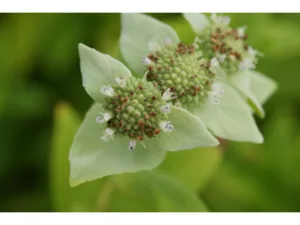


Whiteleaf Mountain Mint

Pycnanthemum albescens

Other common name(s):

Whiteleaf Mountainmint

Family:

Lamiaceae (Mint Family)

Plant Ecoregion Distribution Map

This map uses data from the US EPA. EPA  servers have been offline frequently so maps may not display. We are working on a solution.

Western Gulf Coastal Plain
Flatwoods, Floodplains and Low Terraces3, Pleistocene Fluvial Terraces, Red River Bottomlands, Southern Tertiary Uplands, Tertiary Uplands

Plant Characteristics

Growth Form

Herbaceous

Height

1
to
4
ft.

Spread

1
to
4
ft.

Leaf Retention

Deciduous

Lifespan

Perennial

Habitat and Care Requirements

Soil Type(s)

Sand, Loam, Clay, Gravelly, Rocky, Moist, Dry

Light Requirement

Sun, Part Shade

Water Requirement

Medium, High

Native Habitat

Grassland, Woodland

Bloom and Attraction

Bloom Color

White, Purple

Bloom Season

Summer

Seasonal Interest

Pollen

Wildlife Benefit

Bees

Maintenance

Growing conditions variable: partial shade in open woods, full sun in prairies, pinelands to oak woodlands, mesic to dry soils that may be sandy to rocky to clayey. Spreads by rhizomes. It’s gangly appearance makes it best for a naturalistic garden. Deer resistant. Propagation: root division, seed, softwood cutting.

Comments

Blooms July-September. Distinctive whitish edge to the upper leaves, which have a minty aroma when crushed. The white coloration slowly spreads over these leaves creating silvery bracts. The tiny white flowers have purple spots. The fruit is a nutlet.
Previous Scientific Name(s): Koellia albescens, Koellia pauciflora

References

1) bonap.net/TDC/Image/Map?taxonType=Species&taxonId=13607&locationType=County&mapType=Normal 2) www.itis.gov/servlet/SingleRpt/SingleRpt 3) www.wildflower.org/plants/result.php?id_plant=PYAL, 4) https://www.wildflower.org/plants/result.php?id_plant=PYAL, 5) https://portal.torcherbaria.org/portal/taxa/index.php?taxon=Pycnanthemum+albescens&formsubmit=Search+Terms, 6) https://anps.org/2023/08/19/know-your-natives-white-leaf-mountain-mint/
Material Treatment Method Collection References
Seed No Treatment Sow spring or autumn in a cold frame. When they are large enough to handle, prick the seedlings out into individual pots and plant them out in the summer. If there are sufficient seeds they can be sown in an outdoor seedbed in mid spring. Seeds are collected once flower clusters dried on the plant and stored in a paper bag at room temperature in a well-ventilated, dry environment until cleaning. Or once clean, seeds are stored in glassine envelopes inside of airtight containers in a cooler set to 3.8˚Celsius (39° Fahrenheit). Seeds are cleaned by rubbing flower clusters against seive to release the capsules and separate larger chaff from the seeds. 1) https://temperate.theferns.info/plant/Pycnanthemum+albescens#:~:text=Seed%20%2D%20sow%20spring%20or%20autumn,Division%20in%20spring. 2) https://pfaf.org/user/Plant.aspx?LatinName=Pycnanthemum+albescens
Seed Stratification Cold moist stratification is provided for 60 days at 3.8˚Celsius (39° Fahrenheit). Sow seeds directly in a warm environment. Hand sown into PenPaks (6" x 2.5" x 4.5") filled with ProMix FPX germination media at a rate of 200 seeds per container. The seeds are left uncovered due to their requirement for light to germinate. Media is kept consistently moist until germination by gently hand watering with a fine droplet-size breaker. Containers are placed into a greenhouse after cold moist stratification. Bottom heat is provided by hot water tubes under flats with a soil temperature target of 18-24˚Celsius (65-75˚ Fahrenheit). Daytime temperatures varied from 18-26˚ Celsius (65-80˚ Fahrenheit). Night temperature was set at a minimum of 18˚ Celsius (64˚ Fahrenheit). Seeds are placed in a greenhouse on April 1. Seedlings are moved into a shaded greenhouse with average temperatures of 18-24˚ Celsius (65-75˚ Fahrenheit) 2 weeks after germination. Watering frequency is reduced slightly to encourage root development. After true leaves appeare and seedlings are sturdy, approximately 4 weeks after germination, they are potted into 5 centimeter (2 inch) peat pots using a commercial perennial potting media. At this stage, young plants are moved into an unshaded greenhouse set to 12˚ Celsius (55˚ Fahrenheit) minimum night temperature in early May. When roots begin to show through the edges of the peat pots, approximately 8 weeks after germination, the young plants are potted into 15 centimeter (6 inch) round fiber containers using the same potting media. Once established, the plants are watered with drip irrigation for 25 minutes when the media is mostly dried out. Six weeks hardening phase: plants are fully rooted and ready for out planting in early July. No hardening necessary for mid-summer planting. Seeds are collected once flower clusters dried on the plant and stored in a paper bag at room temperature in a well-ventilated, dry environment until cleaning. Or once clean, seeds are stored in glassine envelopes inside of airtight containers in a cooler set to 3.8˚Celsius (39° Fahrenheit). Seeds are cleaned by rubbing flower clusters against seive to release the capsules and separate larger chaff from the seeds. https://npn.rngr.net/renderNPNProtocolDetails?selectedProtocolIds=lamiaceae-pycnanthemum
Stem Cutting Dip the cut ends in rooting hormone and plant in a well-draining rooting mix (e.g., perlite and vermiculite). Maintain high humidity using a propagator or covering with a plastic bag. Rooting can take several weeks, even months. Take cuttings in late summer or early autumn. Use a sharp knife or shears to create cuttings 4-6 inches long, removing lower leaves to prevent rot. https://propagate.one/how-to-propagate-pycnanthemum-albescens/?print=pdf
Clump Division Care must be taken not to damage the root system, which can be quite fibrous. The divisions should be large enough to ensure they possess sufficient roots and foliage for establishment. Replant the divisions immediately in well-draining soil, ensuring they are watered thoroughly. Division is best done in spring or early fall when the plant is actively growing or entering dormancy. Dig up the established plant carefully, separating it into several smaller clumps. Each divisionshould ideally have multiple stems and a healthy root system. https://propagate.one/how-to-propagate-pycnanthemum-albescens/?print=pdf

About the Region

Fall Symposium 2025 Logo - Teach for the Future

Salado, the location of our Fall 2025 Symposium, lies at the intersection of two ecoregions: the Edwards Plateau (Limestone Cut Plain) and Blackland Prairie (Northern Blackland Prairie).

The Edwards Plateau area is also called the Hill Country; however, this general term covers a much larger area extending farther north. Spring-fed creeks are found throughout the region; deep limestone canyons, rivers, and lakes (reservoirs) are common. Ashe juniper is perhaps the most common woody species found throughout the region. Additional woody species include various species of oak, with live oak (Quercus fusiformis) being the most common. Sycamores (Platanus occidentalis) and bald cypress (Taxodium distichum) border waterways. This area is well known for its spring wildflower displays, though they may be viewed in spring, late summer, and fall, as well. According to Texas Parks and Wildlife, average annual rainfall in the Edwards Plateau ranges from 15 to 34 inches.

The Blackland Prairie extends from the Red River south to San Antonio, bordered on the west by the Edwards Plateau and the Cross Timbers, and on the east by the Post Oak Savannah. Annual rainfall averages 30 to 40 inches, with higher averages to the east. This region is dominated by prairie species. The most common grass species include little bluestem (Schizachyrium scoparium) and Indian grass (Sorghastrum nutans) in the uplands and switchgrass (Panicum virgatum) in the riparian areas and drainages. Common herbaceous flowering plants include salvias, penstemons, and silphiums. This area has suffered greatly from overgrazing and agricultural use. Few intact areas remain, though many of the plants can be found along county roadsides throughout the region.

Our fall Symposium host chapter, the Tonkawa Chapter, includes both of these ecoregions.

Source: Wildflowers of Texas by Michael Eason