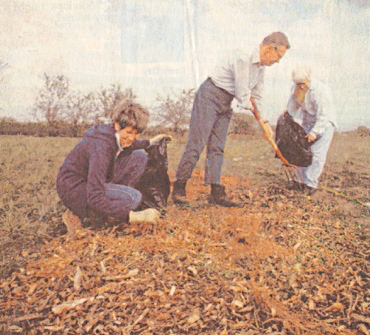
The year was 1995. Trinity Forks (TF) members were working around the clock to restore a piece of prairie in Denton, precisely a 1.5 acres of fire scorched land north-east of the North Lakes Park. The restoration activity got the front page of the Denton Record Chronicle (DRC) on November 5, 1995. Ken Struthers, chairman of the Native Prairie Restoration Project, and Dorothy Thetford, TF outreach coordinator, have been the driving force behind this project. The area burned in a September 9 fire believed to have been set by an arsonist. “It kind of dawned on me that this was an opportunity to take advantage of the burn” Ken Struthers told the DRC reporter. The goal of the project was to prepare and reseed the burned area to become a showcase for prairie restoration, thus creating an environment for education, and helping the community understand the multiple benefits of native prairie. “Watching it grow will be one of the most exciting aspects for society members. You don’t often have a prairie inside a city, and we’re lucky to have it in a city park” said Dorothy Thetford. The area was divided into 11 plots, each adopted by a TF member and planted with natives, and a 7-ft wide walking path was built to allow visitors to meander in and around the prairie.
Above: Sunflowers and the walking and jogging path at the North Lakes Wildflower Prairie (photographer unknown)
Left: Dorothy Thetford, Mike Mizell and Elizabeth McMatjh spreading compost on a trail (DRC/Barron Ludlum photo)
Camelia Maier, 2018-present Trinity Forks Historian, based on material collected by previous Trinity Forks Historians
About the Region
This low-elevations region of Texas extends inland from the barrier islands, about 60 or so miles, and stretches from Brownsville to Louisiana. In total, it covers about 9.5 million acres, with a high point of 150 feet in elevation. More than 1000 species of plants can be found in this region. On the southern end, species more common in Mexico (such as Sabal mexicana) and Central America occur.
The barrier islands provide us with dune systems, and clay flats to the inland side, which have species found in these areas alone. Many plants here, such as Ipomoea pes-caprae (beach morning glory), can be found throughout tropical regions of the globe. I’ve encountered the same species on the beaches of Guam.
Once inland, vast marshes and wet prairies occur. Occasionally, oak (Quercus fusiformis) groves can be found. Common grasses include species of Bothriochloa, Paspalum, and Sporobolus; eastern gamagrass (Tripsacum dactyloides); and switchgrass (Panicum species). Many rivers and creeks cut through the Gulf Prairies, and along these riparian areas various species of trees, Sabal minor, and other plants adapted to clay soils can be found. Due to overgrazing, farming, and fire suppression, woody species such as mesquite (Prosopis glandulosa) and huisache (Acacia farnesiana), and invasive species such as chinaberry (Melia azedarach), Brazilian pepper (Schinus terebinthifolius), and Chinese tallow (Sapium sebiferum) have increased and displaced our native flora.