

David Touchon
NPSOT Member since 2021
 David has been an active member of NPSOT since 2021, when he met his mentor, Veronica Hawk. Going to the monthly meetings led him to friendships with Terry Lashley and Theresa Butler who offered an opportunity to volunteer on several projects at the Cibolo. One of the other “first people” he met was Felicia Zeitman, bonding over their common distaste of Nandinas. With the assistance of Wilt Shaw, Chuck Janzow, Kathy Ward, Marvin Hatter, Delmar Cain and Cynthia Brown, David gained a vast knowledge and history of the Texas Hill Country’s native plants. David has also served on the Board of the Boerne Chapter in a leadership role since 2021, and he is a regular contributor to the Boerne NPSOT newsletter.
“The one thing about the NPSOT Boerne chapter that rang true with me was the dedication to using native plants within the urban interface. Drought-resistant, deer-proof, and uniquely designed for Hill County growth, natives are hearty, and they should be used in their many varying forms. I enjoy NPSOT Boerne’s ingenuity of the membership in conducting a locally sourced and locally grown plant sale.”
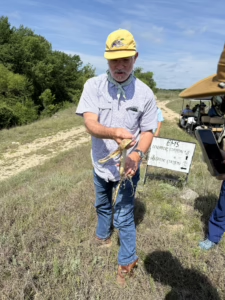 With a career as an outdoor educator, David brings a deep passion for nature, having traveled through the U.S. Midwest and East Coast to gain experience before helping launch a large outdoor education program for the YMCA of Metropolitan Dallas on Possum Kingdom Lake. David is still an outdoor educator offering consulting services to property owners in the Boerne and Kendall County area. “Having conversations that facilitate a better understanding of what landowners are looking at pre- or post-development is important. Build into your land instead of upon it!”
As a member of the Hill Country Master Naturalist program, he shares his knowledge and expertise; the former Land Manager for the Cibolo Center for Conservation has some great stories to share. His articles, published in the Boerne Star, are located on NPSOT Boerne’s website, providing a wealth of information. “Being a Naturalist is not by design but rather a deep branding of memorable experiences, sense of place, and immense curiosity.” David believes in caring for conservation projects and initiatives that precede us as they make a personal impact for the future. According to David, the Big Red Sage and Snowbell Plots at the Cibolo are perfect examples.
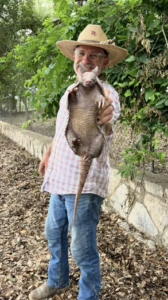
Growing up in the Dallas Turtle Creek area, David was constantly exploring the outdoors, splashing through creeks full of poison ivy and numerous other plants, critters and pollinators. He collected these specimens and studied their origin, growth and demise regularly. At Stephen F. Austin University in Nacogdoches, he entered the East Texas piney woods to experience a whole new set of species of woody plants, trees and insects. His degree in Forestry and Wild Life Management was a given; there were no other choices for this lover of the outdoors. As a 20-year volunteer with the Possum Kingdom East Volunteer Fire Department, David gained a great understanding of structural and wildland fire behavior. Gaining extensive knowledge as a forester and biologist, naturally David had information and experience to share with others.
David shared this knowledge in a Houston ISD magnet program at Camp Olympia as an outdoor educator. When a position as an outdoor educator became available with the Dallas YMCA organization, David took it. He created and maintained, as well as taught classes, in the Camp Grady Spruce Outdoor Education Program on Possum Kingdom Lake. He was responsible for the program growing and prospering. The curriculum included: Forest Ecology; Limnology; Dendrology; along with the Texas Association of Environmental Education courses. Creative curriculum development included: Burrito Island; Wood Duck Nesting Boxes; and Mist Netting.
In his consulting business, David advises property owners about what non-native plants need to be removed to preserve the native plants that grow naturally in that area. He does restoration work like creating targeted access to a river or stream in order to preserve the natural habitat for the animals and pollinators. In urban areas, he suggests planting the Anacacho orchid shrub because it can be deer-resistant. He mentioned the Anacua or Sandpaper tree as being a hardy evergreen found in our area. As he walks the properties, he continues a habit from long ago, picking up leaves to update his leaf displays. He is excited when he finds rare plants that are only found in the Texas Hill Country. On a recent consulting project, he found 12 endemic or rare plant and tree species. 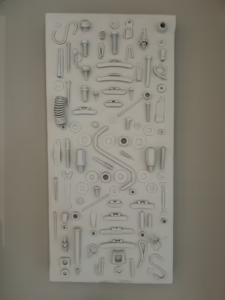 David will continue to share his expertise with property owners. He loves building the friendships and loves teaching. Finding creative solutions to cultivating plant and tree locations is what he does best. He has a deep love for Escarpment Black Cherry and Boise d’Arc.
And, did you know that David is a mixed media artist? Not only is he studying the plants, shrubs, and trees, he picks up “found” art components to add to his framed artwork and sculpture collections. He is married with three children and two doodle dogs.
Connie Clark
Content Creator/Editor/Journalist
https://conniecanwrite.com/
