

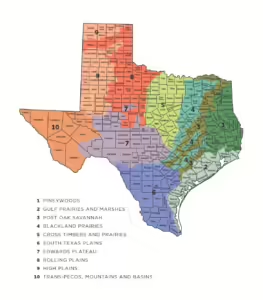
Smith County falls in both the Pineywoods and Post Oak Savannah Ecoregions.
Pineywoods – Rolling terrain covered with pines and oaks, and rich bottomlands with tall hardwoods, characterize the forests of the East Texas Pineywoods. The Pineywoods is graced by 35 to 60 inches of rain per year, and humidity and temperatures are typically high. The rain supports not only the pines – loblolly, shortleaf and longleaf mainly – but also a myriad of woodland specialties like sphagnum mosses, ferns, pitcher plants, sundews, pipeworts, and orchids. Streamside stands of beech, oaks, elm, and magnolia also benefit from the heavy rainfall. The soils of the region are generally acidic and mostly pale to dark gray sands or sandy loams. Elevations range from 200 to 500 feet above sea level.
East Texas boasts a rich diversity of wildlife. Fifteen species of Texas breeding birds, including the Pine Warbler, Brown-headed Nuthatch and Red-cockaded Woodpecker nest in this region. Bachman’s Sparrow nests in the longleaf pine uplands, while Bald Eagles roost in undisturbed uplands near rivers and lakes. Mammals in the region include River Otter, Gray Squirrel, Flying Squirrel and even the Louisiana Black Bear.
Post Oak Savannah – Immediately west of the East Texas Pineywoods we find the Post Oak Savannah. The Post Oak Savannah region is a transitional area for many plants and animals whose ranges extend northward into the Great Plains or eastward into the forests. This region, sometimes called the Cross-Timbers, was named by early settlers, who found belts of oak forest crossing strips of prairie grassland. Annual rainfall averages 28 to 40 inches per year. May or June usually brings a peak in monthly rainfall. Upland soils are light colored, acidic sandy loam or sands. Bottomland soils may be light brown to dark gray and acidic with textures ranging from sandy loams to clays. The landscape of the region is gently rolling to hilly and elevations range from 300 to 800 feet above sea level.
The Post Oak Savannah is punctuated by scattered oaks – mainly post oaks and blackjack oaks. Black hickory may also be locally abundant. Cedar elm, sugarberry, eastern red cedar and common persimmon are also widespread. Historically, wide vistas of tall grass – little bluestem, Indiangrass, switchgrass and a myriad of wildflowers were broken only by the occasional motte of trees giving the landscape a park like atmosphere.
Sampling of Plants in the Regions
Flowering Plants: Black-eyed Susan, Blackfoot Daisy, Butterfly Weed, Cardinal Flower, Coralbean, Drummond Phlox, Flame Acanthus, Gaura, Giant Coneflower, Golden Tickseed, Gregg’s Mistflower, Indian Blanket, Indian Pink, Lanceleaf Coreopsis, Mealy Blue Sage, Prairie Blazing Star, Prairie Verbena, Purple Coneflower, Rain Lily, Rock Rose, Scarlet Sage, Texas bluebells, Texas Bluebonnets, Texas Primrose, Texas Sage, Turk’s Cap, Wild Bergamot, Yarrow
Shrubs: American Beautyberry, American Holly, Autumn Sage, Buttonbush, Coralberry, Elderberry, False Indigo, Halberdleaf Rosemallow, Oakleaf Hydrangea, Red Buckeye, Texas Lantana, Wax Myrtle
Trees: American Beech, American Elm, Black Hickory, Blackjack Oak, Bur Oak, Cedar Elm, Chinkapin Oak, Drummond Red Maple, Eastern Redbud, Eastern Red Cedar, Flowering Dogwood, Longleaf Pine, Loblolly Pine, Mexican Plum, Pecan, Post Oak, River Birch, Sassafras, Shortleaf Pine, Shumard Red Oak, Southern Magnolia, Southern Red Oak, Southern Sugar Maple, Sugarberry, Texas Persimmon, Willow Oak, Yaupon
Vines: Carolina Jessamine, Coral Honeysuckle, Crossvine, Mustang Grape, Net-leaf Leatherflower, Prairie Rose, Purple Passion Flower, Trumpet Creeper, Virginia Creeper, Wooly Pipevine
Ground Covers: Christmas Fern, Frog Fruit, Hairy Flower, Spiderwort, Lyreleaf Sage, Partridgeberry, Winecup
Grasses: Big Muhly, Buffalograss, Bushy Bluestem, Broomsedge, Indiangrass, Inland Sea Oats, Little Blue Stem, Sideoats Grama, Switchgrass
