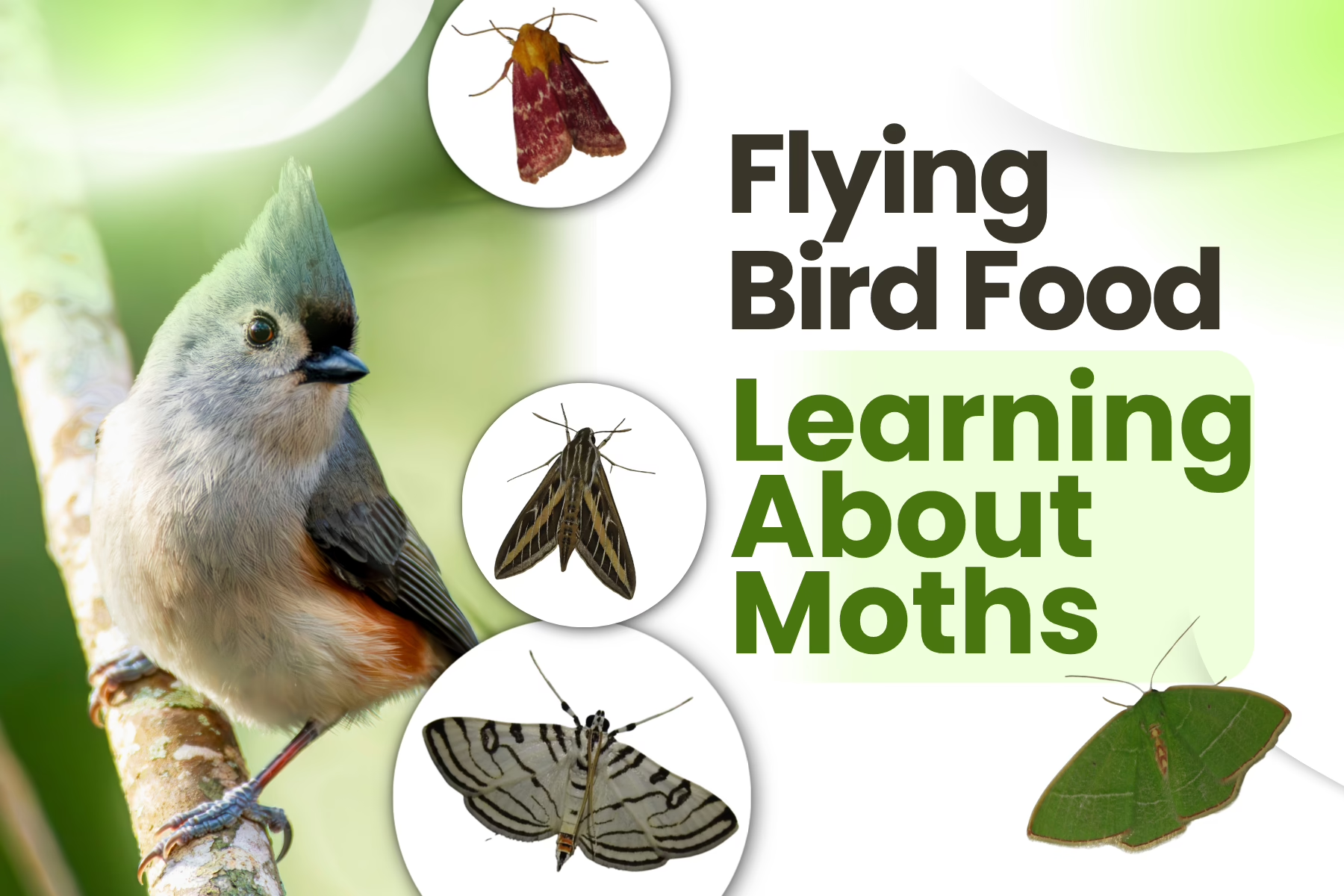

Sam Kieschnick, TPWD, Flying Bird Food – Learning about Moths! North Central Chapter Meeting

Insects are a crucial part of the diet of most birds at some time in their lives. In this program, learn about one of the most important groups of insects for birds. Although not quite as famed as their day-flying cousins, moths are tremendously diverse and have some magnificent patterns.  In the DFW area, we have documented over 1200 species of moths. Learn ways you can manage your habitat to encourage moth diversity and find out some ways that you can document and identify the various species that you might see.

Sam Kieschnick is an urban wildlife biologist with TPWD serving the east side of the DFW metroplex.  He previously worked as a nature educator with the City of Mansfield at Oliver Nature Park, as a naturalist at the Fort Worth Nature Center and Refuge, as a science interpreter with the Fort Worth Museum of Science and History, as a botanist with Botanical Research Institute of Texas, and as an instructor at Weatherford College.  He has a master’s degree from Tarleton State University studying the genetics of pocket gophers.  As an urban wildlife biologist, Sam’s focus will be on three a’s: awareness, appreciation, and action.  

6:30 Doors Open, Socializing and Snacks
7:00 Chapter Meeting and Announcements
The presentation will follow our brief business meeting.

LOCATION
Fort Worth Botanic Garden
Rose Room
3220 Botanic Garden Blvd, Fort Worth, Texas 76107

VIRTUAL ZOOM REGISTRATION
This meeting is hybrid and will be held in person and on Zoom.  You can register in advance to receive the Zoom meeting link by clicking the GREEN BUTTON found at the top of the Calendar page on our website. After registering, you will receive a confirmation email with instructions for joining the online meeting. 

FREE
This is a free event hosted by the North Central Chapter of the Native Plant Society of Texas.  Our meetings are open to members and non-members.  For more information about the North Central Chapter, and the benefits of membership, please visit our website.

Date
Jun 11 2026
Expired!
Time
6:30 pm - 8:30 pm
Cost
$
Organizer
North Central Calendar

About the Region

2026 Fall Symposium Logo

This low-elevations region of Texas extends inland from the barrier islands, about 60 or so miles, and stretches from Brownsville to Louisiana. In total, it covers about 9.5 million acres, with a high point of 150 feet in elevation. More than 1000 species of plants can be found in this region. On the southern end, species more common in Mexico (such as Sabal mexicana) and Central America occur.

The barrier islands provide us with dune systems, and clay flats to the inland side, which have species found in these areas alone. Many plants here, such as Ipomoea pes-caprae (beach morning glory), can be found throughout tropical regions of the globe. I’ve encountered the same species on the beaches of Guam.

Once inland, vast marshes and wet prairies occur. Occasionally, oak (Quercus fusiformis) groves can be found. Common grasses include species of Bothriochloa, Paspalum, and Sporobolus; eastern gamagrass (Tripsacum dactyloides); and switchgrass (Panicum species). Many rivers and creeks cut through the Gulf Prairies, and along these riparian areas various species of trees, Sabal minor, and other plants adapted to clay soils can be found. Due to overgrazing, farming, and fire suppression, woody species such as mesquite (Prosopis glandulosa) and huisache (Acacia farnesiana), and invasive species such as chinaberry (Melia azedarach), Brazilian pepper (Schinus terebinthifolius), and Chinese tallow (Sapium sebiferum) have increased and displaced our native flora.

Source: Wildflowers of Texas by Michael Eason