Operation NICE! (Natives Instead of the Common Exotics!) plant for June is Turk’s cap (Malvaviscus arboreus var. drummondii). This Kendall County native continues to flower through the summer heat and on into the fall, and it is fairly drought-resistant. It has been used as a garden plant for a long time and so is generally available at local nurseries.
Turk’s cap is a bushy member of the Malvaceae family, which includes all the various mallows, rose pavonia, winecup, hibiscus, okra, cotton, and hollyhock, among others. The bright-red flower of Turk’s cap, however, is not the regular “mallow-like” open five-petal bloom.
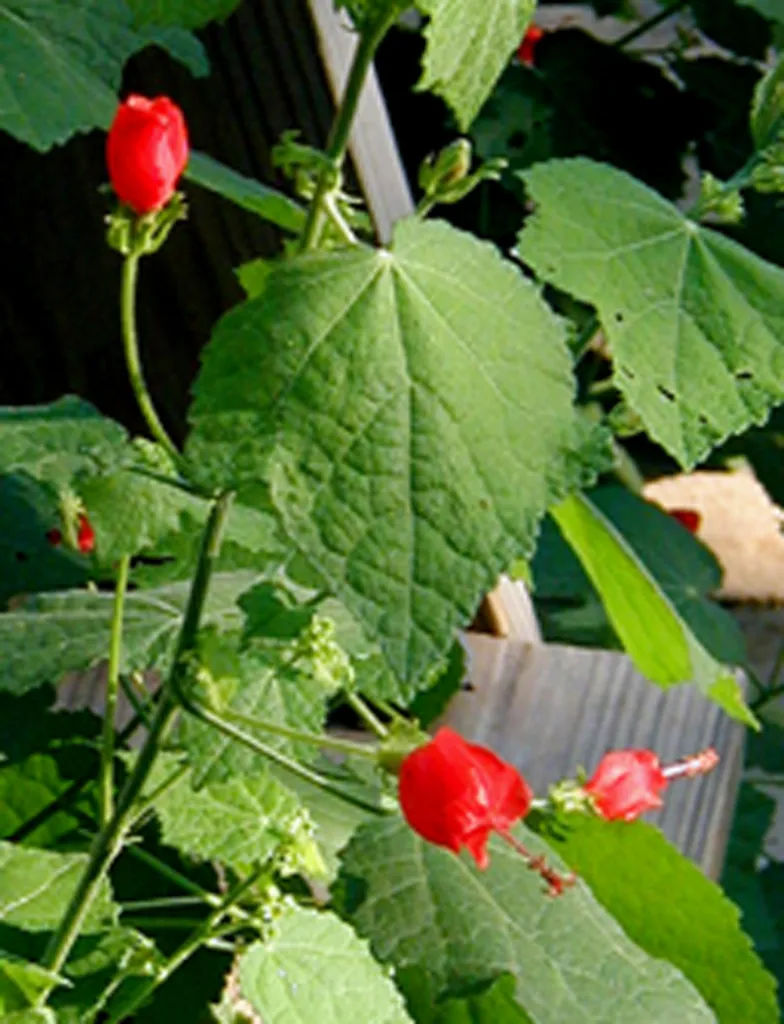
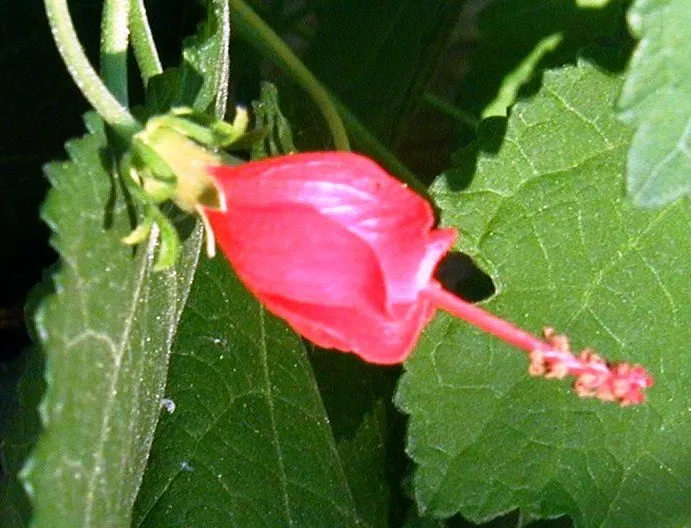
In “Wildflowers of the Texas Hill Country,” Marshall Enquist describes the flower as consisting of one- to two-inch-long petals that “stand erect and are folded into one another,” making a tight irregular bloom. A long red staminate column juts out from the center of the flower. The bright-green leaves are two to four inches long and wide, shallowly lobed, and slightly fuzzy on the underside.
It is not uncommon these days to find white-blooming Turk’s cap for sale at nurseries, and pink cultivars occasionally are available. My preference is the “natural” red, which seems to draw the hummingbirds and butterflies.
Turk’s cap is native to East, South, and Central Texas as well as the eastern part of the Edwards Plateau. This distribution proves it can adjust to a variety of soil types and moisture regimes. Where I’ve noticed it in Kendall County, wild Turk’s cap grows in shady, well-drained areas along stream banks and limestone canyon walls.
In the garden it can grow almost anywhere, from full sun to deep shade. Turk’s cap grows into a multi-branching bush a few feet high. If it gets too much care after it is established, Turk’s cap might need to be cut back occasionally. Most winters our Turk’s cap dies back to the ground, but even last winter’s deep freeze didn’t kill it. The white-tail deer in our neighborhood have an appetite for Turk’s cap leaves, and the plant won’t survive in our yard without an exclosure.
The Boerne Chapter of the Native Plant Society of Texas provides free planting and care instructions for Turk’s cap at the nurseries participating in Operation NICE! (Hill Country African Violets and Nursery, Maldonado Landscape and Nursery, and Medina Garden Nursery) as well as at Cibolo Nature Center.
Whoever gave Turk’s cap its informal name apparently thought the flower resembles a fez, the red felt hat formerly worn by Turkish men (now I think mostly worn for Shriner parades in the US). Other vernacular names include Texas mallow, red mallow, bleeding heart, and Drummond wax-mallow. Its variety name is in honor of Thomas Drummond, a Scottish botanist who collected in Texas when it was still a part of northern Mexico.
Thomas Drummond was curator of the Belfast Botanic Garden during the early 1800s. In 1825 he went with a natural-history collecting expedition to the Hudson Bay area of Canada. It was a trip of hardship and near starvation. By 1831, he reached New York and slowly made his way southwest to Texas, arriving in 1833, three years before the revolution. It is said he brought with him two tons of paper in which he hoped to preserve a collection of Texas flora. During 21 months of 1833 and 1834, Drummond collected 750 species (2,000-3,000 specimens) of plants. He sent these to Sir William Jackson Hooker, founder of Kew Botanical Gardens in London. Drummond also made collections of birds, snakes, land shells, and seeds.
Drummond’s collecting trips in Texas were made at great peril to his health. More than once he almost starved to death, he barely survived cholera, and he endured fevers, boils, hand infections, and ulcerated legs. Drummond made his way from Texas to Cuba, where he died mysteriously in 1835.
Among the plants Hooker described from Thomas Drummond’s collection are the Texas bluebonnet and Drummond’s phlox. The phlox from Texas was enthusiastically grown in Europe, and it was soon “improved” into several color strains now growing in gardens around the world. Twenty-eight other Texas plant species are named in honor of Thomas Drummond. His collection was the first from Texas to be distributed widely among museums and scientific institutions of the world.