The Native Plant Society of Texas offers the following research grant to graduate students at Texas universities who are performing academic research related to Texas native plants and/or to the conservation and restoration of native plant habitats of Texas:
Ann Miller Gonzalez Graduate Research Grant – This research grant is named in honor of an early supporter of Texas native plants. The award amount is up to $2500 for the duration of the grantee’s research project.
The Grants & Scholarships Committee is excited to announce the below 2025 AMG Grant Recipients:
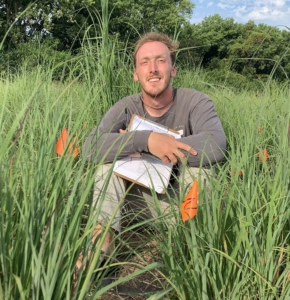
Eli Hartung, Texas State University – Award $2435 (Also awarded in 2023 & 2024)
Originally from western Pennsylvania, Eli earned his undergraduate degree in Botany from Utah Valley University and later completed a master’s degree in biology at Kansas State University. He is currently a PhD student at Texas State University, where his research focuses on plant water uptake on the Edwards Plateau. Through his undergraduate and master’s work, he developed a strong interest in native plant ecology and conservation. While broadly interested in native plant communities, his work focuses on the often-overlooked grasses and forbs that form the understory of these systems and play critical roles in ecosystem function.
Research Summary: Limestone soils are often viewed as a challenge for plants because they are thin, rocky, and prone to drying. Yet across the Edwards Plateau of central Texas, many native species thrive under these conditions. My research examines whether limestone fragments in soil can contribute to plant water availability during drought by storing small amounts of moisture. With previous support the Native Plant Society of Texas (NPSOT), I conducted greenhouse experiments demonstrating that limestone in soil can slow drought stress and delay mortality in some native herbaceous plants. Species that benefited from limestone also showed distinct growth patterns when limestone was present in soil, suggesting that these plants may possess adaptations that allow them to take advantage of water stored in rock. Building directly on these findings, my newly funded NPSOT project focuses on understanding how water moves from limestone to plants. Using controlled greenhouse experiments designed to isolate different pathways of water transfer, I am testing whether rock water moves through surrounding soil, diffuses directly into roots, or is transferred to them via associations with soil fungi. This work aims to clarify the mechanisms behind limestone-facilitated drought tolerance and help explain how native plants persist in rocky landscapes of central Texas.
Sabina Prajapati, Texas State University – Award $2500 (Also awarded in 2024)
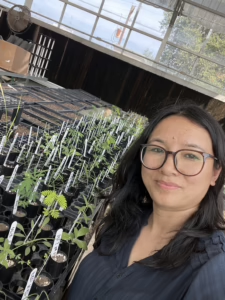 Sabina is Ph.D. student at Texas State University She received her M.Sc. in Forest Sciences and Forest Ecology from University of Göttingen (Germany), a B.Sc. in Forestry from Tribhuvan University (Nepal), and subsequent training from UNESCO-IHE, Netherlands (Watershed and River Basin management). Her research interest lies in understanding the effects of global change on ecosystem functions, particularly soil health and carbon sequestration. Her dissertation work focuses on understanding of how grassland restoration can be optimized to maximize carbon sequestration while simultaneously supporting grassland ecosystem functioning.
Research Summary: “Quantifying root traits of native prairie species to enhance grassland restoration”
This research investigates how root traits of native prairie species influence ecosystem functioning, soil carbon sequestration, and grassland restoration outcomes. Although roots are the primary pathway through which plants contribute carbon to soils, key root traits remain poorly documented, particularly for native prairie forbs and legumes that are central to biodiversity and ecosystem resilience. The project will quantify a comprehensive suite of below-ground and above-ground traits for 24 native prairie species representing four functional groups (C3 grasses, C4 grasses, forbs, and leguminous forbs) grown under controlled greenhouse conditions in one-meter soil columns. Measured traits will include maximum rooting depth, specific root length, root tissue density, root length density, and root carbon and nitrogen content, alongside standard above-ground traits. The project will generate comprehensive empirical root trait datasets and provide mechanistic insight into how root trait diversity regulates below-ground resource use and carbon sequestration, and deliver quantitative, trait-based guidance for designing prairie seed mixes that enhance ecosystem stability and restoration success. All trait data will be made openly available through major international repositories, including TRY, GRooT, and the Fine-Root Ecology Database (FRED).

Tilak Chaudhary, Texas State University – Award $2500
Tilak is PhD candidate at Texas State University working under the supervision of Dr. Jason Martina. He earned his BSc in Forestry from Tribhuvan University, Nepal, followed by an MSc in Forest Sciences and Forest Ecology from the University of Göttingen, Germany, and a second master’s degree in biology from Texas A&M University–Kingsville. His research focuses on understanding ecosystem responses to global change, with particular emphasis on ecosystem stability and resilience. Through his work, he aims to identify the mechanisms that govern ecosystem functioning under anthropogenic pressures.
Research Summary
Anthropogenic global changes, such as fertilization and tilling, strongly alter the composition of native prairie plant communities, with cascading effects on ecosystem functioning. Grasslands are especially important in this context because they store a large proportion of the world’s terrestrial carbon in its soil. Therefore, changes in plant community composition can significantly influence soil carbon dynamics, creating feedback to the global climate system.
My research aims to identify the mechanisms through which global change drivers affect grassland ecosystem services, with particular emphasis on biomass production and soil carbon storage. Specifically, I am investigating how global change–driven shifts in species composition influence ecosystem stability and the ability of grasslands to maintain essential services over time. This research has two main objectives. First, examine how changes in grassland plant communities caused by global change impact ecosystem stability and the long-term provision of key ecosystem services. Second, determine whether grasslands can recover their native species composition and associated ecosystem services after global change pressures are reduced or removed. By addressing both ecosystem responses and recovery potential, my work seeks to provide important insights into grassland resilience and to inform management strategies aimed at sustaining their ecological functions and climate-regulating roles.
Elena Leander – University of Texas, Austin – Award $2500
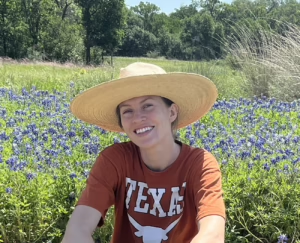 Elena Leander is in the Ecology, Evolution, and Behavior Program at the University of Texas at Austin, advised by Dr. Amelia Wolf. Her research explores how partnerships between plants and arbuscular mycorrhizal fungi (AMF) shape ecosystem resilience, particularly in the context of native grassland restoration. Elena investigates the impacts of interacting disturbances, including management practices, anthropogenic drivers, and invasive species, on plant and soil fungal diversity, community composition, and ecosystem function. She uses molecular tools to uncover belowground processes that inform evidence-based restoration of native Texas plant communities.
Research Summary: Native Texas grasslands are among the most threatened ecosystems in the state, and restoration efforts are often hindered by invasion from yellow bluestem (Bothriochloa ischaemum). Even after extensive invasive grass removal and native seed addition, native grasses may be slow to re-establish or fail to recover altogether. This project investigates whether belowground processes, specifically the availability and dispersal of arbuscular mycorrhizal fungi (AMF), may limit native grass recovery following invasive grass removal.
Building on a long-term field experiment established at the Barton Creek Habitat Preserve, this research examines how AMF communities respond across spatial gradients of yellow bluestem removal (0–100%). Using DNA metabarcoding and root colonization measurements, the study will characterize AMF diversity, community composition, and recovery patterns relative to invasive grass removal intensity. A complementary inoculation experiment will test whether adding locally sourced native AMF can overcome barriers to native grass establishment, focusing on late-successional prairie grasses that have consistently failed to recolonize restored sites.
Together, these experiments address two key restoration questions: how much yellow bluestem removal is sufficient to support AMF recovery, and when targeted AMF inoculation may be an effective post-invasion restoration tool. Results from this work will provide land managers with evidence-based guidance for improving long-term restoration success of native Texas grasslands.
Catarina Miranda – University of Texas Rio Grande Valley – Award $2500
Catarina is a biology master’s student at the University of Texas Rio Grande Valley. She is currently researching the effects of microhabitat and succession on woody plant communities in the Tamaulipan thornscrub ecosystem of south Texas. She is an avid plant enthusiast and enjoys propagating native Texas plants and botanizing any wild landscape.
Research summary
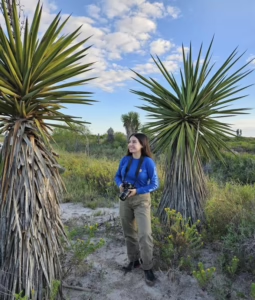 The Tamaulipan Biotic Province extends from south Texas into northeastern Mexico and is a highly biodiverse, semi-arid system dominated by short, dense, woody vegetation, locally known as thornscrub. Plant-plant facilitation is expected to be the norm, as the system is characterized by high abiotic stress from drought, heat, and occasional deep freezes. Upland thornscrub canopy is dominated by two nitrogen-fixing trees, Ebenopsis ebano and Neltuma glandulosa, both documented to be host plants for a variety of understory shrubs, subshrubs, and forbs. Facilitation from these two species likely occurs via microclimate amelioration from shade created by canopies, and I am interested in disentangling the effects of light levels on vegetation community characteristics and overall forest sustenance. This project will leverage an ongoing study as part of my M.S. thesis where I have surveyed understory plots in contrasting microhabitats of E. ebano, N. glandulosa, and open areas in full sun. I will collect climate data using HOBO Pendant MX Temperature/Light Data Loggers in the 3 contrasting microhabitats and use that data to investigate relationships in stem density, diversity, and patterns in plant size. Thornscrub is critically neglected in ecological literature, and learning key mechanisms underpinning community assembly will provide much needed information for the conservation and restoration of habitat in the southern half of Texas and northeastern Mexico.
Caleb Mullins – Stephen F Austin State University – Award $2500
 Caleb Z. Mullins is a PhD student at Stephen F. Austin State University, advised by Dr. Cord B. Eversole. He earned a B.S. in Environmental Science from the University of Virginia’s College at Wise and an M.S. in Conservation Biology from the University of West Alabama. His research focuses on wetland ecology and how invasive plants modify leaf litter dynamics and water chemistry, using amphibians as model organisms to evaluate faunal responses to shifts in detrital inputs from invasive and native vegetation. His work integrates controlled mesocosm experiments with applied questions relevant to wetland management and native plant conservation in East Texas.
Research Summary:
In many wetlands, invasive trees can contribute large pulses of leaf litter that decompose rapidly and may shift water chemistry during the breeding season. The project examines how invasive leaf litter interacts with warming conditions to influence decomposition and water quality, and what those changes may mean for developing amphibians. A controlled laboratory experiment using small mesocosms will be conducted to evaluate invasive Chinese tallow (Triadica sebifera) and Callery pear (Pyrus calleryana) leaf litter in comparison to native leaf litter species, under two temperature conditions (ambient and +4°C) that represent plausible warming scenarios. Throughout the experiment, a suite of water quality variables will be recorded, such as temperature, pH, and dissolved oxygen. Additionally, amphibian responses including hatching success, time to hatching, and developmental stage at hatching will be documented. This research will help clarify how invasive litter inputs and warming may jointly affect wetland habitat quality and amphibian recruitment, supporting broader goals of conserving native plant communities and the ecosystems they help sustain.
Joyce Reed – Midwestern State University – Award $2500
 Joyce Reed is a M.S. in Biology student at Midwestern State University (MSU) under the supervision of Dr. Timothy Pegg. She is studying the plant diversity and the environmental variables that affect it around desert riparian systems at MSU’s Dalquest Desert Research Station near Big Bend National Park.
Research Summary: The Chihuahuan Desert is one of the most botanically diverse deserts in the world, housing around 3400 plant species, 25% of which are endemic to the area. A majority of this diversity can be found around the riparian areas created by the springs and seeps located throughout the region, which are an important source of shelter, food, and hydration for the many animal species that reside in the area. This study aims to identify the plant species found within these riparian areas and identify how different ecological variables like temperature, weather, soil content, and animal interaction may affect the diversity of the area. The use of transect voucher specimens, soil tests, trail cameras, and local weather data will be used in order to determine how these ecological conditions affect the floral diversity of these desert riparian areas and help give insight into the dynamic nature of this diversity year to year.
Victoria Vo – University of North Texas – Award $2500
 Victoria Vo is a master’s student in the Biology Department at the University of North Texas. She received her B.S. in Botany with a minor in Entomology at the University of Florida. Her research focuses on how pollinators contribute to plant reproduction and conservation.
Research Summary
Pollen limitation poses a serious threat to plants by reducing their ability to reproduce and survive. When flowers do not receive enough pollen, they produce fewer viable seeds which limit the next generation. Bees are widely recognized as key pollinators that transfer pollen among plants. However, we need to understand how environmental changes affect all pollinators. Beetles make up about 40% of the world’s arthropod species, yet they are poorly understood as pollinators, especially outside of the tropics. Victoria’s research seeks to compare bees and beetles’ pollination contributions to native plant reproduction. To do so, she will identify pollen grains deposited on stigmas by visiting insects and compare the proportion of viable seeds of flowers visited versus unvisited by pollinators. By understanding the pollination needs of our native plants, we can predict future changes to their communities as insect communities change.
Savannah Zarate – University of Texas Rio Grande Valley – Award $2000
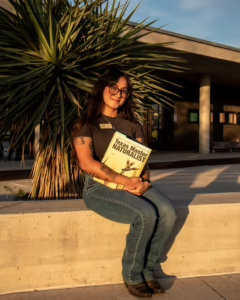 Savannah Zarate is a Brownsville, Texas native and a graduate student in the School of Earth, Environmental, and Marine Sciences at the University of Texas–Rio Grande Valley, specializing in endangered plants. She works as a student researcher in the Gabler Lab, conducting field surveys, population mapping, and germination research on federally threatened and endangered plant species in the Rio Grande Valley. Her research focuses on linking plant reproductive ecology with pollinator services to inform conservation and restoration strategies. Savannah currently serves as President of the Rio Grande Valley Chapter – Texas Master Naturalists, and is a certified Texas Master Gardener, actively engaged in native plant education, leadership, and habitat restoration.
Research Summary: Texas Ayenia (Ayenia limitaris) and Its Pollinators
The Lower Rio Grande Valley of Texas is home to the Texas Ayenia (Ayenia limitaris), a thornless shrub that is officially threatened. Although the distribution, population structure, and reproductive output of the species have been clarified by recent surveys carried out by the Gabler Lab at the University of Texas–Rio Grande Valley, little is known about its pollination ecology. Seed set and long-term population survival may be significantly impacted by low pollinator visits.
This research examines the relationship between Texas Ayenia and its floral visitors across five known populations in Cameron and Hidalgo Counties. Standardized field observations, targeted insect collection, and reproductive monitoring of tagged flowers will be used to identify effective pollinators, quantify visitation rates, and assess links between pollinator diversity and fruit and seed production. Pollinator data will be analyzed using ecological diversity metrics and regression models, and results will be integrated with GIS habitat data from ongoing UTRGV surveys.
Fieldwork will be conducted across multiple flowering seasons, with pilot observations followed by focused sampling during peak bloom periods. Results will complement ongoing propagation and restoration efforts at the Gabler Lab/ UTRGV Native Plant Nursery and support conservation planning conducted by partner agencies, including the U.S. Fish and Wildlife Service and Texas Parks and Wildlife Department. By linking reproductive ecology with pollinator services, this project directly supports science-based management and recovery strategies for one of Texas’s most imperiled native plant species.