During this prolonged drought, I’ve kept a close eye on the penstemons, some of the favorite wildflowers in our backyard.
This week I breathed a sigh of relief to see they finally are putting on new leaves and some are sending up bloom stalks. Penstemons are among the prettiest wildflowers in the Hill Country.
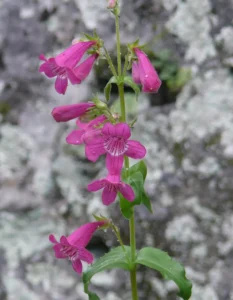
The Operation NICE! (Natives Instead of the Common Exotics!) plant for April is Penstemon.
There are two dozen penstemons native to Texas, and three of the ones native to the Hill Country are available in the nursery trade.
Surely this year has proven that penstemons are drought-tolerant perennials, well worth having in your garden.
The showiest of the native penstemons is foxglove (Penstemon cobea). In the spring, bloom stalks shoot up from the basal rosettes to heights of one or two feet.
The flower is an inflated tube with five lobes and is up to two inches long. Blooms may be lavender, white, pale purple or pink, all with purple lines on the inside of the flower tube. In full bloom, the stalks are crowded with flowers.
Foxglove penstemon ranges widely over North and Central Texas and into the Trans Pecos. Apparently, it is tolerant of a wide range of soil types and rainfall zones.
It does very well with little care in the poor calcareous soil of the wildflower patch in our backyard
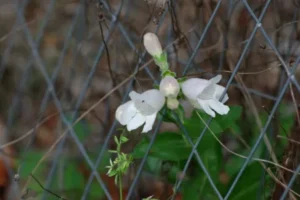
We always let our penstemons go to seed before cutting the old bloom stalks; therefore, we have a few new plants coming up every year.
Foxglove is a common roadside flower in many places. It used to be abundant along the road we drive into Boerne, but I am afraid foxglove has been wiped out of this area in recent years, either by deer browsing or too-early mowing of the roadside.
Scarlet penstemon (Penstemon triflorus) may be the most eye-catching Hill Country penstemon. Its two-foot-long bloom stalk bears numerous bright-red to pinkish-red tubular flowers with five lobes. Inside the flower tubes, the white throats are striped with thin red lines.
Another common name for P. triflorus is Hill Country penstemon. That is a fitting name, because this species is endemic to the Edwards Plateau and adjacent areas.
It is common in the limestone canyons near Boerne. And it also grows well in our wildflower patch.
Another penstemon that we intend to get for our garden is the rock or cut-leaf penstemon (Penstemon baccharifolius). The first time I was aware of this penstemon, I saw it blooming on the sunny sheer wall of a limestone canyon in Bandera County. And it was the last day of October!
I didn’t know penstemons bloom that late around here, Rock penstemon may put on one-inch-long scarlet-red flowers from late spring, through summer, and into fall.
This tough little penstemon grows out of cracks on dry rocky slopes from Bandera and Medina Counties westward to the Big Bend area.
It would be an excellent wildflower for xeric landscaping. That plant is next on my list to buy.
The Boerne chapter of the Native Plant Society of Texas provides free planting and care instructions for penstemons at nurseries participating in Operation NICE! (Hill Country African Violets and Nursery and Maldonado Landscape and Nursery) and at the Cibolo Nature Center.