Since April 2002, Operation NICE! (Natives Instead of the Common Exotics!) has featured a different native landscape plant every month. And there are a lot more native species that are good yard plants, so we could go on adding new Plants of the Month for a while.
However, since we started this program, the Boerne area has added many new homeowners. It is time to repeat some of the favorites!
Evergreen sumac (Rhus virens) is one of favorites that bears repeating. The following is excerpted from my January 2003, column:
When my wife and I first hiked the trails in Friedrich Park several years ago, it was a sunny winter day. Most of the trees and bushes were leafless, but we kept admiring some shrubs and low trees that still had shiny green foliage. “That would be a great plant to have in our yard,” I said. “I wonder what it is?”
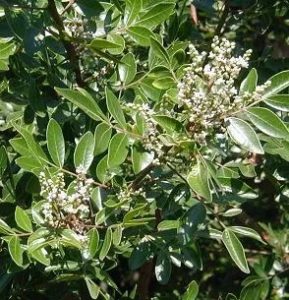
We were carrying Jan Wrede’s book, “Texans Love Their Land, a Guide to Native Texas Hill Country Woody Plants,” and we soon identified the handsome plant as evergreen sumac. We often had admired the flame-leaf sumac, but had no idea that sumac has an evergreen version.
As soon as we left Friedrich Park, we drove to our local nursery. Almost apologetically I asked, “I suppose you don’t sell such a thing as evergreen sumac, do you?”
“I certainly do,” Ken Froboese answered.
Of course, other people had discovered evergreen sumac long ago, and there was a demand for it as a landscape plant.
Now we know that, but this was before we joined the Native Plant Society of Texas and became a little more educated about the variety of native plants that are available at nurseries.
We took home an evergreen sumac that day and have purchased several more in the years since. It is one of my favorite yard plants. Wherever we have an eyesore that needs screening from view, I plant either an evergreen sumac or a Texas mountain laurel in front of it.
The glossy leaves of the evergreen sumac stay green all winter, and then in early spring the leaves are shed and soon replaced by new leaves. You hardly notice that it is not truly evergreen.
The evergreen sumac usually is multibranched. In full sun it commonly is a large densely foliated shrub with a more or less domal shape. In part shade its foliage and limbs are less densely packed. Some evergreen sumacs grow into small trees up to about 12 feet high.
The experts may not advise this, but I’ve found that some control on the shape can be gained from moderate pruning. Most of the time, however, the shape they take naturally is very pleasing.
There are several reasons evergreen sumac is a good choice for the January Plant of the Month for Operation NICE!. It is freeze-tolerant in our area, it is virtually “evergreen,” it is an attractive landscape shrub or low tree, it attracts butterflies and birds, and it rarely needs watering once established. Too much water will hurt this plant. It needs good drainage.
In the late summer, evergreen sumac puts on many clusters of small white blooms. Bees and butterflies come from all around.
The fuzzy red berries which follow the blooms are attractive to several birds, and I think I’ve seen signs in our yard that ringtails also like the berries.
Our neighborhood deer love to strip the leaves and tender shoots off any unfenced evergreen sumac they find, especially small ones.
Apparently mature woody plants are not so delectable, but in November the bucks like to “rub” trunks of that diameter with their antlers. We lost half of a large evergreen sumac after it did battle with a buck one night.
Planting and care instructions for the evergreen sumac are available free of charge at local nurseries participating in Operation NICE!: Hill Country African Violets and Nursery and Maldonado Landscape and Nursery.