


The October Plant of the Month for Operation NICE! (Natives Instead of the Common Exotics!) is a local native, American Smoke Tree (Cotinus obovatus). As a landscape ornamental, this small deciduous tree provides “smoky” flowers in the spring and bright leaf color in the fall.
Smoke tree gets its name from the long fuzzy pinkish or purplish flower stems capped with a few small yellow-green blooms. Supposedly, at a distance, the spring flower clusters look like haze or smoke rising above the tree.
I must admit, I have a hard time making that analogy, but the airy blooms are intriguing.
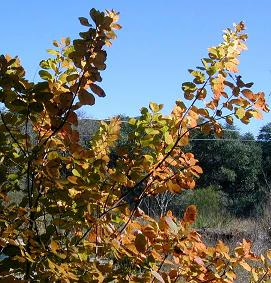
Autumn foliage surpasses the spring flowers. As with other members of the sumac family, the smoke tree turns shades of yellow, gold and scarlet during the cool months of fall. However, I like the look of smoke tree foliage all year.
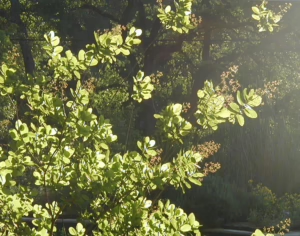
When leaves first emerge, they are pink and lime green. With maturity leaves are 2 to 6 inches long, oval, and olive green with paler underside.
In the wild in the Hill Country, the smoke tree grows in well-drained rocky limestone soils. In cultivation, the little tree can survive in a variety of settings, but rich garden soil may produce a brittle tree, according to some horticulturists.
Once established, smoke tree has considerable tolerance for dry spells. The tree can grow 25 to 30 feet high, but mostly stays much shorter.
Chuck Janzow recommends planting smoke trees where they are protected from the hot afternoon sun. Indeed, our backyard smoke tree is doing very well in dry soil under a liveoak in a spot that gets morning sun and afternoon shade. However, the two places I happen to have seen clumps of smoke trees in the wild are in full sun. It’s a tough little tree.
The Boerne chapter of the Native Plant Society of Texas provides free planting and care instructions for American smoke tree at nurseries participating in Operation NICE! (Hill Country African Violets and Nursery, Maldonado Landscape and Nursery, and Barkley’s Nursery Center).
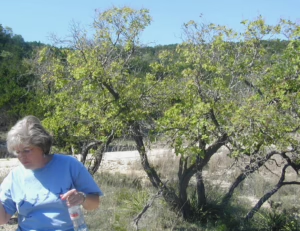
north of Boerne. (Photo by Bill Ward)
Smoke tree is uncommon throughout its range of Tennessee, Kentucky, Alabama, Missouri, Arkansas, Oklahoma and Central Texas. In Texas, smoke tree grows mainly in Kendall, Kerr and Bandera counties. It also has been collected in Blanco, Hayes and Uvalde counties. Probably the fact that deer like to browse this plant is one reason for its scarcity.
During Civil War times, the smoke tree was widely harvested to make yellow dye.
Two places to see smokes trees in natural settings are between Utopia and Tarpley and in the Spanish Pass area north of Boerne. Some of the most ancient-looking smoke trees in this area grow on Jane and Jack McAuliffe’s limestone hill north of Spanish Pass.
Even in the hot rocky soil, these trees have reached about 12 feet high and the gnarled dark-gray trunks have expanded to many inches in diameter. Those are old trees! How much Kendall County history have those smoke trees witnessed?
