

NICE! Plant of the Month
(Bignonia capreolata)
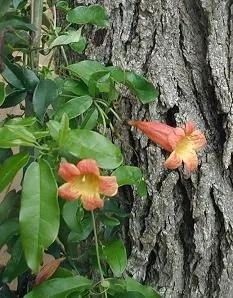
Family: Bignoniaceae (Catalpa or Trumpet-Creeper Family)
Type: Evergreen, woody vine; climbs by tendrils with flattened tips.
Natural Habitat: Usually found high climbing in trees in moist woods of eastern Texas to Florida and north to Illinois and New Jersey. Uncommon in most of its range but may be common in some regional locations.
Growth: Height to 65′ in moist areas; 10-20′ is more common in Hill Country plantings.
Preferred Site and Use: Widely used in landscapes on screens, fences or arbors.
Deer Resistance: May be browsed by deer.
Wildlife: Hummingbirds use nectar from flowers.
Light Tolerance: Dappled shade is best; full sun if given extra water and organic supplemented soil.
Flowers: usually red-orange but can be yellow; 2-3″ long tubular with 5 lobes; lighter or yellow inside; in clusters of 2-5 flowers.
Bloom Period: April – June
Fruit: Leathery, long slim pods; 4-7″ long; seeds winged.
Leaves: Evergreen, opposite, compound with 2 leaflets, elliptic or lanceolate, 1-6″ long, margins entire.
Water Requirements: Moderate; for established plant in absence of rain, water deeply once every month.
Soil Requirements: Various; organic supplementation improves performance in limestone areas; in limestone soils may take 3+ years to become established.
Maintenance: Little is required; few natural predators. Trim lightly when necessary, add compost around plant, and keep mulched. To encourage full, lush growth and lots of flowers trim back after flowering or during winter months.
Planting Instructions: Space plants 10 feet apart. Dig a hole at least two times wider than, but the same depth as the root ball in the nursery container. Sides of the hole should be irregular, not smooth. Remove plant from container, taking care to support the root ball. Loosen exterior roots gently with your fingers. If the plant is root-bound and cannot be loosened by hand, the outer roots may be cut in several places. Lift the plant by the root ball and place into the hole. Backfill hole, using soil that was dug out supplemented lightly with compost. Do not add any soil to the top of the root ball, but a thin layer of compost may be spread over the soil surface. Gently firm the soil with your hands, but do not tamp it down. Place 3-4 inches of mulch over the bare soil around, but not touching the base of the plant.
Watering Instructions: Water deeply after planting to settle soil around roots. Then every 7-10 days, as needed, during the first growing season. Before watering, check for soil moisture at a depth of an inch or two at the edge of the root ball. Skip a watering after a rainfall of ½ to 1 inch. Maintain this watering schedule until the first fall. Reduce watering during the cool fall and winter months. In a “normal” year, no watering may be necessary during the fall and winter, but during a dry period, monthly watering may be needed. Second Spring and thereafter: Water deeply monthly only during periods of drought. Once established, natives will survive with little supplemental irrigation.
NICE! Tip: This evergreen vine produces a striking, heavy floral display during the Spring, but may produce scattered blooms throughout the growing season. May be propagated from fresh seeds, early summer cuttings or by layering growing stems in soil until roots form at nodes. A cultivar, ‘Tangarine Beauty,’ with abundant dark orange flowers is widely available in the nursery trade.
Look for the NICE! Plant of the Month signs and information sheets on your next visit to a participating Boerne nursery. And thank you for supporting native plants by using them in your landscapes.
