San Antonio Chapter

Bigtooth maple in central Texas past, present and perhaps the future

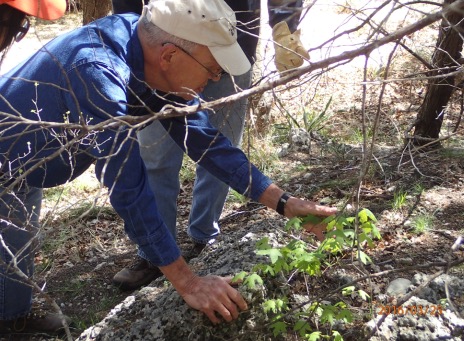
Small Big Tooth Maple Seedlings

March 2022 Presentation by Bill Van Auken

Dynamics of woodland or forest communities have been difficult to understand. In private property states, trying to determine community dynamics is more difficult because with changing ownership, management changes and temporal effects are difficult to follow especially with long-lived species. In addition to recent changing management strategies, long term changes at least over the last 20,000 years was caused by warming temperatures, glacial re-treat, the presence of Native Americans and the arrival of the Europeans and their animal. Populations of Acer grandidentatum Nutt. (Bigtooth maple, Aceraceae=Sapindaceae) a rare species in central Texas are mostly found in isolated, deep, relatively remote, limestone canyons. Acer grandidentatum is found with a few other mostly deciduous species. Recruitment of juveniles has been reported to be lacking. Populations of A. grandidentatum juveniles were found in limestone canyons in a State Natural Area in Central Texas. Enclosures were placed around half and half were left in the open. Plant survival was followed for four years. At the end of that time when survivals were compared there was a significant difference in survival in the treatments (χ2 , P<0.001). Survival in the enclosures was 92% with 52% in the open. When population extinction was compared, for planted plants using linear regression, extinction was 60.5 yrs in exclosures and 11.9 yrs in the open. For native juveniles it was 12.6 yrs in enclosures and 5.9 yrs in the open. The cause of most mortalities in the open seemed to be herbivory by white-tailed deer (Odocoleus virginianus).

About the Region

2026 Fall Symposium Logo

This low-elevations region of Texas extends inland from the barrier islands, about 60 or so miles, and stretches from Brownsville to Louisiana. In total, it covers about 9.5 million acres, with a high point of 150 feet in elevation. More than 1000 species of plants can be found in this region. On the southern end, species more common in Mexico (such as Sabal mexicana) and Central America occur.

The barrier islands provide us with dune systems, and clay flats to the inland side, which have species found in these areas alone. Many plants here, such as Ipomoea pes-caprae (beach morning glory), can be found throughout tropical regions of the globe. I’ve encountered the same species on the beaches of Guam.

Once inland, vast marshes and wet prairies occur. Occasionally, oak (Quercus fusiformis) groves can be found. Common grasses include species of Bothriochloa, Paspalum, and Sporobolus; eastern gamagrass (Tripsacum dactyloides); and switchgrass (Panicum species). Many rivers and creeks cut through the Gulf Prairies, and along these riparian areas various species of trees, Sabal minor, and other plants adapted to clay soils can be found. Due to overgrazing, farming, and fire suppression, woody species such as mesquite (Prosopis glandulosa) and huisache (Acacia farnesiana), and invasive species such as chinaberry (Melia azedarach), Brazilian pepper (Schinus terebinthifolius), and Chinese tallow (Sapium sebiferum) have increased and displaced our native flora.

Source: Wildflowers of Texas by Michael Eason