


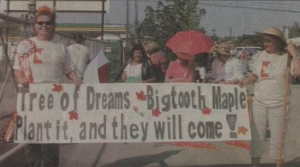
Two weeks ago, the Boerne chapter of the Native Plant Society of Texas (NPSOT) entered a float in the Kendall County Fair Parade. That may have been the first time any chapter of NPSOT ever had a float in any parade. But we thought the Kendall County parade might be a good way to let the public in on something special that is brewing for Boerne.
“Bigtooth Maples for Boerne” was the subject of our float. Decorations were a dozen real bigtooth maple trees in big pots, lots of artificial autumn leaves in all the maple colors and some bright posters announcing this unique community-service program.
The float riders wore costumes representing Boerne tourists of various persuasions – photographers, artists, fishermen, ranchers and even fall brides. Two or three NPSOT members carried a long banner that read “Tree of Dreams – Plant It and They Will Come.” Some other NPSOТ members handed out fliers to spectators along the parade route.
What was this all about? That is what many parade-watchers wanted to know. As we sat in the holding area waiting for the parade to roll, several passersby had a string of questions for us.
The first question was, “Are you a landscaping company selling maple trees?” Answer: No, not at all! This is a community-service program through which the Boerne chapter of NPSOT will distribute bigtooth maple trees to qualified Boerne residents, businesses and organizations.
This program for planting bigtooth maples throughout Boerne was sparked by a longtime dream of one of our members, Jan Wrede. She imagined how beautiful Boerne would be in the fall if bigtooth maples were planted along every street. In her dreams Boerne could be the bigtooth maple capital of Texas. After all, bigtooth maple is a native of the Boerne area. It’s a natural for this city!
Jan’s dream became the Boerne chapter’s dream, and those dreams will come true thanks to the very generous support of the Lende Foundation. Every year for the next 10 years, a limited number of bigtooth maples will be awarded free of charge for planting within the Boerne city limits. Applications must be submitted by Oct. 1 each year. Contact Suzanne Young to see if you qualify for a tree by calling 830- 249-8240.
Another question was, “Are those anything like the trees at Lost Maples State Natural Area?” Answer: Yes, they are the same maple tree (Acer grandidentatum). The natural range of bigtooth maples extends to the Boerne area.
These cousins of the sugar maple grow wild in many stream canyons just west and northwest of town. Maple trees for sale at some nurseries may not be the native species. We are talking about bigtooth maples here!
Probably the most relevant question hollered out during the parade was, “Do those trees need lots of water?” Answer: Not once they are established. This is an important reason for growing bigtooth maples in home landscapes. Once they set their root system, bigtooth maples are quite tolerant of droughts. In addition, they generally are disease free.
Chuck Janzow, who knows a lot about the local wild populations of bigtooth maples, says that in past years many Kendall County ranch owners transplanted maples from their ranches to their town homesites in Boerne. Chuck knows of 35 or 40 older maples already in Boerne. Some of the Boerne big tooth maples that are conspicuous for their fall color are those at Frost Bank, Ebensberger Funeral Home, Boerne Convention and Community Center and the Boerne Cemetery on School Street. “Bigtooth Maples for Boerne” has a good start already!
