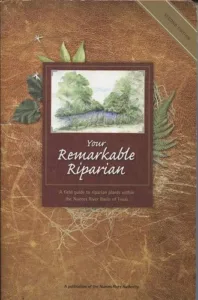
Your Remarkable Riparian A Field Guide to Riparian Plants Within the Nueces River Basin of Texas

Steve Nelle

Publisher:

Nueces River Authority

Publication Date:

January 1, 2010

Category:

Reference, Regional

This user-friendly guide introduces the most commonly observed riparian vegetation in
the Edwards Plateau and Rio Grande Plains. However, most of the plants presented
herein occur in riparian areas all across Texas, including the Cross Timbers, Trans-Pecos
and Rolling Plains. The riparian principles described apply to all creeks and rivers.
We’ve included images and details on plants that truly provide the heavy lifting when
it comes to holding and cleaning water within the riparian landscape.

This field guide is a tool that you can refer to again and again. Keep it on the dashboard,
take it to the creek, or leave it on the kitchen table so you can consult it regularly. It’s up to
you to learn to read your riparian areas and determine if they’re gaining or losing function.
With this knowledge and appreciation, you can successfully assess and monitor your
riparian areas and help manage them in ways that conserve and enhance their function.

The Purchase button links to a FREE PDF eBook.
About the Region

Fall Symposium 2025 Logo - Teach for the Future

Salado, the location of our Fall 2025 Symposium, lies at the intersection of two ecoregions: the Edwards Plateau (Limestone Cut Plain) and Blackland Prairie (Northern Blackland Prairie).

The Edwards Plateau area is also called the Hill Country; however, this general term covers a much larger area extending farther north. Spring-fed creeks are found throughout the region; deep limestone canyons, rivers, and lakes (reservoirs) are common. Ashe juniper is perhaps the most common woody species found throughout the region. Additional woody species include various species of oak, with live oak (Quercus fusiformis) being the most common. Sycamores (Platanus occidentalis) and bald cypress (Taxodium distichum) border waterways. This area is well known for its spring wildflower displays, though they may be viewed in spring, late summer, and fall, as well. According to Texas Parks and Wildlife, average annual rainfall in the Edwards Plateau ranges from 15 to 34 inches.

The Blackland Prairie extends from the Red River south to San Antonio, bordered on the west by the Edwards Plateau and the Cross Timbers, and on the east by the Post Oak Savannah. Annual rainfall averages 30 to 40 inches, with higher averages to the east. This region is dominated by prairie species. The most common grass species include little bluestem (Schizachyrium scoparium) and Indian grass (Sorghastrum nutans) in the uplands and switchgrass (Panicum virgatum) in the riparian areas and drainages. Common herbaceous flowering plants include salvias, penstemons, and silphiums. This area has suffered greatly from overgrazing and agricultural use. Few intact areas remain, though many of the plants can be found along county roadsides throughout the region.

Our fall Symposium host chapter, the Tonkawa Chapter, includes both of these ecoregions.

Source: Wildflowers of Texas by Michael Eason