


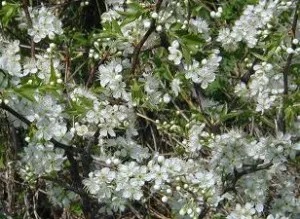
About this time of year or usually a little earlier, certain fence rows and creek banks in this area turn bright-white. The creek plums are in bloom! Spring is arriving!
Creek plum (Prunus rivularis) is Operation NICE! (Natives Instead of the Common Exotics!) plant of the month for April. This shrub is a faithful spring bloomer that, once established, requires practically no care.

In bloom, the creek plum is especially pretty, because the little flowers are so densely packed along the numerous leafless branches. It is an eye-catching mound of white blossoms. After the flowering period, abundant small shiny green leaves emerge to create a densely foliaged shrub that can make a nice addition to home landscapes. The late-summer fruits are inch-diameter plums that turn yellow to bright red.
Creek plum does well in the calcareous soils of this area. It can take full sun or part shade and rarely needs watering after it becomes established. Creek plum usually doesn’t grow much higher than about six feet high. Deer will browse this shrub; therefore, it needs to be caged if not planted within a fenced area.
One caveat is that the creek plum tends to sucker from the roots, creating little thickets. Wherever it is planted, there needs to be some space for it to spread. Of course, it can be contained by cutting off new shoots without harming the main plant.
The Boerne Chapter of the Native Plant Society of Texas provides free planting and care instructions for creek plum at nurseries participating in Operation NICE! (Barkley=s Nursery Center, Hill Country African Violets and Nursery, and Maldonado Landscape and Nursery).
Creek plum is available in local nurseries from time to time. More commonly available is another Hill Country native, Mexican plum (Prunus mexicana). Mexican plum blooms about the same time as creek plum and can be almost as densely covered with white flowers as creek plum. In full bloom, Mexican plum is a spectacular sight, and it sends off a fragrant odor that saturates the entire vicinity. Mexican plum grows fairly rapidly into a small tree up to 20 feet tall or so in this part of Texas; it gets taller in East Texas.
Other members of the Prunus genus that grow wild in the Hill Country are escarpment black cherry (P. serotina var. eximia) and Texas almond (P. minutiflora). Escarpment black cherry is available in some nurseries and is a fairly fast-growing small tree favored for its good fall color.
Strangely enough, none of these Prunus species are shown to have been recorded in Kendall County in the “Atlas of the Vascular Plants of Texas” by B.L. Turner and others. Most of these plums and cherries, in fact, do grow wild in Kendall County, but apparently no one has collected Kendall County specimens for the arboretums which were the sources of data for the atlas.
The one Prunus species shown to have been collected in Kendall County is wild goose plum or Munson’s plum (P. munsoniana), named for Thomas Munson, the Texas botanist who saved the French wine industry in the 1870s from a devastating root disease by developing rootstock from native-Texas grapes. Munson’s plum is only doubtfully separable from the creek plum, according to some botanists. That probably explains the odd occurrence of Munson’s plum and the odder absence of creek plum in Kendall County on the maps in the atlas.
By any name, creek plum is a beautiful spring bloomer.
