


Operation NICE! (Natives Instead of Common Exotics!) began in April 2002 with the popular mountain laurel (Sophora secundiflora). Almost six years later, we finally are highlighting the other Hill Country Sophora, Eve’s necklace (S. affinis).
Eve’s necklace is not so well known as its showy first cousin, but it deserves more use as an ornamental in Hill Country yards.

Eve’s necklace is a tall shrub or small tree, growing up to about 20 feet or so high. The foliage is airy, typical of legumes, with long compound leaves composed of 13-17 narrow leaflets.
In the spring it has hanging wisteria-like clusters of pale-pink or white blooms.
During fall and winter, the jetblack string-of-beads seed pods are eye-catching. The common name “Eve’s necklace” derives from this striking seed pod.
I assume “Eve” is the Eve of Adam-and-Eve fame. Another common name is “Texas sophora,” even though the plant ranges from Central Texas into Oklahoma, Arkansas and northwestern Louisiana. Unlike mountain laurel, Eve’s necklace is deciduous and is browsed by deer. Caging is necessary where the deer population is overabundant and, of course, that takes in most places in this area.
Even when the tree is tall enough that leaves are out of browsing reach, some protection for the trunks might be necessarу. During the fall rutting season, bucks love to rub trunks the size of Eve’s necklace trunks.
Once established, Eve’s necklace is drought tolerant. It is not as slow-growing as its cousin, mountain laurel. In the Hill Country, Eve’s necklace grows in limestone soils on sunny and partly shady rocky slopes and fencerows as well as in shady understory ravines.
Sunny locations probably promote better blooms. There is a rumor that Eve’s necklace is given to sending up sucker shoots. So far, we’ve not had that problem nor have any of several friends who have Eve’s necklace in their yards.
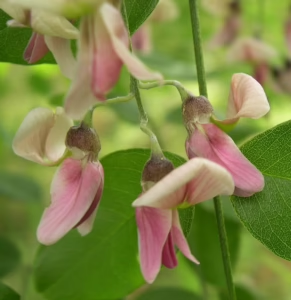
The Boerne chapter of the Native Plant Society of Texas provides free planting and care instructions for Eve’s necklace at nurseries participating in Operaаtion NICE! (Barkley’s Nursery Center, Hill Country African Violets and Nursery and Maldonado Landscape and Nursery).
FIRST SIGNS OF SPRING
Despite the unusually low rainfall and too many freezing nights this winter, this week there are few signs of spring showing up in our backyard. As usual, one of the first things to say spring is on the way is the emergence of our East Texas Jack-in-the-pulpit.
Rosettes of several forbs such as Engelmann daisy, standing cypress, Mexican hat, Maximilian sunflower, Texas aster, lyre-leaf sage, cedar sage, big red sage, purple coneflower and greeneye are decidedly bigger this week.
There is new growth on blue curl, old man’s beard, foxglove penstemon, columbine, violet, giant spiderwort and several kinds of native fem. Also possumhaw and rusty blackhaw are putting out little leaves.
Buds on the blackfoot daisy are bulging, but the Mexican plum and redbud are holding back in our cold yard.
What plants actually are in bloom are yellow: agarita, slender-stem bitterweed, and some sort of dandelion (probably exotic).
Spring IS coming. I’m ready!
