Highland Lakes Chapter

Fall Plant Sale Success

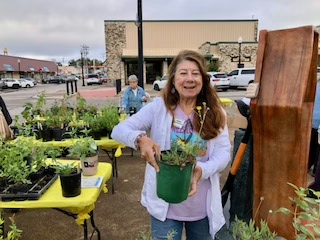
Even with two inches of rain the night before and a flash flood watch during the day, Saturday’s plant sale was a success!! Our preliminary estimate is $1,600 net!! The weather dampened the crowd at the Farmers Market but we still had customer’s trying to buy plants before the sale was slated to open!
A super big THANKS goes out to Joan Mukherjee and MaryLynne Norman for furnishing so many plants. Joan’s F150 truck bed was packed full with plants and MaryLynne keeping pulling plants out of her car. You ladies are amazing!!! A great big shout out to everyone else who brought even one plant or multiple plants—every plant is a big addition to the effort.

Another big thanks goes out to Backbone Valley Nursery! They donated plants to the
sale and gave us great prices on the plants that we purchased.

The volunteers are what makes the day so much fun. We had volunteers who have worked more than twenty sales throughout the years and volunteers who were at their very first sale. It was a wonderful day learning from each other and spreading the word
about natives to the public.
Thanks to Wendy Tillotson, DJ Sanders, Carolyn Crouchet, Pat Campbell, Melissa
Macdougall, Cassie Oberhaus, MaryLynne Norman, Chris Northup, Linda O’Nan, Tria
Fink, Kim McGregor and Joan Mukherjee for volunteering for the morning.

About the Region

2026 Fall Symposium Logo

This low-elevations region of Texas extends inland from the barrier islands, about 60 or so miles, and stretches from Brownsville to Louisiana. In total, it covers about 9.5 million acres, with a high point of 150 feet in elevation. More than 1000 species of plants can be found in this region. On the southern end, species more common in Mexico (such as Sabal mexicana) and Central America occur.

The barrier islands provide us with dune systems, and clay flats to the inland side, which have species found in these areas alone. Many plants here, such as Ipomoea pes-caprae (beach morning glory), can be found throughout tropical regions of the globe. I’ve encountered the same species on the beaches of Guam.

Once inland, vast marshes and wet prairies occur. Occasionally, oak (Quercus fusiformis) groves can be found. Common grasses include species of Bothriochloa, Paspalum, and Sporobolus; eastern gamagrass (Tripsacum dactyloides); and switchgrass (Panicum species). Many rivers and creeks cut through the Gulf Prairies, and along these riparian areas various species of trees, Sabal minor, and other plants adapted to clay soils can be found. Due to overgrazing, farming, and fire suppression, woody species such as mesquite (Prosopis glandulosa) and huisache (Acacia farnesiana), and invasive species such as chinaberry (Melia azedarach), Brazilian pepper (Schinus terebinthifolius), and Chinese tallow (Sapium sebiferum) have increased and displaced our native flora.

Source: Wildflowers of Texas by Michael Eason
