

NICE! Plant of the Month
(Cercis canadensis var. texensis)
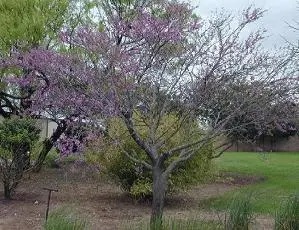
Description:
Texas Redbud grows as a deciduous small tree or multi-trunked shrub, achieving a maximum height of 10-20 feet. It differs from the Eastern Redbud in that the leaves are rounder, thicker, and very glossy. This tree is best known for the spring display of clusters of rose-pink flowers on bare gray branches. The seed pod is a flat, reddish-brown legume that ripens in the fall. Texas Redbud is adapted to the limestone soils of Central Texas, and has limited distribution in Oklahoma and Mexico.
Deer Resistance:
This tree is often browsed, especially where the deer have become overpopulated. As with many trees, deer may rub their antlers on the trunk.
Planting Sites:
Plant in dappled shade, part shade, or full sun in well-drained sites. Space 15-20 feet apart. Do not plant under sprinkler irrigation where it will be watered with the lawn. Alkaline soil is preferred, and acceptable soil types include sand, loam, clay, and limestone.
Planting Instructions:
Dig hole at least 2 times wider, but the same depth as the root ball. Carefully remove the tree from container, supporting the root ball. Gently loosen any compacted soil around roots. Roots may need to be pruned if tightly wound around in pot. Plant tree so that the root collar (bulge right above the root system) is above ground level. Do not add any soil to the top of the root ball. Adding a layer of 3-4 inches of mulch is desirable, but do not allow mulch to touch tree trunk.
Watering Instructions:
If planting in spring: Water in well after planting, using root stimulator according to directions. Water deeply every 7-10 days, checking an inch or two into soil at edge of root ball to determine soil moisture. Skip a watering after a rainfall of ½ to 1 inch.
First fall/winter:
Maintain this watering schedule until the first fall after planting. Reduce water during fall and winter. In a “normal” year, no watering may be necessary in fall and winter, but during a dry period, monthly watering may be desirable.
Second spring and thereafter:
Water monthly only in periods of drought. Once established, Texas Redbud will survive on 10-20 inches of water per year.
Other care:
Needs little care. Is most attractive when allowed to grow naturally, removing only unwanted branches.
NICE! Tip:
Plant Texas Redbud instead of Purple-leaf Plum, ornamental plums, Bradford Pear, Crape Myrtle, Golden Raintree, Chinaberry, or Chinese Tallow.
Look for the NICE! Plant of the Month signs and information sheets on your next visit to a participating Boerne nursery. And thank you for supporting native plants by using them in your landscapes.
