Home » San Antonio » Gardening Tips, Hints and Hacks June 2023
San Antonio Chapter
Gardening Tips, Hints and Hacks June 2023
If you’ve been gardening for any amount of time, you have probably discovered practical gardening practices that work for you here in Central Texas.We’d love for you to share them with us!In coming newsletters, we’ll select and share one or two submissions.Please help us make this new monthly feature a success by sending your submissions to sanantonio@npsot.org.Be sure to include your name, fully describe the gardening tip, and possibly include an illustrative photo.
Create a Little Artificial Shade
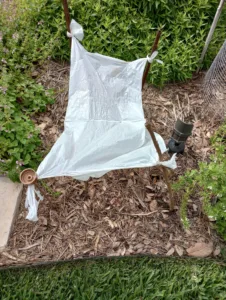
Sometimes when we install a new sun-loving plant, it is not ideal timing.Maybe the temperature spiked early, the nursery only carries that summer blooming plant when at peak bloom, or you otherwise found that perfect plant when we’re having hot, sunny days.Nothing is more alarming than to find your new “full sun” plant wilting by 3 p.m. despite the wet soil, then to your relief, recovering overnight, only to wilt again the following afternoon.Ideally, you’ve “hardened off” the plant.(See, Baby plant boot camp – Garden Style San Antonio).But if you didn’t do this, or the plant was root bound requiring the roots to be significantly disturbed during planting, I’ve found that creating a little shade works wonders until the plant is past the planting shock and the roots are efficiently functioning again. (Submitted by Pam Peck)
Photo by Pam Peck
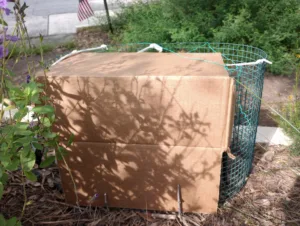
Shade Cages
If you “caged” your tender plant to protect it from critters, you can simply secure a cover across the top and perhaps down the sunny side.Anything that creates shade works –cardboard, a piece of opaque plastic bag, or fabric.Alternatively, you can use four poles and attach the four corners of your covering to them. For poles, I’ve used bamboo,odd metal pieces, and/or recently pruned tree branches.The cover can be as simple as cutting a shopping bag in half, spreading it flat, and utilizing the handles (cut at the halfway point) as ties to the poles.You will want the cover low each to actually create shade and you may even need to angle it to maximize the shade as the sun moves across.I’m sure you can find many other ways to rig up some artificial shade.However you do it, your new plant(s) will thank you as we all benefit from a little shade on a hot summer afternoon! (Submitted by Pam Peck)
Photo by Pam Peck
Gardening Challenge
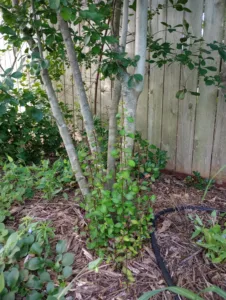
Readers:Please share any suggestions for suppressing root sprouts from a possumhaw holly tree (located in mulched beds).
Photo by Pam Peck
About the Region
This low-elevations region of Texas extends inland from the barrier islands, about 60 or so miles, and stretches from Brownsville to Louisiana. In total, it covers about 9.5 million acres, with a high point of 150 feet in elevation. More than 1000 species of plants can be found in this region. On the southern end, species more common in Mexico (such as Sabal mexicana) and Central America occur.
The barrier islands provide us with dune systems, and clay flats to the inland side, which have species found in these areas alone. Many plants here, such as Ipomoea pes-caprae (beach morning glory), can be found throughout tropical regions of the globe. I’ve encountered the same species on the beaches of Guam.
Once inland, vast marshes and wet prairies occur. Occasionally, oak (Quercus fusiformis) groves can be found. Common grasses include species of Bothriochloa, Paspalum, and Sporobolus; eastern gamagrass (Tripsacum dactyloides); and switchgrass (Panicum species). Many rivers and creeks cut through the Gulf Prairies, and along these riparian areas various species of trees, Sabal minor, and other plants adapted to clay soils can be found. Due to overgrazing, farming, and fire suppression, woody species such as mesquite (Prosopis glandulosa) and huisache (Acacia farnesiana), and invasive species such as chinaberry (Melia azedarach), Brazilian pepper (Schinus terebinthifolius), and Chinese tallow (Sapium sebiferum) have increased and displaced our native flora.