This is the time of year I like to try to find time to sit in the backyard on a sunny day and enjoy the flowers. The bright-yellow areas of goldeneye (Viguiera dentata), Maximilian sunflowers (Helianthus maximiliani), and esperanza (Tacoma sans) are eye-catching indeed, and the big white mounds of thoroughwort (Ageratina havanaensis) are abuzz with bees and butterflies. But what I enjoy most this time of year are all the salvias. I’ve just got a thing about salvias.
Salvias come in nearly every color. Most of the ones we grow are native to Texas or northeastern Mexico. Nearly all of them are drought-tolerant and thrive with little irrigation, and most salvias seem to grow in our poor Glen Rose soil without fertilizer. Besides that, several of the salvias we grow are not even munched on by the overpopulated deer herds that roam our subdivision. Salvias are great.
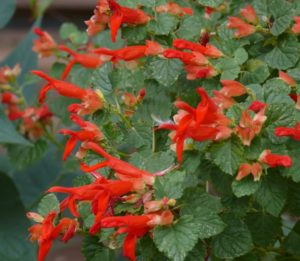
One of my favorites is Salvia regla (mountain sage), which is densely covered with orange-red blooms during the fall. I like to let this salvia grow into a tall woody bush, just as it does in the Chisos Mountains in Big Bend National Park. In fact, I was inspired by the natural plant assemblage in the Chisos to plant some Salvia regla next to our madrone (Arbutus xalapensis) trees. It is a nice combination. Usually our mountain sage also has some blooms in the spring, but fall is when it is at its best.
Other red salvias blooming now are the old native-Texas standbys Salvia greggii (autumn sage) and S. coccinea (tropical sage), the Mexican S. darcyi, and the “Van Houttei” cultivar of the Brazilian S. splendens (scarlet sage). Hummingbirds and butterflies visit them all.
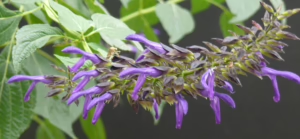
There are several blue salvias blooming in our yard. The most spectacular at the moment is Salvia mexicana (Mexican sage). With all the rain this past summer, our Mexican sage grew nearly nine feet high. Its stalks of dark-blue blooms are a foot long.
Other blue salvias are the local natives mealy sage (Salvia farinacea), giant blue sage (Salvia azurea), shrubby blue sage (Salvia ballotaeflora), and the small, tiny-flowered Salvia reflexa. We also have horticulturally tweaked varieties of mealy sage (such as “Henry Duelberg”) that have thicker foliage and darker-blue flowers than the one that comes up wild in our backyard. Another reliable blue sage is Salvia guaranitica, a South American native that blooms in the shade under our liveoaks. It is highly drought-tolerant. Robust cultivars of this salvia are available in local nurseries. Some varieties have large blue-black flowers. It is one salvia that our whtetail deer never browse.
Also still going strong is the violet-blue Salvia indigo spires, the accidental hybrid created at a botanical garden when bees carried pollen from a Salvia longispicata (a native of southwestern Mexico) to Salvia farinacea. Another salvia with long spires is the purple-flowered Salvia leucantha (Mexican bush sage). Both indigo spires and Mexican bush sage are reliable perennials that are readily available at local nurseries. They rarely fail to bloom even during the drought years.
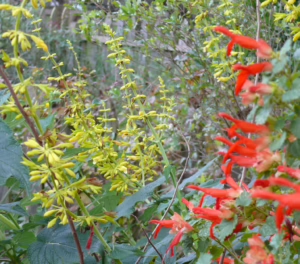
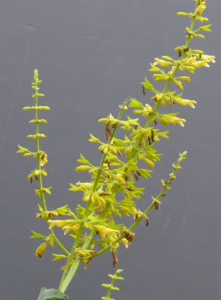
Not all salvias are shades of blue or red. One salvia we grow has one to four long spikes of butter-yellow flowers projecting from the end of each branch. This is Salvia madrensis, named after its native habit, the Sierra Madre Oriental in Mexico. For some reason, the wet summer this year seems to have slowed the growth of S. madrensis. Usually this salvia gets about 7 feet tall in our yard, but this year it is only 3 to 5 feet high.
Another large salvia from the Sierra Madre Oriental with an unusual flower color is Salvia puberula (S. involucrata). This salvia has clusters of large bright-magenta blooms.
So far all of these salvias have come back in the spring after having been frozen to the ground. Salvias are a tough lot and require little care. My kind of yard plant!