


When Kendall County purchased parkland on Little Joshua Creek north of Boerne, the county also might have bought a state champion. On that property is a huge Texas madrone (Arbutus xalapensis), and it may be big enough to beat out the current champion madrone on the remote Estrella Ranch in Uvalde County.
The verdict is still out. Mark Duff, the Texas Forest Service guy who measured the current state champ, has yet to visit the Kendall County giant. He’s coming to take its dimensions soon, according to Steve Lowe, Kendall County Park Naturalist.

This future Kendall County park with the big madrone is not yet open for the public to visit, but the people in charge are working hard to put in the necessary infrastructure as soon as possible. They are very interested in finding out how Kendall County residents would like to see the Little Joshua Creek parkland developed. The next meeting to gather public input on what the new park should provide will be held within the next two months.
The eastern and southern Edwards Plateau is Texas madrone country. In our part of the Hill Country, Madrones are fairly common on many hillsides north and west of Boerne and into Bandera County. Also, I’ve seen it as far east as Canyon Lake and as far south as northern Bexar County. The other hot spot for madrones in Texas is the Trans Pecos region.
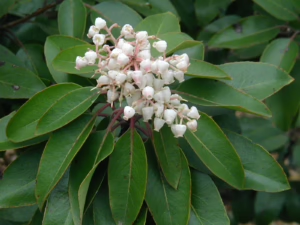
Texas madrone (madroño, madrona, naked Indian) is a native tree or shrub that is too seldom used as a landscape plant. It is a glossy evergreen that has clusters of white lantern-shaped blooms during early summer and red berries in the fall. The most striking thing about the madrone is the reddish-brown bark, which peels off to reveal a smooth rusty-pink underbark.
One reason that Texas madrones are not seen more commonly in Hill Country yards is that few wholesale nurseries raise them. Although nursery men such as Chuck Janzow and others are very successful in propagating madrones from seeds, these trees have a bad reputation for being difficult to cultivate. Indeed, Chuck Janzow told me he has come to expect customers to say, “Remember that madrone you sold me? It died.” That kind of response has discouraged nurseries from selling madrones.
I wonder if their bad reputation is not a little exaggerated and the fault lies with the planter. During the past several years, I’ve planted five small madrone trees, two in our yard, one in the Griffis’ yard across the street, and two in the botanical garden at Cibolo Nature Center. They are all alive and growing well. The ones in our backyard are over ten years old.
To plant those madrones, I did not dig a hole, but instead built up a sort of rock “pot” about a foot high. I planted the little madrones in these “pots” in porous soil. Then I watered the madrones once, but not again. Well, to tell the truth, once or twice during the worst droughts I did give them a little water from the hose. They all have protection from the hottest afternoon sun and from deer browsing.
Madrones have roots without root hairs and depend on a symbiotic relationship with certain mycorrhizal fungi to absorb nutrients from the soil. Some growers like to inoculate the soil around madrones with soil dug from under Ashe junipers. In nature, Ashe junipers (“cedars”) seem to be nursery trees for natural propagation of madrones.
Young madrones are heavily browsed by deer. Probably the stress from deer browsing is keeping native population of madrones from regenerating in many places. With increasing suburbanization in the Hill Country, the population of these beautiful native trees is likely to steadily decline.
In her book “How to Grow Native Plants of Texas and the Southwest”, Jill Nokes pleads “that the Texas madrone be cherished and fiercely protected where it grows in nature, and that even scrawny trees be provided protection from browsing, bulldozers, trampling, and crowding.”
