


Mid-winter is the only time of year I do not enjoy being out of doors. Cold north winds and leafless trees do not inspire me to take walks in the woods or even to work around the yard.
Winter is the time of year I least resent all the time I have to spend in front of the computer screen.
On the other hand, this is the time of year when I appreciate how many native plants do provide some wintergreen to the Central Texas countryside. Besides the obvious liveoak and Ashe juniper (“cedar”), there are quite a few other trees, bushes and vines that keep their leaves through Hill Country winters.
Thankfully, our yard has enough evergreen native plants that the winter landscape is not so bleak. And with the ever-increasing number of houses popping up in the hills behind us, I am grateful for every evergreen screen our backyard plants provide.
Besides our very old front yard liveoaks, the evergreen trees of which I’m proudest are our two medium-size Texas madrones (Arbitus xalapensis).
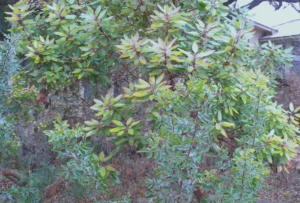
A native shrub that grows fairly fast in our yard is evergreen sumac (Rhus virens). It thrives in part shade to full sun, and, if necessary, its shape and size can be controlled by clipping and trimming.
Evergreen sumac is browsed by deer in many yards around the Boerne area, so caging is necessary. Local nurseries commonly have evergreen sumac in stock.
Another local shrub that provides an evergreen screen is Lindheimer’s silktassel (Garrya ovata subsp. lindheimeri). Deer rarely browse silktassel, but a couple of small silktassels in our yard were thoroughly thrashed by a buck this winter. Especially during November and December, small trees and bushes need protection from rutting bucks.
Cenizo (Leucophyllum frutescens) provides evergreen or evergray foliage, according to the variety. This hardy shrub is widely available in nurseries.
Usually, cenizo is not browsed by deer, but in our neighborhood, some bucks like to shred it with their horns during rutting season.
One evergreen shrub deer don’t bother is the holly-like agarita (Berberis trifoliata). Agarita’s cousin, Texas barberry (Berberis swayseyi), is another nice evergreen shrub, and its leaves may turn red or darker green during fall.
Both these Berberis species are resistant to drought and grow in part shade to full sun.
Texas barberry is less commonly available at nurseries. Texas mountain laurel (Sophora secundiflora) is perhaps the most widely favorite native evergreen grown in Central Texas yards. We have several and enjoy the year-round privacy their foliage provides to certain parts of our yard.
Yaupon holly (Ilex vomitoria) is a longtime favorite evergreen shrub for landscaping. In the wild in the eastern Hill Country, it is much less common than possumhaw or deciduous holly (Ilex deciduas), but it is widely used as a yard plant in this area.
Wax myrtle (Myrica cerifera) is another evergreen shrub or small tree that is growing well in some Hill Country yards, even though it is an East Texas native. It may require a little extra watering during very dry periods.
Of the many salvias we grow, the only one that keeps its leaves all winter is Salvia greggii.
Our evergreen “accent plants” include beargrass (Nolina texana), devil’s shoestring (Nolina lindheimeriana), Texas sotol (Dasylirion texanum), Buckley’s yucca (Yucca constricta), twist-leaf yucca (Yucca rupicola), Spanish dagger (Yucca treculeana), red yucca (Hesperaloe parviflora), century plants (Agave spp.), palmetto (Sabal minor) and a variety of cacti.
The evergreen or almost-evergreen native vines we have in our yard are crossvine (Bignoniacapreolata), Carolina jessamine (Gelsemium sempervirens), and coral honeysuckle (Lonicera sempervirens). The vine-like shrub Mexican butterfly vine (Mascagnia macroptera) is another good evergreen garden plant.
Besides the large variety of evergreen plants we have, there is another thing I truly appreciate about the mid-winter landscape in our yard – the dead-brown color of the Bermuda grass and KR bluestem?
