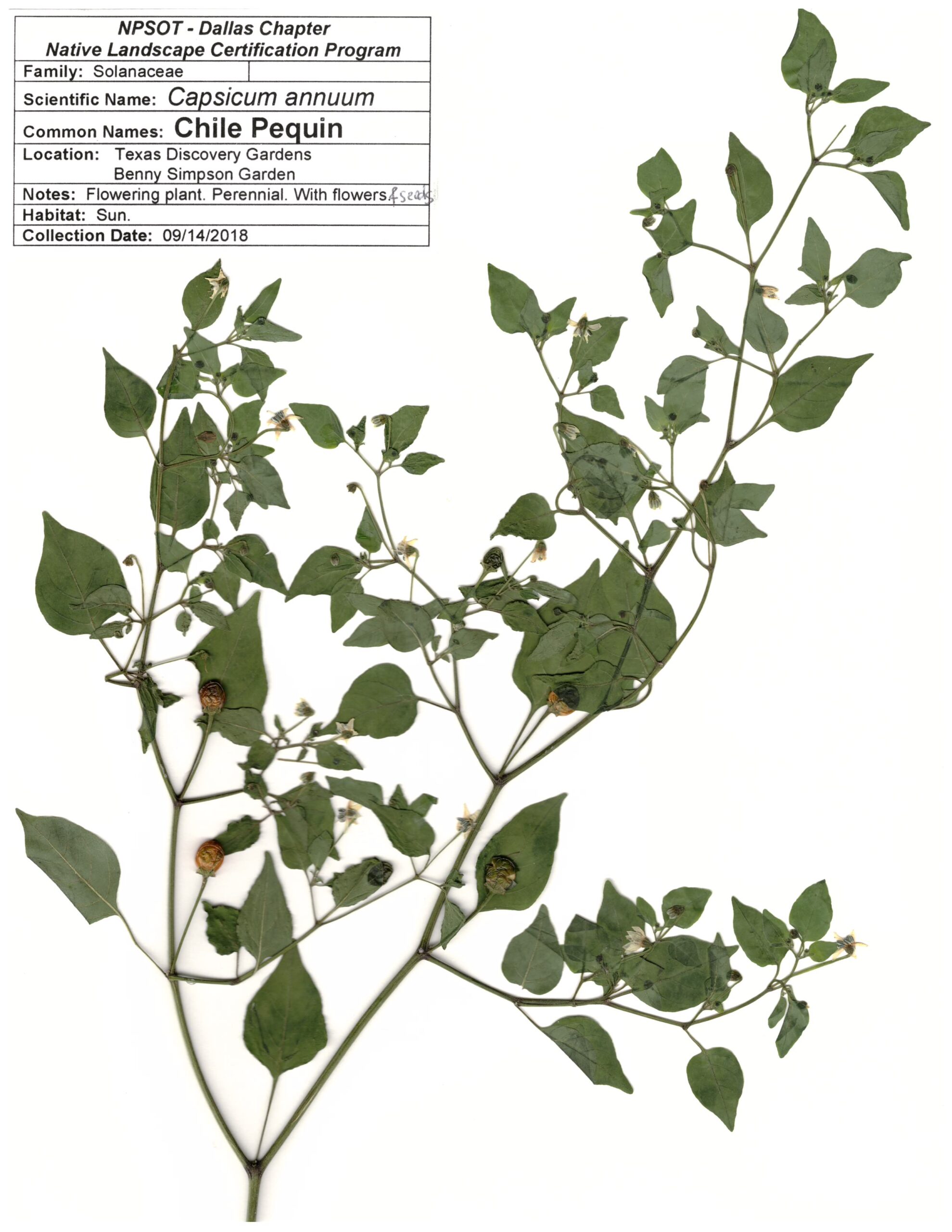
Chile Pequin

Capsicum annuum

Other common name(s):

Chile Pequin, Chile Tepin, Bird Pepper, Turkey Pepper, Cayenne Pepper, Chili Pepper

Family:

Solanaceae (Nightshade Family)

Plant Ecoregion Distribution Map

This map uses data from the US EPA. EPA  servers have been offline frequently so maps may not display. We are working on a solution.

East Central Texas Plains, Edwards Plateau, Gulf Coast Prairies and Marshes, Southern Texas Plains, Texas Blackland Prairies
Southern Post Oak Savanna
Balcones Canyonlands
Coastal Sand Plain, Floodplains and Low Terraces4, Laguna Madre Barrier Island and Coastal Marshes, Lower Rio Grande Alluvial Floodplain, Lower Rio Grande Valley, Mid-Coast Barrier Islands and Coastal Marshes, Northern Humid Gulf Coastal Prairies, Southern Subhumid Gulf Coastal Prairies
Northern Nueces Alluvial Plains, Rio Grande Floodplain and Terraces, Semiarid Edwards Bajada, Texas-Tamaulipan Thornscrub
Northern Blackland Prairie

Plant Characteristics

Growth Form

Herbaceous

Height

2
to
3
ft.

Spread

2
to
2
ft.

Leaf Retention

Deciduous

Lifespan

Perennial

Habitat and Care Requirements

Soil Type(s)

Sand, Loam, Clay, Limestone, Caliche, Moist

Light Requirement

Sun, Part Shade, Shade

Water Requirement

Low

Native Habitat

Woodland, Wetland or Riparian

Bloom and Attraction

Bloom Color

White

Bloom Season

Spring, Summer, Fall

Seasonal Interest

Fruit, Nectar

Wildlife Benefit

Birds, Nectar Insects, Bees

Maintenance

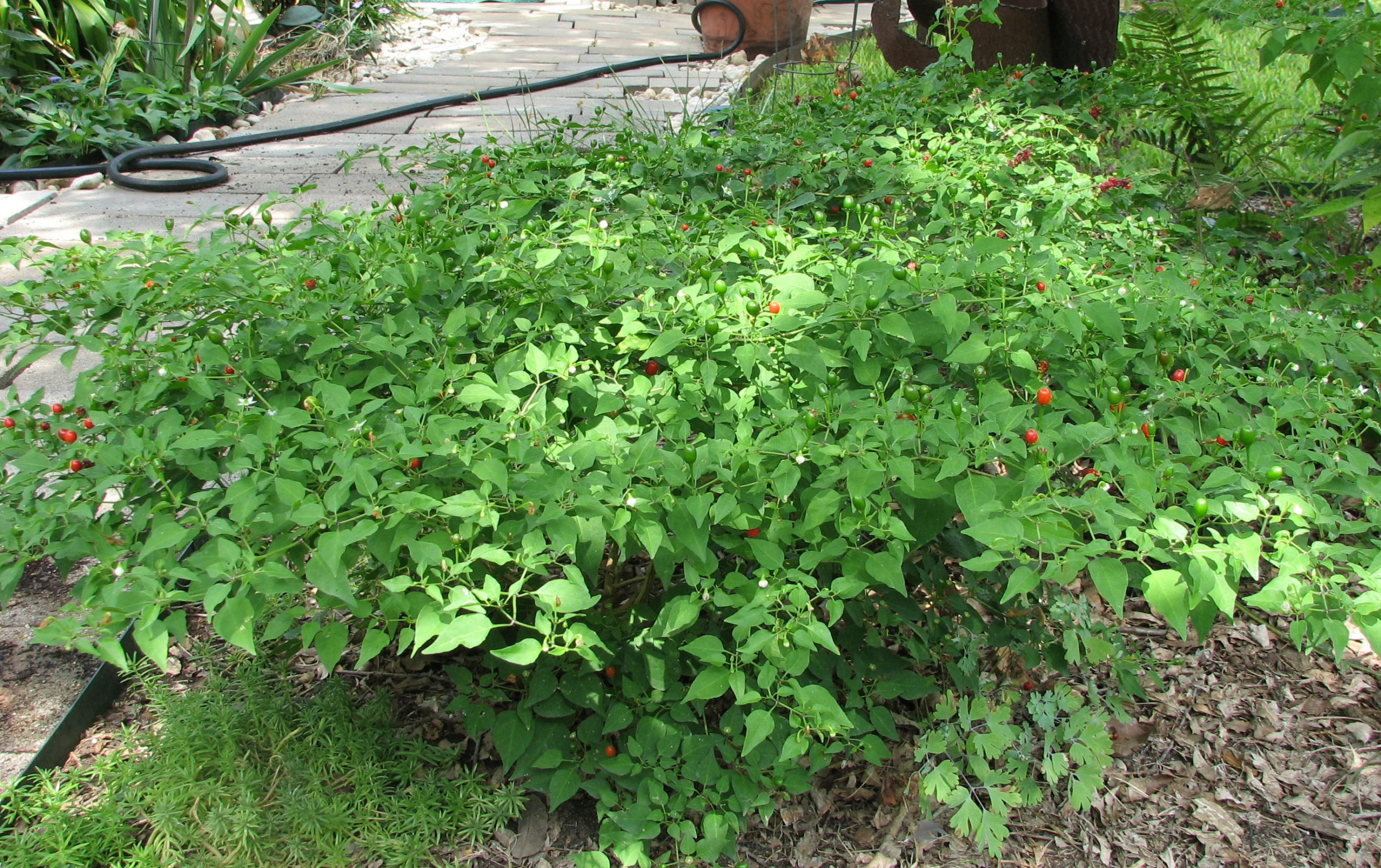
Can act as an annual in cooler regions or perennial in warmer regions. Easy to grow. Looks nice as mass planting. Cut back to 3″ just before spring growth. Can be grown in container gardens. Native habitat: ledges along rivers, thickets and groves, along arroyos on the Edwards Plateau and in South Texas. There are many cultivars, which are not covered here. Propagation: seed, cutting.

Comments

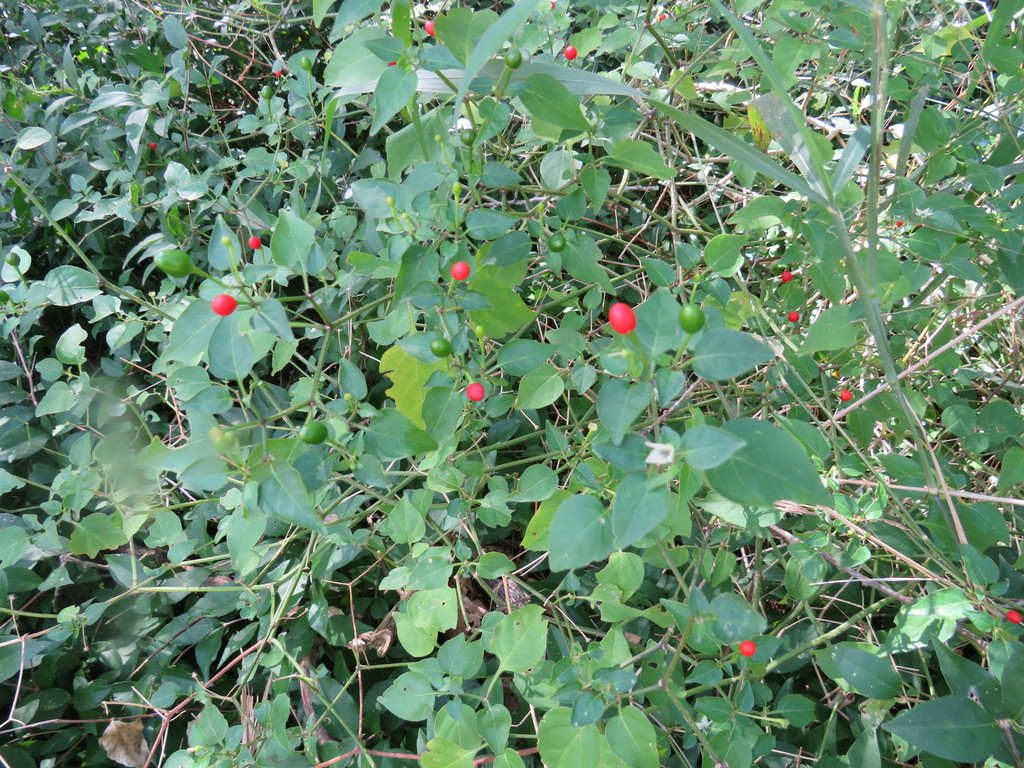
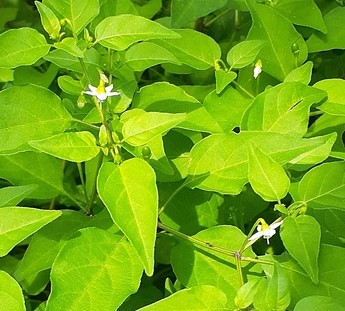
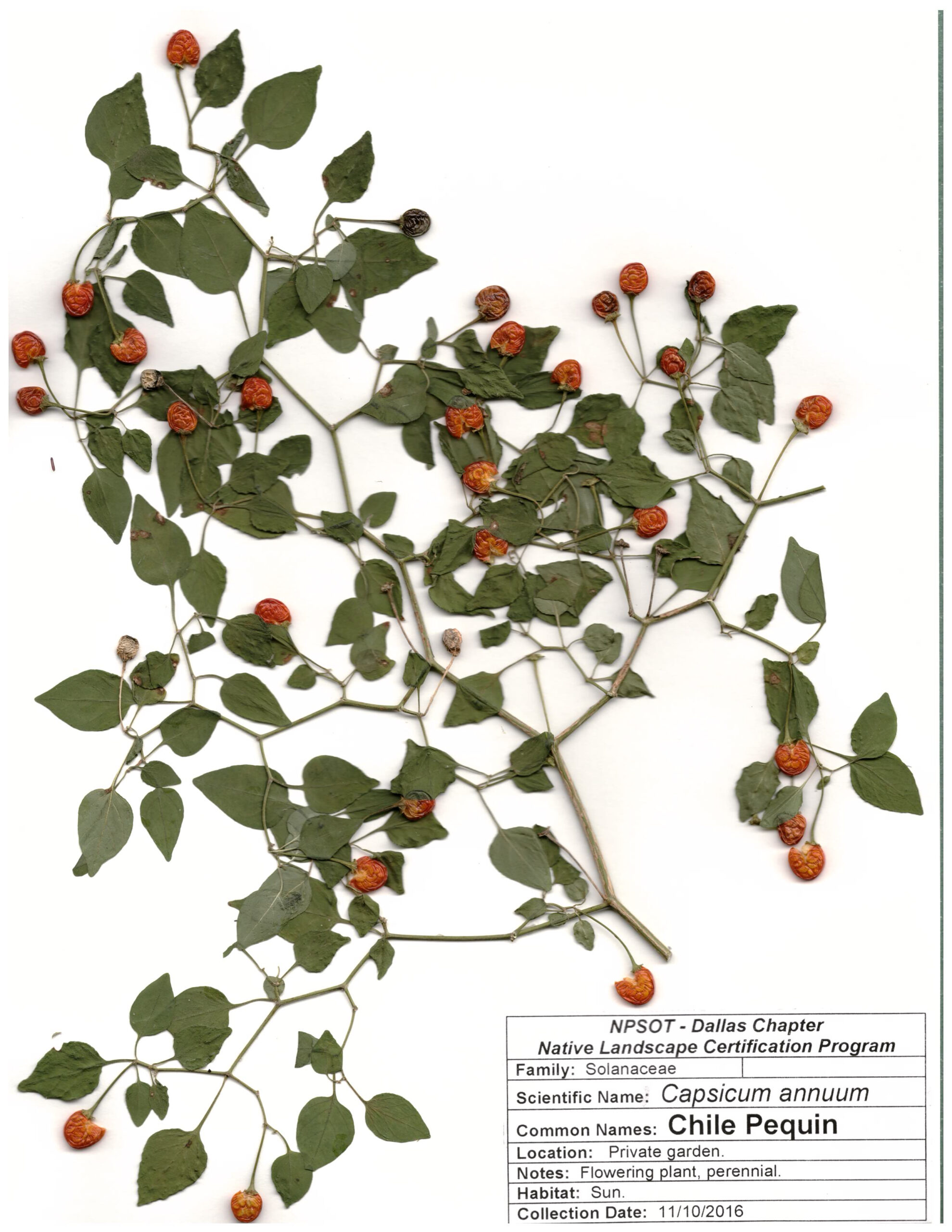
Blooms May-October. It has a bush-like form but is not woody. In the absence of frost it can grow as perennial. Leaves are oval to lance-shaped, with smooth margins. Flowers are star- or bell-shaped with 4–5 petals, usually solitary but can sometimes occur in small clusters. The fruit is a small round to oval berry that turns from green to red. Birds love the fruit, they are not bothered by the spicy taste.
Previous Scientific Name(s): Capsicum annuum var. aviculare, Capsicum annuum var. minimum, Capsicum annuum var. minus, Capsicum baccatum, Capsicum frutescens
Material Treatment Method Collection References
Seed Scarification Soak the seeds of capsicum annuum var. conoides in lukewarm water overnight to enhance germination. This softens the seed coat and prompts the germination process. Plant the seeds of capsicum annuum var. conoides in a well-draining seed starting mix, approximately 1/4 inch deep. Cover lightly with soil, and gently water the mix, keeping it evenly moist but not waterlogged. Keep the seed trays in a warm location (about 70-85°F or 21-29°C) with indirect light. Capsicum annuum var. conoides seeds typically germinate in 7-14 days under optimal conditions. Once the seedlings of capsicum annuum var. conoides emerge, provide them with stronger light, such as a sunny window or a grow light. Water them regularly to keep the soil moist, and begin fertilizing with a balanced, diluted fertilizer every two weeks. Choose high-quality seeds of capsicum annuum var. conoides, ensuring they are disease-free and harvested from mature fruits. This ensures a better germination rate and healthier seedlings. https://www.picturethisai.com/care/propagate/Capsicum_annuum_var._conoides.html
Seed No Treatment Sow the seeds indoors 6-8 weeks before the last frost date. Keep the soil warm and moist until germination occurs, then transplant the seedlings outdoors or into larger pots. https://earthone.io/plant/capsicum%20annuum?srsltid=AfmBOopwiyJ5NopHi3f5dyXvaZ2aWP6vqH3PC9D5ZTMPiXBVq36oP3Xo

About the Region

Fall Symposium 2025 Logo - Teach for the Future

Salado, the location of our Fall 2025 Symposium, lies at the intersection of two ecoregions: the Edwards Plateau (Limestone Cut Plain) and Blackland Prairie (Northern Blackland Prairie).

The Edwards Plateau area is also called the Hill Country; however, this general term covers a much larger area extending farther north. Spring-fed creeks are found throughout the region; deep limestone canyons, rivers, and lakes (reservoirs) are common. Ashe juniper is perhaps the most common woody species found throughout the region. Additional woody species include various species of oak, with live oak (Quercus fusiformis) being the most common. Sycamores (Platanus occidentalis) and bald cypress (Taxodium distichum) border waterways. This area is well known for its spring wildflower displays, though they may be viewed in spring, late summer, and fall, as well. According to Texas Parks and Wildlife, average annual rainfall in the Edwards Plateau ranges from 15 to 34 inches.

The Blackland Prairie extends from the Red River south to San Antonio, bordered on the west by the Edwards Plateau and the Cross Timbers, and on the east by the Post Oak Savannah. Annual rainfall averages 30 to 40 inches, with higher averages to the east. This region is dominated by prairie species. The most common grass species include little bluestem (Schizachyrium scoparium) and Indian grass (Sorghastrum nutans) in the uplands and switchgrass (Panicum virgatum) in the riparian areas and drainages. Common herbaceous flowering plants include salvias, penstemons, and silphiums. This area has suffered greatly from overgrazing and agricultural use. Few intact areas remain, though many of the plants can be found along county roadsides throughout the region.

Our fall Symposium host chapter, the Tonkawa Chapter, includes both of these ecoregions.

Source: Wildflowers of Texas by Michael Eason