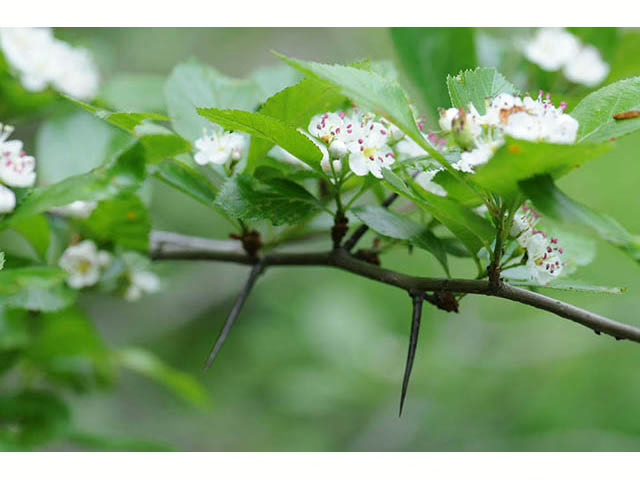


Cockspur Hawthorn

Crataegus crus-galli

Other common name(s):

Bush Hawthorn, Cockspur Thorn, Newcastle Hawthorn, Newcastle Thorn, Hog Apple

Family:

Rosaceae (Rose Family)

Plant Ecoregion Distribution Map

This map uses data from the US EPA. EPA  servers have been offline frequently so maps may not display. We are working on a solution.

Cross Timbers, East Central Texas Plains, Edwards Plateau, Texas Blackland Prairies, Western Gulf Coastal Plain
Eastern Cross Timbers, Grand Prairie, Limestone Cut Plain
Southern Post Oak Savanna
Balcones Canyonlands, Edwards Plateau Woodland, Llano Uplift
Floodplains and Low Terraces1, Northern Blackland Prairie, Southern Blackland Prairie
Flatwoods, Southern Tertiary Uplands

Plant Characteristics

Growth Form

Tree

Height

20
to
30
ft.

Spread

20
to
30
ft.

Leaf Retention

Deciduous

Lifespan

Perennial

Habitat and Care Requirements

Soil Type(s)

Sand, Loam, Clay, Moist

Light Requirement

Sun, Part Shade, Shade

Water Requirement

Low

Native Habitat

Woodland, Wetland or Riparian

Bloom and Attraction

Bloom Color

White

Bloom Season

Spring

Seasonal Interest

Fruit, Fall Color, Nectar, Pollen, Larval Host

Wildlife Benefit

Butterflies, Birds, Small Mammals, Bees

Maintenance

Densely set branches make it difficult to grow grasses underneath. Thicket forming. Glossy foliage which turns bright orange or red in fall. Native Habitat: limestone regions, growing in fertile or rocky ground in thickets and pastures, and in open woodland along small streams.

Comments

Blooms May-June. Short trunk with exfoliating bark. Horizontal, thorny branches sweep the ground. Produces shiny dark green, spoon-shaped leaves. Profuse clusters of white flowers are followed by small, red “apples,” persistent until January. Larval host: Striped Hairstreak, Banded Hairstreak, Soapberry Hairstreak, King’s Hairstreak, Gray Hairstreak.
Previous Scientific Name(s): Crataegus acutifolia, Crataegus acutifolia var. insignis, Crataegus algens, Crataegus barrettiana, Crataegus bushii, Crataegus canbyi, Crataegus cherokeensis, Crataegus cocksii, Crataegus crus-galli var. barrettiana, Crataegus crus-galli var. bellica, Crataegus crus-galli var. capillata, Crataegus crus-galli var. exigua, Crataegus crus-galli var. leptophylla, Crataegus crus-galli var. macra, Crataegus crus-galli var. oblongata, Crataegus crus-galli var. pachyphylla, Crataegus crus-galli var. pyracanthifolia, Crataegus danielsii, Crataegus denaria, Crataegus fecunda, Crataegus fontanesiana, Crataegus hannibalensis, Crataegus mohrii, Crataegus operta, Crataegus palliata, Crataegus palmeri, Crataegus permixta, Crataegus pyracanthoides, Crataegus regalis, Crataegus regalis var. paradoxa, Crataegus sabineana, Crataegus schizophylla, Crataegus signata, Crataegus subpilosa, Crataegus tantula, Crataegus tenax, Crataegus triumphalis, Crataegus uniqua, Crataegus vallicola
Material Treatment Method Collection References
Seed Stratification It should be warm stratified for 3 months at 15°c and then cold stratified for another 3 months at 4°c. It may still take another 18 months to germinate. It is best to pot up the seedlings as soon as they are large enough to handle and grow them in individual pots for their first year, planting them out in late spring into nursery beds or their final positions. When growing larger quantities, it might be best to sow them directly outdoors in a seedbed, but with protection from mice and other seed-eating creatures. Grow them in the seedbed until large enough to plant out, but undercut the roots if they are to be left undisturbed for more than two years. 1) https://pfaf.org/user/Plant.aspx?LatinName=Crataegus+crus-galli#:~:text=Plant%20Propagation&text=Stored%20seed%20can%20be%20very,for%20more%20than%20two%20years. 2) https://www.picturethisai.com/care/propagate/Crataegus_crus-galli.html
Softwood Cutting Ensure that cuttings and seedlings of cockspur hawthorn receive sufficient light, as inadequate light can weaken plants and decrease the chances of successful propagation. Applying bottom heat to cuttings can promote quicker root development, which is critical for the successful propagation of cockspur hawthorn. Employ a well-draining rooting medium to maintain proper moisture levels and prevent rot in cuttings of cockspur hawthorn. Can be taken in early summer. Choose a disease-free, vigorous parent plant for obtaining cuttings or to ensure the best start for propagation. 1) https://www.picturethisai.com/care/propagate/Crataegus_crus-galli.html 2) https://earthone.io/plant/crataegus%20crus-galli
Seed Scarification Scarify the seed before stratifying it might reduce this time. Fermenting the seed for a few days in its own pulp may also speed up the germination process. It is best to pot up the seedlings as soon as they are large enough to handle and grow them in individual pots for their first year, planting them out in late spring into nursery beds or their final positions. When growing larger quantities, it might be best to sow them directly outdoors in a seedbed, but with protection from mice and other seed-eating creatures. Grow them in the seedbed until large enough to plant out, but undercut the roots if they are to be left undisturbed for more than two years. Another possibility is to harvest the seed 'green' (as soon as the embryo has fully developed but before the seedcoat hardens.
Seed No Treatment Sow it immediately in a cold frame. If timed well, it can germinate in the spring. If you are only growing small quantities of plants. It is best to pot up the seedlings as soon as they are large enough to handle and grow them in individual pots for their first year, planting them out in late spring into nursery beds or their final positions. When growing larger quantities, it might be best to sow them directly outdoors in a seedbed, but with protection from mice and other seed-eating creatures. Grow them in the seedbed until large enough to plant out, but undercut the roots if they are to be left undisturbed for more than two years.

About the Region

Fall Symposium 2025 Logo - Teach for the Future

Salado, the location of our Fall 2025 Symposium, lies at the intersection of two ecoregions: the Edwards Plateau (Limestone Cut Plain) and Blackland Prairie (Northern Blackland Prairie).

The Edwards Plateau area is also called the Hill Country; however, this general term covers a much larger area extending farther north. Spring-fed creeks are found throughout the region; deep limestone canyons, rivers, and lakes (reservoirs) are common. Ashe juniper is perhaps the most common woody species found throughout the region. Additional woody species include various species of oak, with live oak (Quercus fusiformis) being the most common. Sycamores (Platanus occidentalis) and bald cypress (Taxodium distichum) border waterways. This area is well known for its spring wildflower displays, though they may be viewed in spring, late summer, and fall, as well. According to Texas Parks and Wildlife, average annual rainfall in the Edwards Plateau ranges from 15 to 34 inches.

The Blackland Prairie extends from the Red River south to San Antonio, bordered on the west by the Edwards Plateau and the Cross Timbers, and on the east by the Post Oak Savannah. Annual rainfall averages 30 to 40 inches, with higher averages to the east. This region is dominated by prairie species. The most common grass species include little bluestem (Schizachyrium scoparium) and Indian grass (Sorghastrum nutans) in the uplands and switchgrass (Panicum virgatum) in the riparian areas and drainages. Common herbaceous flowering plants include salvias, penstemons, and silphiums. This area has suffered greatly from overgrazing and agricultural use. Few intact areas remain, though many of the plants can be found along county roadsides throughout the region.

Our fall Symposium host chapter, the Tonkawa Chapter, includes both of these ecoregions.

Source: Wildflowers of Texas by Michael Eason