
Narrowleaf Gumweed

Grindelia lanceolata

Other common name(s):

Fall Gumweed

Family:

Asteraceae (Aster Family)

Plant Ecoregion Distribution Map

This map uses data from the US EPA. EPA  servers have been offline frequently so maps may not display. We are working on a solution.

Cross Timbers, Edwards Plateau, Texas Blackland Prairies, Western Gulf Coastal Plain
Carbonate Cross Timbers, Eastern Cross Timbers, Grand Prairie, Limestone Cut Plain, Western Cross Timbers
Balcones Canyonlands
Floodplains and Low Terraces1, Northern Blackland Prairie
Flatwoods, Southern Tertiary Uplands

Plant Characteristics

Growth Form

Herbaceous

Height

1
to
5
ft.

Spread

1.5
to
2
ft.

Leaf Retention

Deciduous

Lifespan

Perennial

Habitat and Care Requirements

Soil Type(s)

Sand, Gravelly, Rocky, Shallow, Well Drained

Light Requirement

Sun

Water Requirement

Low, Medium

Native Habitat

Grassland

Bloom and Attraction

Bloom Color

Yellow

Bloom Season

Summer, Fall

Seasonal Interest

Seeds, Pollen

Wildlife Benefit

Birds, Bees

Maintenance

Drought tolerant. Good for for pollinator gardens, pollinator or butterfly gardens, xeriscape, restoration, naturalization. Native habitat: limestone glades and rocky prairies, calcareous beach deposits.

Comments

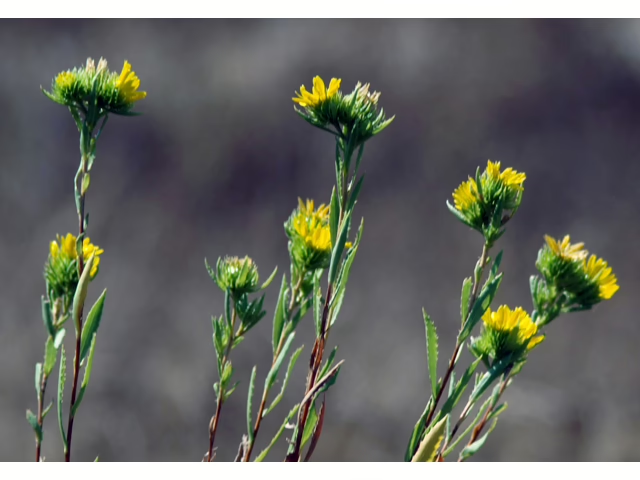
Blooms June-October. Stem erect. Leaves triangular, ovate, or oblong to lance-shaped. Can grow as short-lived perennial or biennial depending on the region. produces yellow flower heads in the summer, usually in flat-topped arrays but sometimes only one per flower stalk. Each head contains 12-36 ray flowers surrounding numerous disc flowers. Flower bracts have sticky resin.
Previous Scientific Name(s): Grindelia littoralis, Grindelia texana, Grindelia lanceolata var. lanceolata, Grindelia lanceolata var. texana, Grindelia texana var. lanceolata
Material Treatment Method Collection References
Seed No Treatment Sow autumn or spring in a cool greenhouse and only just cover the seed. Prick out the plants into individual pots when they are large enough to handle and plant them out into their permanent positions in early summer. https://pfaf.org/user/Plant.aspx?LatinName=Grindelia+lanceolata#:~:text=Plant%20Propagation,Cuttings.
Clump Division Division as new growth commences in the spring. Very easy, larger clumps can be replanted direct into their permanent positions, though it is best to pot up smaller clumps and grow them on in a cold frame until they are rooting well. Plant them out in the spring. https://pfaf.org/user/Plant.aspx?LatinName=Grindelia+lanceolata#:~:text=Plant%20Propagation,Cuttings.
Seed Stratification Propagation is easiest from seed, and germination rates are generally high. Achenes placed under a thin layer of soil on wet filter paper at ambient temperature and diffuse light germinate at around 70%, but an 8-day cool pretreatment at 46°F can raise these rates slightly. Germination usually occurs at 2 to 3 weeks at 50–60°F. Seed can be propagated in containers and transplanted, or sown directly on-site in the fall or spring, though October plantings tend to produce higher yields with lower irrigation requirements. https://plants.usda.gov/DocumentLibrary/plantguide/pdf/pg_grca.pdf
Seed Scarification Place a sheet of sandpaper (medium grit) with the sandy side up in a beer or soda box (one with short sides) on a smooth or hard surface. Place the seeds to be scarified on the sandpaper. Now rub the seeds between the sandpaper for about ½ to 1 minute to wear holes in the impermeable surface of the seed. A second method that works well with about 1/3 to 1 cup of seeds is to place the seeds in a blender and hit the low speed touch blend button several times. Let the blender speed almost reach the maximum of its low setting. The following are some general steps to follow when germination seeds indoors. 1. Use flats, pots, or trays that are about three inches deep. There should be drainage holes in the bottoms of the containers. The containers should be new or else used containers should be soaked in 10% Clorox solution. 2. Fill the container to the top with a moist soil less growing medium and level off. Use a germination mix if possible that contains small particles. There are many soil less mixes on the market that contain predominantly peat moss and vermiculite. The important thing they lack is weed seeds and the fungi that cause damping off of the seedlings. 3. Using a board, hand, or other flat surface mash the loose potting mixture down about ¼ to ½ inch below the top of the container. 4. Sow seeds on the surface of the mix. Small seeds can be evenly scattered over the surface. Shaking them from a saltshaker may help. Larger seeds can also be scattered on the surface or planted in rows. 5. Cover the seeds to a depth that is about twice their diameter. Very small seeds like cardinal flower need no covering at all. The same fine particle germinating mix or fine sifted sphagnum or peat moss can be used to cover seeds. 6. Clearly label and date the seeds in a way that the writing will not be washed away by water. 7. Large and small seeds can be watered from above with a watering can that dispenses small drops. Large droplets tend to splash the seeds around a lot. It is often recommended that small seeds be watered from below by placing a container in a pan of water and letting the mix soak up the water. 8. Many people lay a piece of glass or plastic over the surface of the container to keep the seeds moist until they just begin to germinate. If this is done, don’t keep the seeds in direct sunlight or they may become too warm. The 3 inches of germination mix holds enough water to keep the surface moist during most of a 24 hr period without the use of a glass or plastic covering. This is assuming the air is still and sunlight is not intense. www.missouribotanicalgarden.org/Portals/0/Shaw%20Nature%20Reserve/PDFs/horticulture/Propagation.pdf

About the Region

Fall Symposium 2025 Logo - Teach for the Future

Salado, the location of our Fall 2025 Symposium, lies at the intersection of two ecoregions: the Edwards Plateau (Limestone Cut Plain) and Blackland Prairie (Northern Blackland Prairie).

The Edwards Plateau area is also called the Hill Country; however, this general term covers a much larger area extending farther north. Spring-fed creeks are found throughout the region; deep limestone canyons, rivers, and lakes (reservoirs) are common. Ashe juniper is perhaps the most common woody species found throughout the region. Additional woody species include various species of oak, with live oak (Quercus fusiformis) being the most common. Sycamores (Platanus occidentalis) and bald cypress (Taxodium distichum) border waterways. This area is well known for its spring wildflower displays, though they may be viewed in spring, late summer, and fall, as well. According to Texas Parks and Wildlife, average annual rainfall in the Edwards Plateau ranges from 15 to 34 inches.

The Blackland Prairie extends from the Red River south to San Antonio, bordered on the west by the Edwards Plateau and the Cross Timbers, and on the east by the Post Oak Savannah. Annual rainfall averages 30 to 40 inches, with higher averages to the east. This region is dominated by prairie species. The most common grass species include little bluestem (Schizachyrium scoparium) and Indian grass (Sorghastrum nutans) in the uplands and switchgrass (Panicum virgatum) in the riparian areas and drainages. Common herbaceous flowering plants include salvias, penstemons, and silphiums. This area has suffered greatly from overgrazing and agricultural use. Few intact areas remain, though many of the plants can be found along county roadsides throughout the region.

Our fall Symposium host chapter, the Tonkawa Chapter, includes both of these ecoregions.

Source: Wildflowers of Texas by Michael Eason