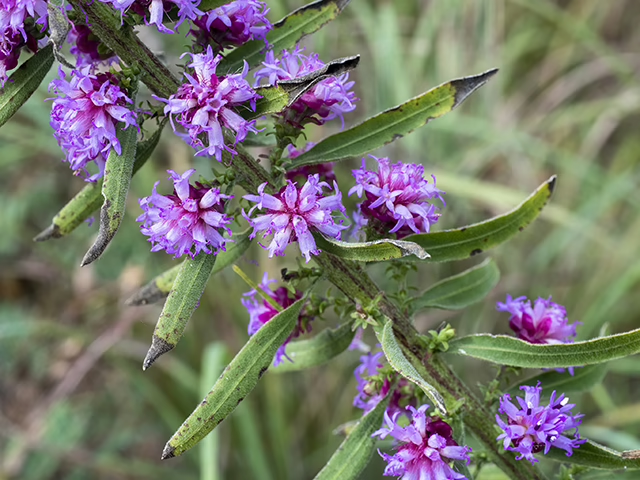

Tall Blazing Star

Liatris aspera

Other common name(s):

Tall Gayfeather, Tall Liatris, Rough Blazing Star, Rough Gayfeather, Rough Liatris, Button Snakeroot

Family:

Asteraceae (Aster Family)

Plant Ecoregion Distribution Map

This map uses data from the US EPA. EPA  servers have been offline frequently so maps may not display. We are working on a solution.

East Central Texas Plains, Gulf Coast Prairies and Marshes, Texas Blackland Prairies, Western Gulf Coastal Plain
Bastrop Lost Pines, Floodplains and Low Terraces2, Northern Post Oak Savanna, Northern Prairie Outliers, San Antonio Prairie, Southern Post Oak Savanna
Northern Humid Gulf Coastal Prairies
Floodplains and Low Terraces1, Northern Blackland Prairie, Southern Blackland Prairie
Flatwoods, Floodplains and Low Terraces3, Pleistocene Fluvial Terraces, Red River Bottomlands, Southern Tertiary Uplands, Tertiary Uplands

Plant Characteristics

Growth Form

Herbaceous

Height

2
to
3
ft.

Spread

1
to
1.5
ft.

Leaf Retention

Deciduous

Lifespan

Perennial

Habitat and Care Requirements

Soil Type(s)

Sand, Loam, Clay, Rocky, Shallow, Dry

Light Requirement

Sun

Water Requirement

Low

Native Habitat

Grassland, Woodland

Bloom and Attraction

Bloom Color

Pink, Purple

Bloom Season

Summer

Seasonal Interest

Seeds, Nectar, Pollen

Wildlife Benefit

Butterflies, Birds, Small Mammals, Nectar Insects, Hummingbirds, Bees

Maintenance

Very drought tolerant. Intolerant of wet soils in winter. Landscape uses include perennial borders, cutting gardens, naturalized areas, pollinator gardens. One of the last blazing stars to bloom in the fall, providing late season food for pollinators. Makes good cut flowers. Native habitat: dry prairies, sand dunes, fields, stream bottoms, sandstone outcrops, limestone ridges, oak-juniper and oak-pine woodlands, Aphids, thrips, and whiteflies are minor Liatris pests. Common diseases include powdery mildew, rust, leafspots, and wilts. These diseases can be controlled by cultural management and chemical applications. Wildlife pests include voles that consume or hoard corms. Rabbits and deer will eat young shoots.

Comments

Blooms August-September. Erect, slightly zig-zag stem. Leaves are numerous on the stem, narrowly lance-shaped, with the lower leaves larger, becoming smaller and narrower higher on the plant. This species is distinguished by its roughness and rounded bracts. A spike of rounded, rayless, pinkish to lavender (sometimes white) flower heads occur along stiff erect stems covered with grayish hairs.
Previous Scientific Name(s): Lacinaria aspera, Liatris aspera var. aspera, Liatris aspera var. intermedia, Liatris aspera var. salutans, Lacinaria squarrosa var. intermedia
Material Treatment Method Collection References
Seed Stratification Blazing star seed usually germinates readily. Four to six weeks of cold, moist stratification is helpful. Sow the stratified seed ¼ inch deep into transplanting containers two months before the last frost freeze date and grow in the greenhouse. Takes 5.5 months to grow out seedling transplants under greenhouse conditions. Seedlings will be ready for transplanting when they become root bound with vigorous root growth and small corm. Place plants in a shade house for approximately two weeks to harden off before transplanting. Transplant the seedlings at 8 inch intervals into rows in a firm, weed free seedbed. Harvest seed in October. 1) https://mowildflowers.net/liatris-aspera-rough-blazing-star-1/#:~:text=Liatris%20aspera%20(Rough%20Blazing%20Star) 2) https://plants.usda.gov/DocumentLibrary/plantguide/pdf/pg_lias.pdf
Clump Division Divide the corms so each one has a growth point. Treat the corms with fungicide and store in slightly moist sphagnum peat moss at 28-30°F for 10 weeks of cold storage before replanting the following spring. Do not allow the corms to thaw and refreeze or dry out during cold storage. After freezing, the corms can be stored up to 2 weeks at 40-45°F before replanting. Plant corms 1” deep into a firm, weed free seedbed using a planting rate of no more than 4 corms per square foot. Water corms as needed for the first three weeks after planting to provide a moderately moist soil and promote sprouting. Afterwards, allow the soil to dry between waterings as a constantly saturated soil will promote root rot development. Divide corms of older tall blazing star plants in the fall after stem die-back. https://plants.usda.gov/DocumentLibrary/plantguide/pdf/pg_lias.pdf

About the Region

Fall Symposium 2025 Logo - Teach for the Future

Salado, the location of our Fall 2025 Symposium, lies at the intersection of two ecoregions: the Edwards Plateau (Limestone Cut Plain) and Blackland Prairie (Northern Blackland Prairie).

The Edwards Plateau area is also called the Hill Country; however, this general term covers a much larger area extending farther north. Spring-fed creeks are found throughout the region; deep limestone canyons, rivers, and lakes (reservoirs) are common. Ashe juniper is perhaps the most common woody species found throughout the region. Additional woody species include various species of oak, with live oak (Quercus fusiformis) being the most common. Sycamores (Platanus occidentalis) and bald cypress (Taxodium distichum) border waterways. This area is well known for its spring wildflower displays, though they may be viewed in spring, late summer, and fall, as well. According to Texas Parks and Wildlife, average annual rainfall in the Edwards Plateau ranges from 15 to 34 inches.

The Blackland Prairie extends from the Red River south to San Antonio, bordered on the west by the Edwards Plateau and the Cross Timbers, and on the east by the Post Oak Savannah. Annual rainfall averages 30 to 40 inches, with higher averages to the east. This region is dominated by prairie species. The most common grass species include little bluestem (Schizachyrium scoparium) and Indian grass (Sorghastrum nutans) in the uplands and switchgrass (Panicum virgatum) in the riparian areas and drainages. Common herbaceous flowering plants include salvias, penstemons, and silphiums. This area has suffered greatly from overgrazing and agricultural use. Few intact areas remain, though many of the plants can be found along county roadsides throughout the region.

Our fall Symposium host chapter, the Tonkawa Chapter, includes both of these ecoregions.

Source: Wildflowers of Texas by Michael Eason