
Diamond Petal Primrose

Oenothera rhombipetala

Other common name(s):

Fourpoint Evening-primrose, Four-point Evening Primrose, Greater Four-point Evening-primrose

Family:

Onagraceae (Evening Primrose Family)

Plant Ecoregion Distribution Map

This map uses data from the US EPA. EPA  servers have been offline frequently so maps may not display. We are working on a solution.

Central Great Plains, Chihuahuan Deserts, Cross Timbers, High Plains, Southwestern Tablelands, Western Gulf Coastal Plain
Broken Red Plains, Limestone Plains, Red Prairie
Chihuahuan Desert Grasslands
Carbonate Cross Timbers, Eastern Cross Timbers, Grand Prairie, Limestone Cut Plain, Western Cross Timbers
Shinnery Sands
Canadian/Cimarron Breaks, Caprock Canyons Badlands Breaks, Flat Tablelands and Valleys
Tertiary Uplands

Plant Characteristics

Growth Form

Herbaceous

Height

3
to
5
ft.

Spread

2
to
3
ft.

Leaf Retention

Semi Evergreen

Lifespan

Biennial

Habitat and Care Requirements

Soil Type(s)

Sand, Loam, Dry

Light Requirement

Sun, Part Shade

Water Requirement

Low

Native Habitat

Grassland

Bloom and Attraction

Bloom Color

Yellow

Bloom Season

Summer, Fall

Seasonal Interest

Nectar, Pollen

Wildlife Benefit

Hummingbirds, Moths, Bees

Maintenance

For the home landscape, it’s best to in a newly prepared area rather than well-established sites, as it doesn’t do well with a lot of competition. Despite its preference for dry sites, this plant will continue to bloom through the summer if given supplemental water. Trim if it gets leggy. Native habitat: prairies meadows, pastures, woodland edges, Not common in plant nurseries but seeds are available commercially. Propagation: seed.

Comments

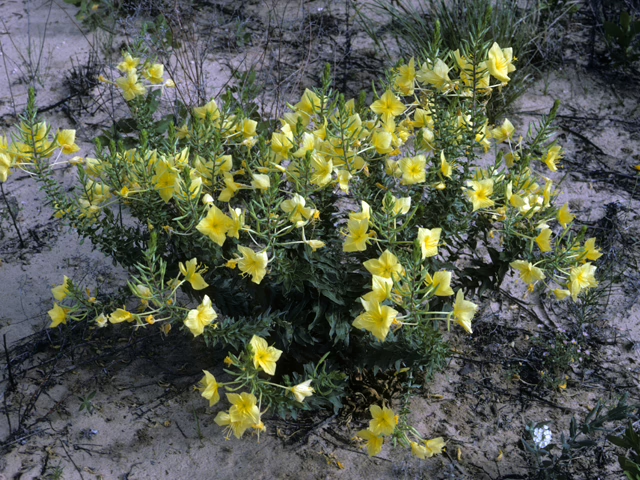
Blooms May-September. Grows in a mounding to spreading form. As a biennial this plant will produce a rosette of leaves the first year and a taller plant with flowers the second year. Small, narrow leaves grow the length of long, stout stems. The loose flowering spike is composed of yellow, 2-3 in. flowers, each with four wide petals which taper to a blunt point. The flowers open in the evening and wither the following morning. The fruit is a capsule. The dusk and night flying bee Lasioglossum texanum collects pollen only from the four-point evening-primrose. A night-blooming plant that is a food source for nocturnal pollinators such as Hawk Moths, Hummingbird Moths, and Clearwing Moths, as well as Ruby-Throated Hummingbirds on overcast days.
Previous Scientific Name(s): Oenothera heterophylla var. rhombipetala, Raimannia rhombipetala
Material Treatment Method Collection References
Seed No Treatment Mother Nature offers two prime sowing windows. You can sow seeds directly into the garden after the last frost in spring, or opt for a fall sowing, allowing the seeds to overwinter and naturally stratify. Select a location blessed with full sun and well-drained soil. Lightly rake the area to loosen the top inch of soil. Sprinkle the tiny seeds across the prepared bed, leaving a bit of space between them. Lightly press the seeds into the soil, ensuring they are barely covered — light is essential for germination. Mist the sown area with water, being careful not to dislodge the seeds. With a bit of patience (usually 2-3 weeks), you’ll be greeted by the emergence of tiny seedlings. Keep the soil consistently moist but not waterlogged. Once the seedlings develop a few true leaves, thin them out to provide adequate spacing for healthy growth. As the vibrant yellow flowers fade, keep a watchful eye on the developing seed pods. Once they turn brown and begin to split open, it’s harvest time https://propagate.one/how-to-propagate-oenothera-rhombipetala/
Clump division Division Using a clean, sharp knife or garden spade, divide the plant into sections. Each section should have a healthy amount of roots and shoots. Replant the divisions in their designated locations, ensuring the crown of each plant sits at soil level. Water them in well and maintain consistent moisture. Early spring, when new growth emerges, presents the ideal time for division. Carefully dig up a mature plant, ensuring minimal disturbance to the roots. https://propagate.one/how-to-propagate-oenothera-rhombipetala/

About the Region

Fall Symposium 2025 Logo - Teach for the Future

Salado, the location of our Fall 2025 Symposium, lies at the intersection of two ecoregions: the Edwards Plateau (Limestone Cut Plain) and Blackland Prairie (Northern Blackland Prairie).

The Edwards Plateau area is also called the Hill Country; however, this general term covers a much larger area extending farther north. Spring-fed creeks are found throughout the region; deep limestone canyons, rivers, and lakes (reservoirs) are common. Ashe juniper is perhaps the most common woody species found throughout the region. Additional woody species include various species of oak, with live oak (Quercus fusiformis) being the most common. Sycamores (Platanus occidentalis) and bald cypress (Taxodium distichum) border waterways. This area is well known for its spring wildflower displays, though they may be viewed in spring, late summer, and fall, as well. According to Texas Parks and Wildlife, average annual rainfall in the Edwards Plateau ranges from 15 to 34 inches.

The Blackland Prairie extends from the Red River south to San Antonio, bordered on the west by the Edwards Plateau and the Cross Timbers, and on the east by the Post Oak Savannah. Annual rainfall averages 30 to 40 inches, with higher averages to the east. This region is dominated by prairie species. The most common grass species include little bluestem (Schizachyrium scoparium) and Indian grass (Sorghastrum nutans) in the uplands and switchgrass (Panicum virgatum) in the riparian areas and drainages. Common herbaceous flowering plants include salvias, penstemons, and silphiums. This area has suffered greatly from overgrazing and agricultural use. Few intact areas remain, though many of the plants can be found along county roadsides throughout the region.

Our fall Symposium host chapter, the Tonkawa Chapter, includes both of these ecoregions.

Source: Wildflowers of Texas by Michael Eason