

Potato Tree

Solanum erianthum

Other common name(s):

Potatotree, Potato-Tree, Mullein nightshade, Velvet Nightshade

Family:

Solanaceae (Nightshade Family)

Plant Ecoregion Distribution Map

This map uses data from the US EPA. EPA  servers have been offline frequently so maps may not display. We are working on a solution.

Gulf Coast Prairies and Marshes
Lower Rio Grande Alluvial Floodplain, Lower Rio Grande Valley

Plant Characteristics

Growth Form

Shrub, Tree

Height

6
to
12
ft.

Spread

6
to
12
ft.

Leaf Retention

Evergreen

Lifespan

Perennial

Habitat and Care Requirements

Soil Type(s)

Sand, Limestone, Well Drained

Light Requirement

Sun, Part Shade

Water Requirement

Low, Medium

Native Habitat

Grassland, Woodland, Wetland or Riparian

Bloom and Attraction

Bloom Color

White

Bloom Season

Spring, Summer, Fall

Seasonal Interest

Fruit

Wildlife Benefit

Birds

Maintenance

Drought tolerance is high, does not require any supplemental water once established. Primarily recommended for natural landscapes and habitat restorations. Native habitat: can be found in a variety of habitats, including riparian zones, dry forests, and moist forests. It often grows in disturbed areas, such as roadsides, fields, It is a pioneer species quickly colonizing forest gaps caused by treefall, and is able to grow on degraded sites prior to other vegetation. Needs lot of room spread in the landscape. WARNING: the leaves, stems and roots contain various alkaloids and are poisonous to humans, causing headache, cramps, and nausea. Propagation: can be grown from seed but also spreads into clumping mounds as adventitious shoots arise from the roots

Comments

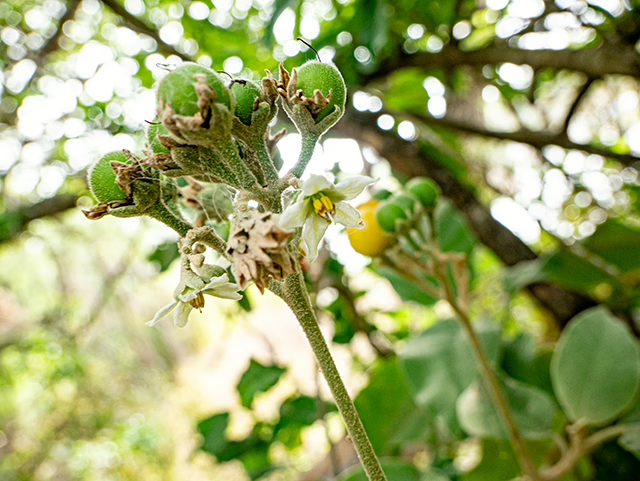
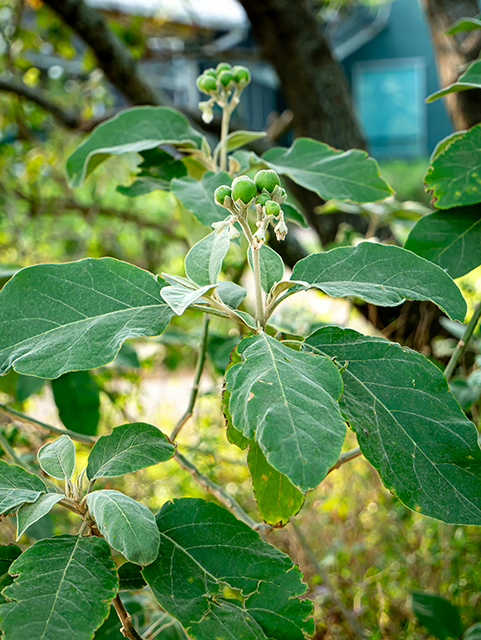
Potatotree is a fast-growing evergreen shrub or small tree, The crown is flat-topped and spreading. The wood is soft and brittle, The bark is greyish-brown, and smooth, becoming rough with age and bearing many wart-like projections. The leaves are oval to elliptical. All parts of the plant are cover in dense hairs. White flowers are arranged in flat-toped clusters. The fruit is a small, yellow berry with many seeds. Broken roots smell like cooked potatoes. Leaves and stems release an odor similar to tar when rubbed.
Previous Scientific Name(s): Solanum erianthum var. adulterinum, Solanum verbascifolium
Material Treatment Method Collection References
Seed No Treatment Sow seeds in well draining soil, trays in a nursery. Keep them moist but not soggy. Prick out the seedlings into individual pots when they are large enough to handle and grow them on fast. Plant them out when 10cm or more tall. 1) https://tropical.theferns.info/viewtropical.php?id=Solanum+erianthum 2) https://earthone.io/plant/solanum%20erianthum
Root Cutting Cuttings of half-ripe wood. Keep the cutting in a warm, humid environment until it roots. Very easy, the cuttings root within a couple of weeks. 1) https://tropical.theferns.info/viewtropical.php?id=Solanum+erianthum 2) https://regionalconservation.org/beta/nfyn/plantdetail.asp?tx=Solaeria#:~:text=Wildlife%20and%20Ecology:%20Provides%20food,from%20seed%20and%20root%20cuttings. 2) https://earthone.io/plant/solanum%20erianthum

About the Region

Fall Symposium 2025 Logo - Teach for the Future

Salado, the location of our Fall 2025 Symposium, lies at the intersection of two ecoregions: the Edwards Plateau (Limestone Cut Plain) and Blackland Prairie (Northern Blackland Prairie).

The Edwards Plateau area is also called the Hill Country; however, this general term covers a much larger area extending farther north. Spring-fed creeks are found throughout the region; deep limestone canyons, rivers, and lakes (reservoirs) are common. Ashe juniper is perhaps the most common woody species found throughout the region. Additional woody species include various species of oak, with live oak (Quercus fusiformis) being the most common. Sycamores (Platanus occidentalis) and bald cypress (Taxodium distichum) border waterways. This area is well known for its spring wildflower displays, though they may be viewed in spring, late summer, and fall, as well. According to Texas Parks and Wildlife, average annual rainfall in the Edwards Plateau ranges from 15 to 34 inches.

The Blackland Prairie extends from the Red River south to San Antonio, bordered on the west by the Edwards Plateau and the Cross Timbers, and on the east by the Post Oak Savannah. Annual rainfall averages 30 to 40 inches, with higher averages to the east. This region is dominated by prairie species. The most common grass species include little bluestem (Schizachyrium scoparium) and Indian grass (Sorghastrum nutans) in the uplands and switchgrass (Panicum virgatum) in the riparian areas and drainages. Common herbaceous flowering plants include salvias, penstemons, and silphiums. This area has suffered greatly from overgrazing and agricultural use. Few intact areas remain, though many of the plants can be found along county roadsides throughout the region.

Our fall Symposium host chapter, the Tonkawa Chapter, includes both of these ecoregions.

Source: Wildflowers of Texas by Michael Eason