Coralberry

Symphoricarpos orbiculatus

Other common name(s):

Indian Currant, Buckbrush

Family:

Caprifoliaceae (Honeysuckle Family)

Plant Ecoregion Distribution Map

This map uses data from the US EPA. EPA  servers have been offline frequently so maps may not display. We are working on a solution.

East Central Texas Plains, Edwards Plateau, Gulf Coast Prairies and Marshes, Texas Blackland Prairies, Western Gulf Coastal Plain
Bastrop Lost Pines, Floodplains and Low Terraces2, Northern Post Oak Savanna, Northern Prairie Outliers, San Antonio Prairie, Southern Post Oak Savanna
Balcones Canyonlands, Edwards Plateau Woodland
Mid-Coast Barrier Islands and Coastal Marshes, Northern Humid Gulf Coastal Prairies
Floodplains and Low Terraces1, Northern Blackland Prairie, Southern Blackland Prairie
Flatwoods, Southern Tertiary Uplands

Plant Characteristics

Growth Form

Shrub

Height

4
to
6
ft.

Spread

1
to
2
ft.

Leaf Retention

Deciduous

Lifespan

Perennial

Habitat and Care Requirements

Soil Type(s)

Loam, Rocky, Well Drained, Moist

Light Requirement

Part Shade, Shade

Water Requirement

Low, Medium

Native Habitat

Woodland

Bloom and Attraction

Bloom Color

White, Green

Bloom Season

Spring, Summer

Seasonal Interest

Berry, Forage, Nectar, Pollen, Nesting Material

Wildlife Benefit

Browsers, Birds, Small Mammals, Bees

Maintenance

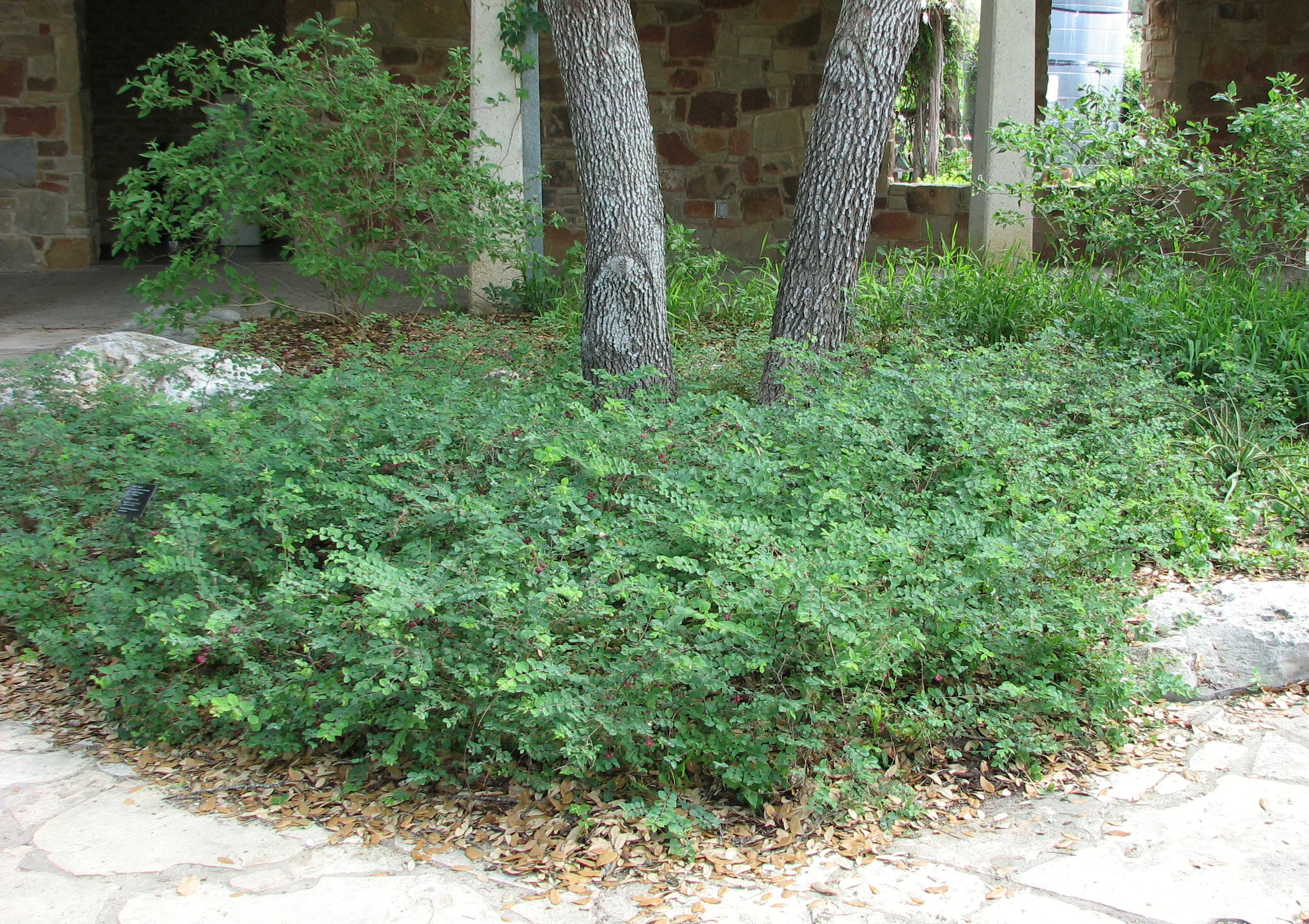
Very low maintenance. Coralberry can adapt to various soil types, but prefers well-drained, moist, loamy, or rocky soil. Spreads by runners, so give lots of room. Cut back in winter if it gets leggy or to control runners as needed. Good for erosion control. Native habitat: along stream banks and common in Post Oak woodlands. Propagation: semi-hardwood cutting, seed.

Comments

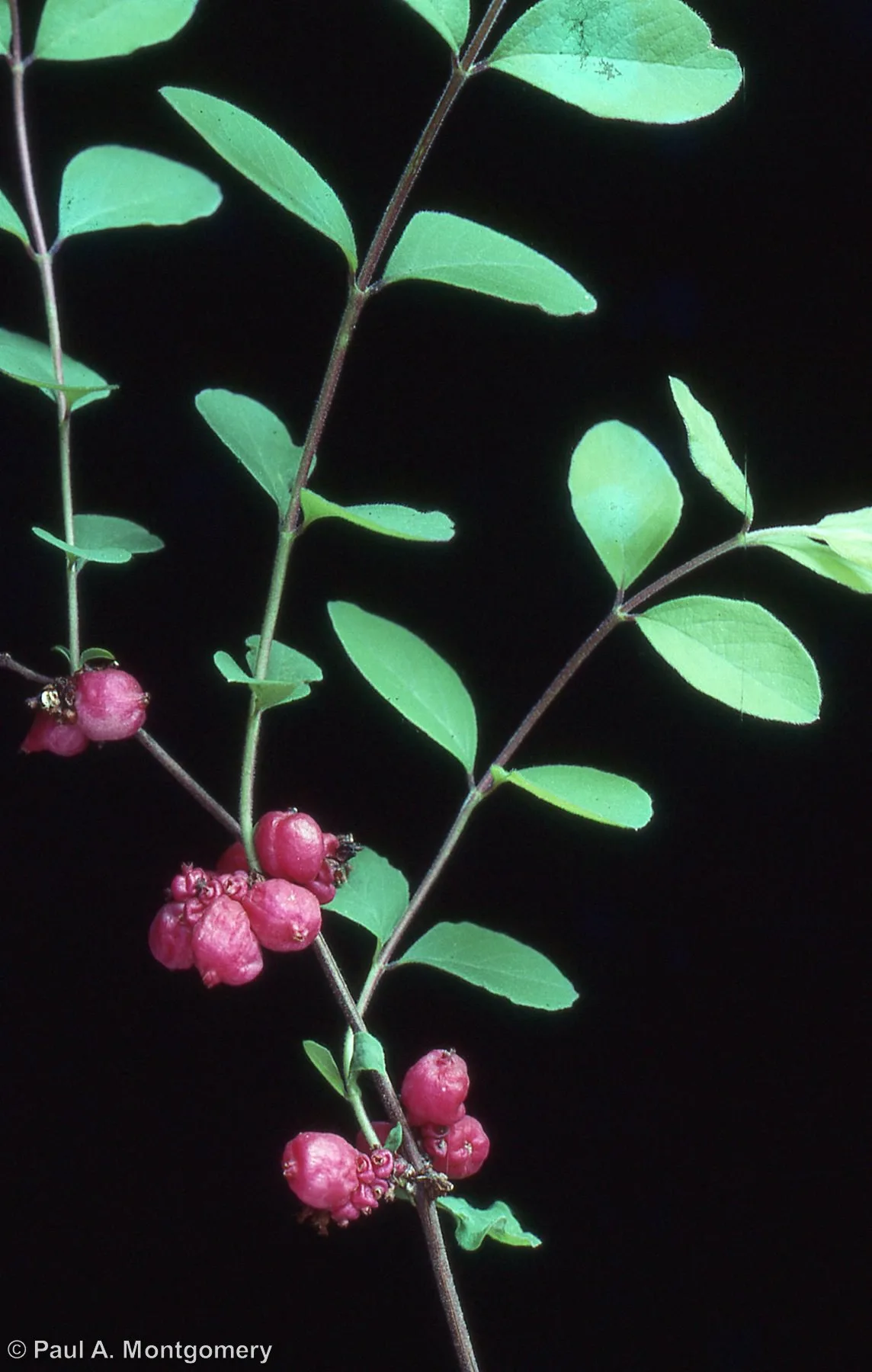
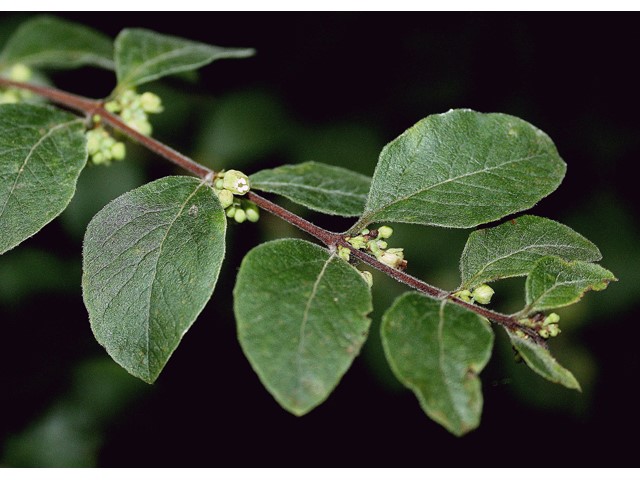
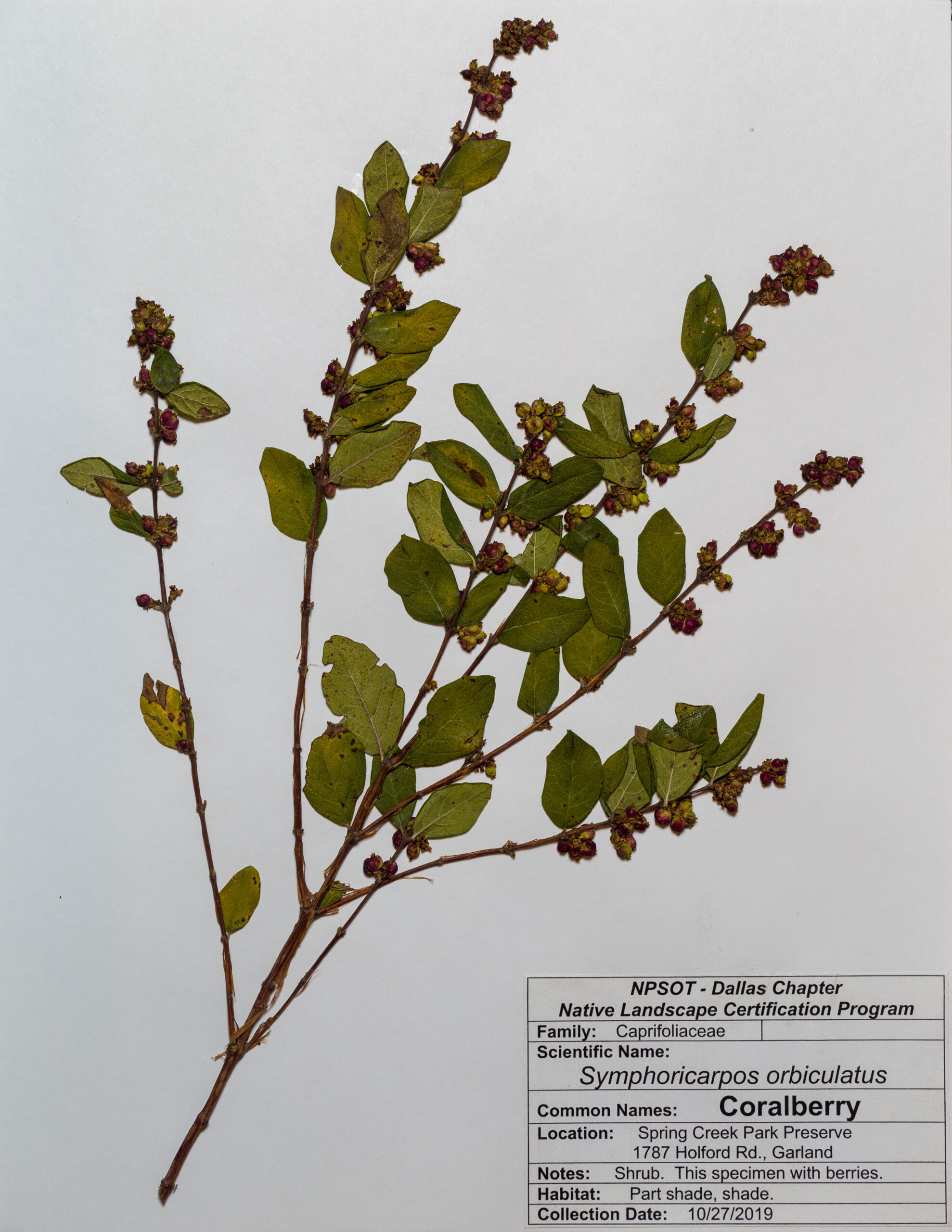
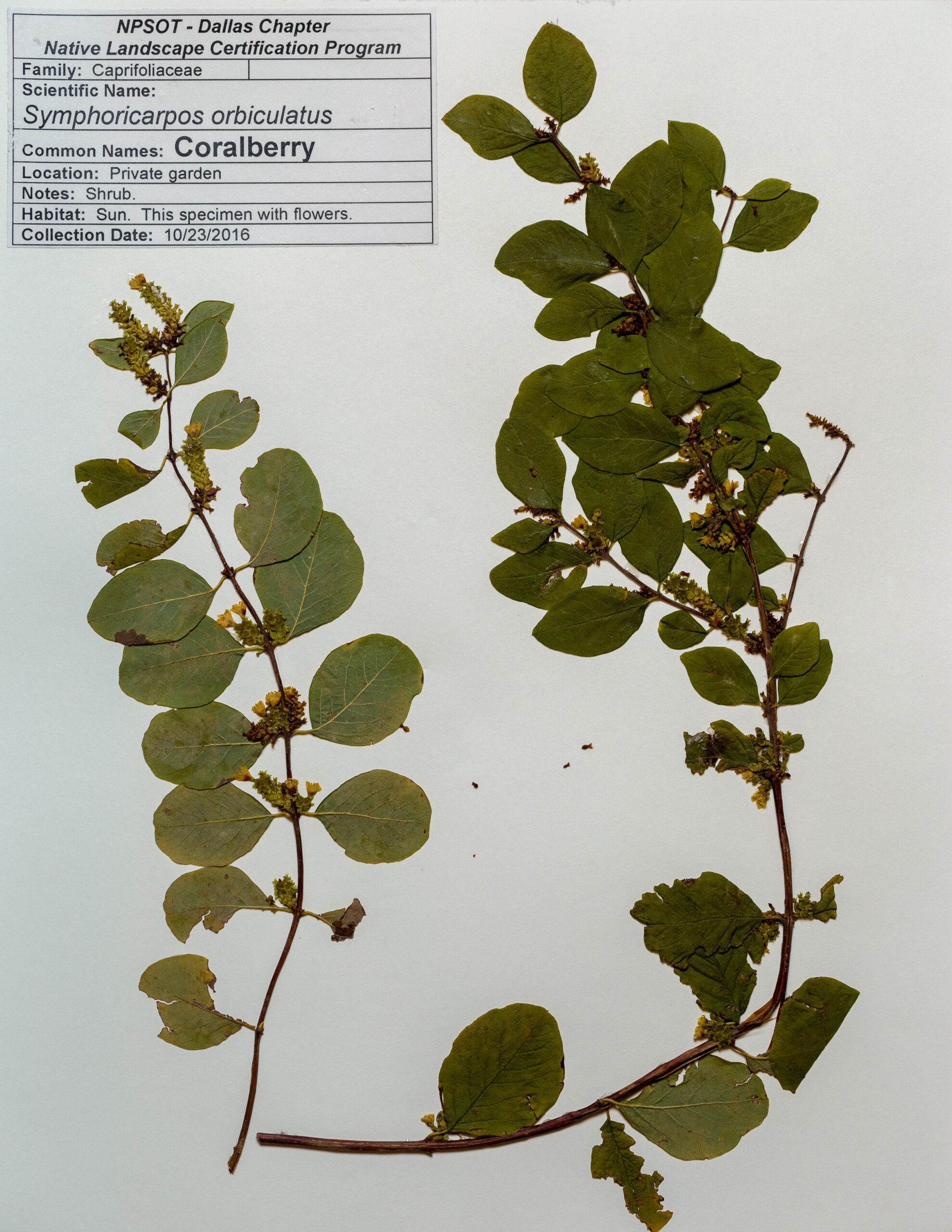
Blooms April-September. A low-growing shrub with purple stems, some trailing and root to form colonies. Small oval leaves are blunt at both ends and hairy beneath. Small, bell-shaped, greenish to purplish, flowers grow in dense clusters, occurring in uppermost leaf axils. The fruit is a red to purple berry.
Previous Scientific Name(s): Symphoricarpos symphoricarpos
Material Treatment Method Collection References
Softwood Cutting Cuttings taken in late spring or early summer. Dip the cuttings in rooting hormone and plant them in a well-draining soil mix. Keep the soil moist and provide indirect light until roots develop. https://earthone.io/plant/symphoricarpos%20orbiculatus
Seed Stratification Nutlets are difficult to germinate because of hard seed coats and immature embryos. Warm stratification for 3-4 months followed by cold for 4-6 months is necessary. Fruits can be collected anytime during the fall and winter by stripping or flailing onto drop cloths. Seeds can be extracted by macerating the fruits in water. 1) https://www.wildflower.org/plants/result.php?id_plant=SYOR 2) https://www.epicgardening.com/coralberry/
Seed Scarification Coralberry is not typically grown from seed because it requires a lengthy process to get the seeds to germinate. It is recommended to scarify the seeds (nick the seeds with a knife or rub them against sandpaper to break open or soften the seed coat). After scarification, subject the seeds to 2 cold, moist periods. This period is called cold stratification. https://www.epicgardening.com/coralberry/
Semi-harwood Cutting To take a semi-hardwood cutting, ensure your snips are sharp and clean. Select a section of the stem that’s healthy and beginning to thicken and darken, ensuring you have at least 4 to 6 inches of this semi-hardwood section. Snip off any fresh green growth at the top if the top of the stem is still soft. Cut the remaining leaves in half. Pull the leaves off the bottom 1 to 2 nodes (where the leaves grow from the stem; this is where your new roots will grow). You can choose to use a rooting hormone or not. If so, dip the end of the stem in the rooting hormone. Use a dibbler (or pencil) to poke a hole in your well-draining, loose potting mix for your cutting. Place the cutting in the hole so the bottom nodes are buried. Press the potting mix firmly around the cutting. Keep the cutting moist with high humidity for a few weeks. Cover the pot with a plastic milk jug or plastic wrap to keep moisture high. You don’t want the cutting to be soggy wet–just evenly moist. Mist the plant to keep humidity high instead of watering the potting mix in the beginning. Propagate coralberry with semi-hardwood cuttings. Semi-hardwood cuttings are those taken when the plant stem becomes slightly darker and thicker. Collect these cuttings between mid-July and early fall. https://www.epicgardening.com/coralberry/
Stem Layering If coralberry “suckers” are already present, using a spade, dig out a section of the plant that has rooted and move it to a new location. There is no need to amend the soil. Just make sure there is enough to cover the plant’s crown so none of the roots are above the soil line. If you do not notice any stems already rooted to the ground, artificially create this by laying a stem along the ground and securing it by mounding soil up around nodes (where the leaves join the stem). Once you see new growth emerging from the soil mound, you can separate these plantlets from the main stem and transplant them accordingly. Collect in the fall or early spring. Coralberry propagates itself in the wild by rooting at the nodes where its stems meet the ground. However, the cultivated varieties of coralberry are not as ambitious as the wild coralberry. https://www.epicgardening.com/coralberry/

About the Region

Fall Symposium 2025 Logo - Teach for the Future

Salado, the location of our Fall 2025 Symposium, lies at the intersection of two ecoregions: the Edwards Plateau (Limestone Cut Plain) and Blackland Prairie (Northern Blackland Prairie).

The Edwards Plateau area is also called the Hill Country; however, this general term covers a much larger area extending farther north. Spring-fed creeks are found throughout the region; deep limestone canyons, rivers, and lakes (reservoirs) are common. Ashe juniper is perhaps the most common woody species found throughout the region. Additional woody species include various species of oak, with live oak (Quercus fusiformis) being the most common. Sycamores (Platanus occidentalis) and bald cypress (Taxodium distichum) border waterways. This area is well known for its spring wildflower displays, though they may be viewed in spring, late summer, and fall, as well. According to Texas Parks and Wildlife, average annual rainfall in the Edwards Plateau ranges from 15 to 34 inches.

The Blackland Prairie extends from the Red River south to San Antonio, bordered on the west by the Edwards Plateau and the Cross Timbers, and on the east by the Post Oak Savannah. Annual rainfall averages 30 to 40 inches, with higher averages to the east. This region is dominated by prairie species. The most common grass species include little bluestem (Schizachyrium scoparium) and Indian grass (Sorghastrum nutans) in the uplands and switchgrass (Panicum virgatum) in the riparian areas and drainages. Common herbaceous flowering plants include salvias, penstemons, and silphiums. This area has suffered greatly from overgrazing and agricultural use. Few intact areas remain, though many of the plants can be found along county roadsides throughout the region.

Our fall Symposium host chapter, the Tonkawa Chapter, includes both of these ecoregions.

Source: Wildflowers of Texas by Michael Eason