
Fall Aster

Symphyotrichum oblongifolium

Other common name(s):

Aromatic Aster

Family:

Asteraceae (Aster Family)

Plant Ecoregion Distribution Map

This map uses data from the US EPA. EPA  servers have been offline frequently so maps may not display. We are working on a solution.

Central Great Plains, Cross Timbers, Edwards Plateau
Limestone Plains
Carbonate Cross Timbers, Eastern Cross Timbers, Grand Prairie, Limestone Cut Plain, Western Cross Timbers
Balcones Canyonlands, Edwards Plateau Woodland, Llano Uplift

Plant Characteristics

Growth Form

Shrub

Height

1
to
3
ft.

Spread

2
to
3
ft.

Leaf Retention

Deciduous

Lifespan

Perennial

Habitat and Care Requirements

Soil Type(s)

Sand, Rocky, Calcareous, Well Drained, Moist, Dry

Light Requirement

Sun, Part Shade

Water Requirement

Low

Native Habitat

Grassland

Bloom and Attraction

Bloom Color

Purple

Bloom Season

Fall

Seasonal Interest

Seeds, Forage, Nectar, Pollen, Larval Host

Wildlife Benefit

Browsers, Butterflies, Birds, Small Mammals, Moths, Bees

Maintenance

Although its native habitat is in calcareous prairies of Edwards Plateau and lower plains, it is adaptable and has become popular in gardens throughout Texas. Similar to S. patens which prefers the eastern half of Texas. Provides dazzling color in the fall. Slowly colonizes by stolons. If it gets top heavy, prune it back in June. Wait to cut back to the basal rosette until late fall or early winter when plant has stopped blooming and is dormant. May be thinned, divided, and transplanted. Propagation: seed, softwood cutting.

Comments

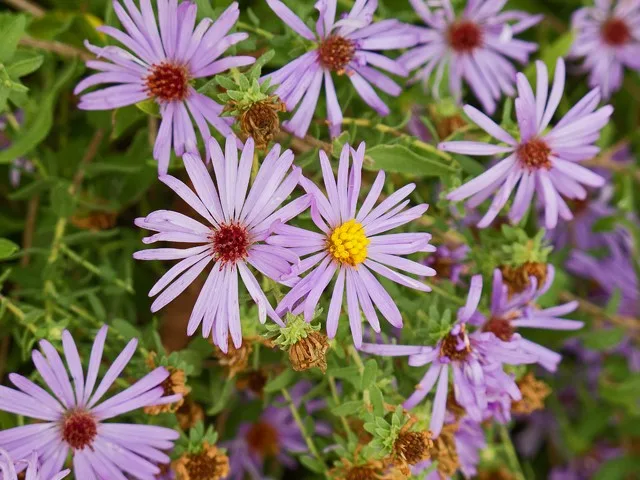
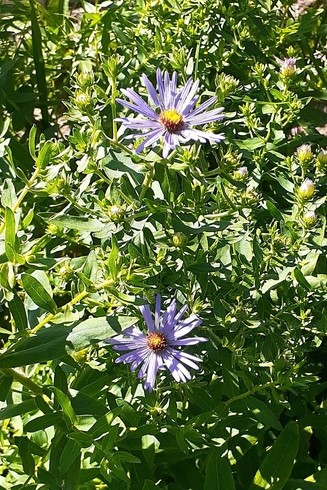
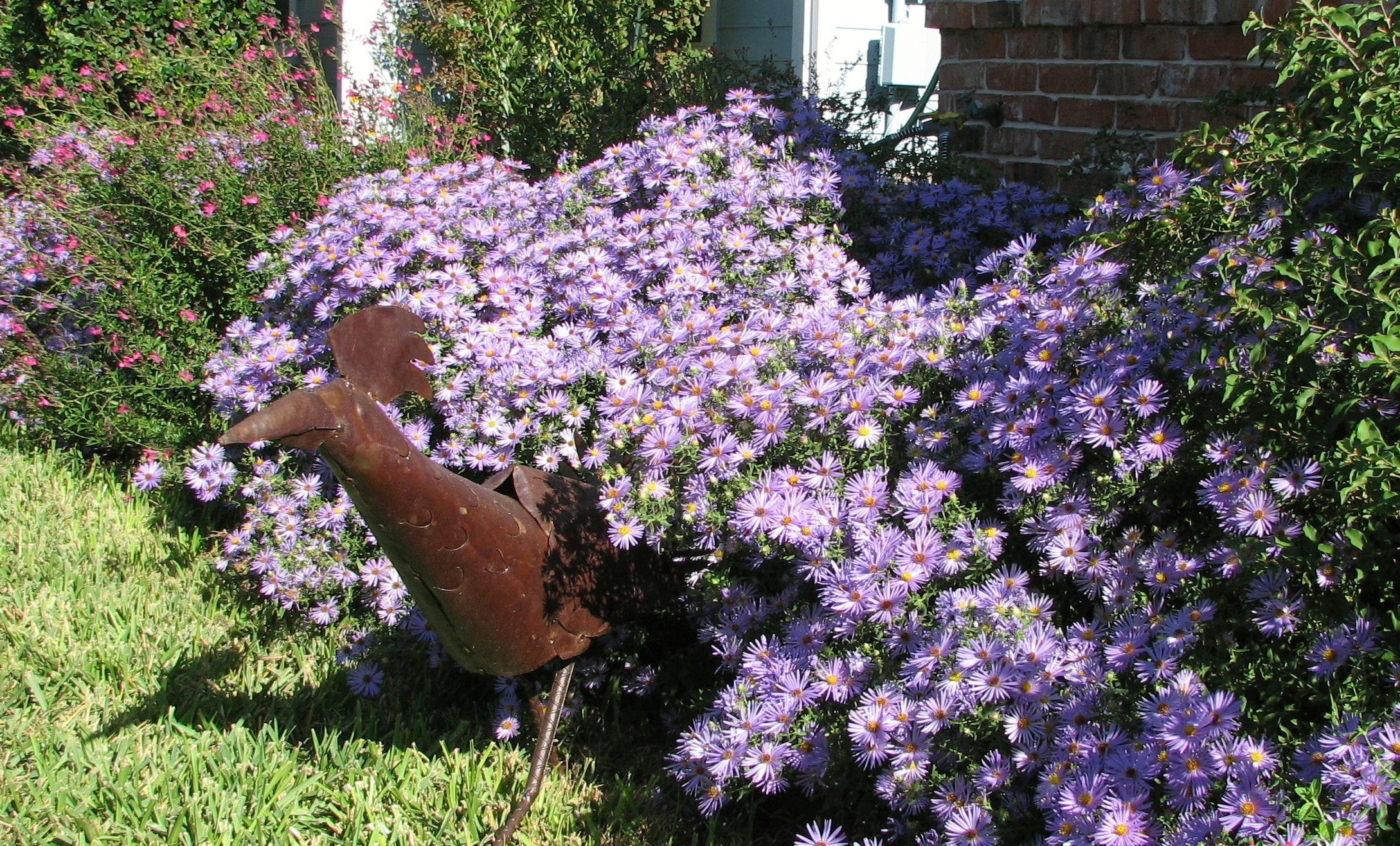
Blooms September-December. Forms dense, low mounds of aromatic foliage. The flowers are composite with purple ray flowers along their edges and yellow disk flowers in the center. The fruit is a cypsela: a dry, one-seeded fruit, usually topped by pappus. Game birds and browsers eat the seeds and sometimes foliage. Larval host: Silvery Checkerspot and many other moth species.
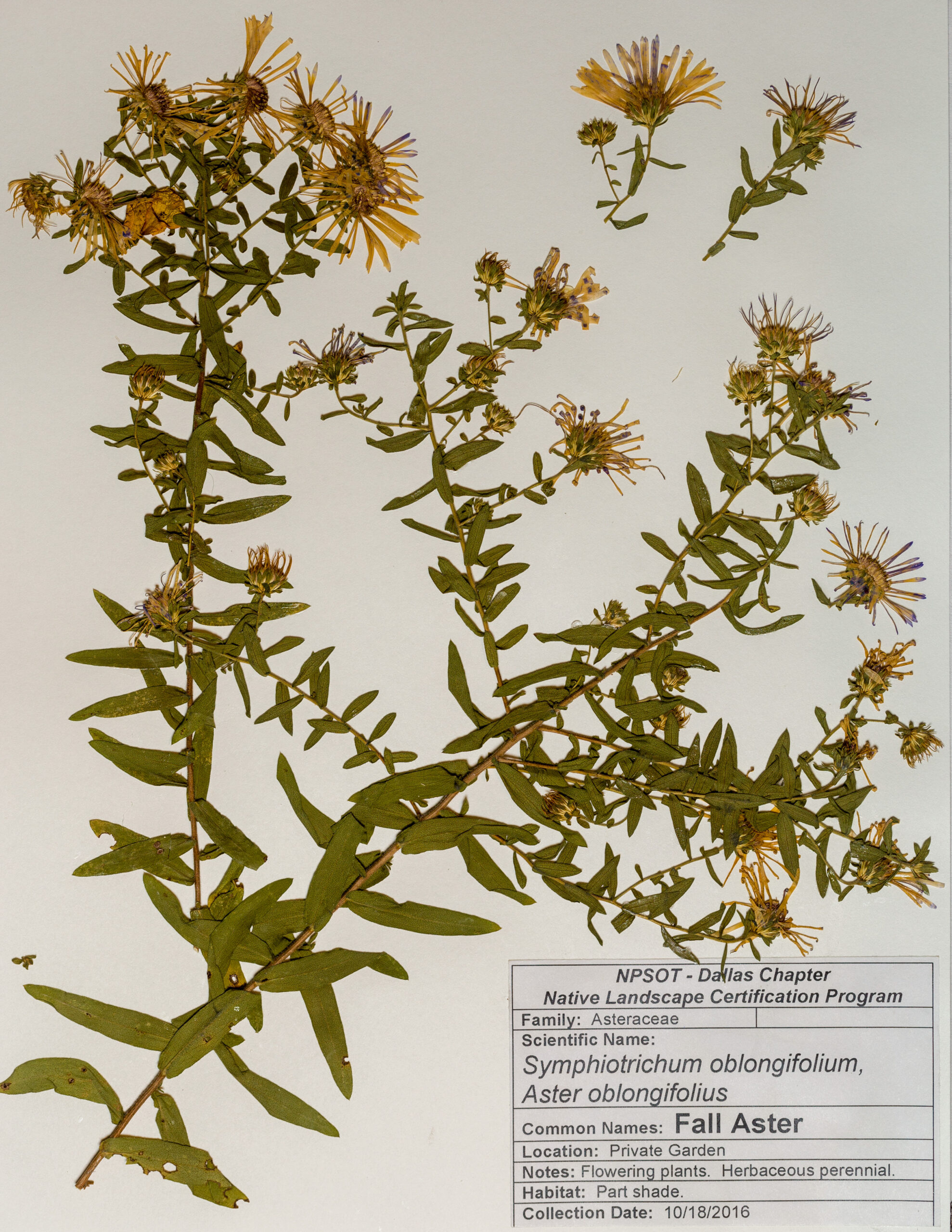
Previous Scientific Name(s): Aster kumleinii, Aster oblongifolius, Aster oblongifolius var. angustatus, Aster oblongifolius var. orientis, Aster oblongifolius var. rigidulus, Lasallea oblongifolia, Virgulus oblongifolius
Material Treatment Method Collection References
Seed No Treatment If seeds are sown directly, sow them five-eighths of an inch deep in the fall and sow thickly. Plant a cover crop of a cool-season annual grass over the seedbed to protect seed over the winter. Seeds can be collected from wild plants in late fall when the achenes (dry fruits) separate easily from the receptacle. Seeds should be collected in paper bags and allowed to dry for 1–2 weeks. 1) https://plants.usda.gov/DocumentLibrary/factsheet/pdf/fs_syob.pdf 2) https://growitbuildit.com/aromatic-aster-symphyotrichum-oblongifolium/#:~:text=Aromatic%20Aster%20can%20also%20be,to%20a%20new%20colonizing%20plant.
Seed Stratification If seeds are to be propagated in a container, they should be stored for 1–3 months at 30–40 degrees Fahrenheit before sowing. Many species of Aster benefit from moisture during the cold storage (stratification) period. Use a perlite/vermiculite mix for stratification. The seed will germinate in 10 to 15 days at 72 degrees Fahrenheit. Germination to true leaf stage is 7 to 15 days. Seedlings should be thinned at this stage. Seeds can be collected from wild plants in late fall when the achenes (dry fruits) separate easily from the receptacle. Seeds should be collected in paper bags and allowed to dry for 1–2 weeks. https://plants.usda.gov/DocumentLibrary/factsheet/pdf/fs_syob.pdf
Rhizome Division Given this plant spreads by rhizomes and division is a great way to propagate. It can be formally divided every 3-5 years. But in reality, if one wants to propagate new plants you only need to cut and plant the newly emerging shoots in Spring. If a stalk has at least a few roots, then planting it in the cool Spring soil is all that is needed to give birth to a new colonizing plant. https://growitbuildit.com/aromatic-aster-symphyotrichum-oblongifolium/#:~:text=Aromatic%20Aster%20can%20also%20be,to%20a%20new%20colonizing%20plant.

About the Region

Fall Symposium 2025 Logo - Teach for the Future

Salado, the location of our Fall 2025 Symposium, lies at the intersection of two ecoregions: the Edwards Plateau (Limestone Cut Plain) and Blackland Prairie (Northern Blackland Prairie).

The Edwards Plateau area is also called the Hill Country; however, this general term covers a much larger area extending farther north. Spring-fed creeks are found throughout the region; deep limestone canyons, rivers, and lakes (reservoirs) are common. Ashe juniper is perhaps the most common woody species found throughout the region. Additional woody species include various species of oak, with live oak (Quercus fusiformis) being the most common. Sycamores (Platanus occidentalis) and bald cypress (Taxodium distichum) border waterways. This area is well known for its spring wildflower displays, though they may be viewed in spring, late summer, and fall, as well. According to Texas Parks and Wildlife, average annual rainfall in the Edwards Plateau ranges from 15 to 34 inches.

The Blackland Prairie extends from the Red River south to San Antonio, bordered on the west by the Edwards Plateau and the Cross Timbers, and on the east by the Post Oak Savannah. Annual rainfall averages 30 to 40 inches, with higher averages to the east. This region is dominated by prairie species. The most common grass species include little bluestem (Schizachyrium scoparium) and Indian grass (Sorghastrum nutans) in the uplands and switchgrass (Panicum virgatum) in the riparian areas and drainages. Common herbaceous flowering plants include salvias, penstemons, and silphiums. This area has suffered greatly from overgrazing and agricultural use. Few intact areas remain, though many of the plants can be found along county roadsides throughout the region.

Our fall Symposium host chapter, the Tonkawa Chapter, includes both of these ecoregions.

Source: Wildflowers of Texas by Michael Eason