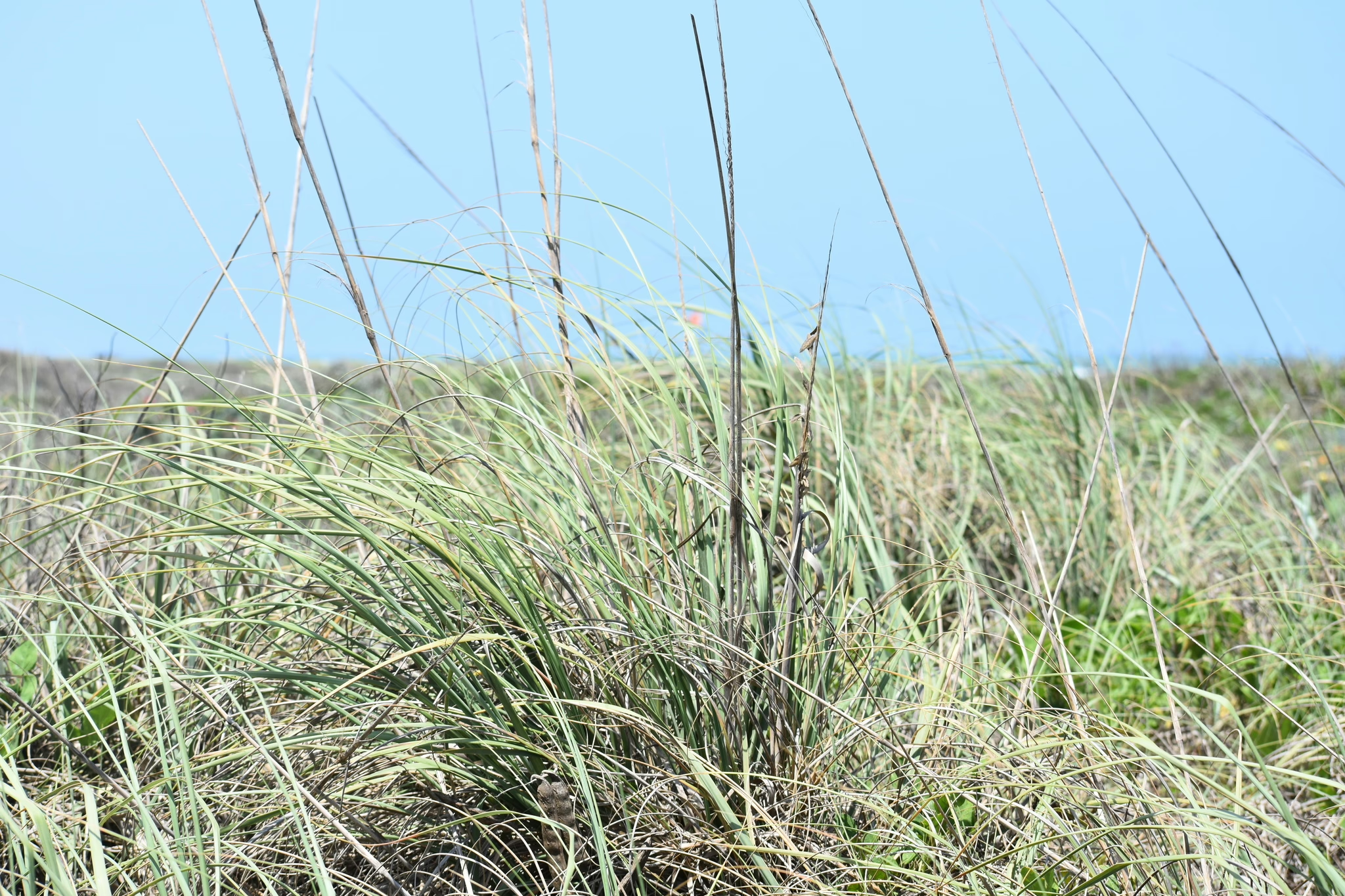

Sea Oats

Uniola paniculata

Other common name(s):

Arroz de costa

Family:

Poaceae (Grass Family)

Plant Ecoregion Distribution Map

This map uses data from the US EPA. EPA  servers have been offline frequently so maps may not display. We are working on a solution.

Gulf Coast Prairies and Marshes
Coastal Sand Plain, Floodplains and Low Terraces4, Laguna Madre Barrier Island and Coastal Marshes, Lower Rio Grande Alluvial Floodplain, Lower Rio Grande Valley, Mid-Coast Barrier Islands and Coastal Marshes, Northern Humid Gulf Coastal Prairies, Southern Subhumid Gulf Coastal Prairies, Texas-Louisiana Coastal Marshes

Plant Characteristics

Growth Form

Grass & Sedge

Height

3
to
7
ft.

Spread

.5
to
1
ft.

Leaf Retention

Evergreen

Lifespan

Perennial

Habitat and Care Requirements

Soil Type(s)

Sand, Loam, Calcareous, Saline

Light Requirement

Sun

Water Requirement

Low

Native Habitat

Grassland, Wetland or Riparian

Bloom and Attraction

Bloom Color

Green, Brown

Bloom Season

Summer

Seasonal Interest

Seeds, Nesting Material

Wildlife Benefit

Birds, Small Mammals

Maintenance

Salt and wind tolerant. Drought tolerant, only needing supplemental water to get established. Cannot withstand water logged roots. Planted as a garden ornamental and collected for dried bouquets. Provides erosion control along beaches. Native habitat; coastal sands. Seed production is generally poor, the reason is not known. Propagation: seed, root division.

Comments

Blooms June-July. Flat, oval, scaly, brownish spikelets are crowded into a curving cluster on a tall, smooth stem. The inflorescence is more open with age. Spreads by rhizomes.
Previous Scientific Name(s): Briza caroliniana, Nevroctola maritima, Nevroctola paniculata, Trisiola paniculata, Uniola floridana, Uniola heterochroa, Uniola macrostachys, Uniola maritima
Material Treatment Method Collection References
Seed Stratification The cold treatment required to break seed dormancy decreases southward along the range of seaoats, and is nonexistent for the south Atlantic coast Florida populations. Seeds from North Carolina gave optimal germination when cold-layered moist for 30 days at 40 degrees Fahrenheit (4.4 deg C) before being given an alternating thermoperiod (conditions of no light and alternating temperatures of 65 degrees Fahrenheit [18.3 deg C] for 17 hours followed by 95 degrees Fahrenheit [35 deg C] for 7 hours). No cold and/or moist treatment was required for seeds from Louisiana; room temperature treatment gave highest germination, but moist cold (40 degrees Fahrenheit [4.4 deg C]) pretreatment gave rates almost as high. Exposure of seeds to 30 days of dry cold at 40 degrees Fahrenheit (4.4 deg C) adversely affected germination. Louisiana seeds collected October 1981 and tested in April 1982 had germination rates of 78.0 to 88.8 percent under the alternating thermoperiod. Seedlings establish during the first growing season and produce extensive tillers by the second season. https://www.fs.usda.gov/database/feis/plants/graminoid/unipan/all.html#:~:text=Seeds%20from%20North%20Carolina%20gave,thermoperiod%20described%20above%20%5B11%5D.
Seed No Treatment Sow early spring in situ and only just cover the seed https://pfaf.org/user/Plant.aspx?LatinName=Uniola+paniculata#:~:text=Plant%20Propagation,Division%20in%20spring%5B200%5D.
Clump Division Division can be done in the spring by separating clumps of the plant and replanting them in suitable locations. https://earthone.io/plant/uniola%20paniculata

About the Region

Fall Symposium 2025 Logo - Teach for the Future

Salado, the location of our Fall 2025 Symposium, lies at the intersection of two ecoregions: the Edwards Plateau (Limestone Cut Plain) and Blackland Prairie (Northern Blackland Prairie).

The Edwards Plateau area is also called the Hill Country; however, this general term covers a much larger area extending farther north. Spring-fed creeks are found throughout the region; deep limestone canyons, rivers, and lakes (reservoirs) are common. Ashe juniper is perhaps the most common woody species found throughout the region. Additional woody species include various species of oak, with live oak (Quercus fusiformis) being the most common. Sycamores (Platanus occidentalis) and bald cypress (Taxodium distichum) border waterways. This area is well known for its spring wildflower displays, though they may be viewed in spring, late summer, and fall, as well. According to Texas Parks and Wildlife, average annual rainfall in the Edwards Plateau ranges from 15 to 34 inches.

The Blackland Prairie extends from the Red River south to San Antonio, bordered on the west by the Edwards Plateau and the Cross Timbers, and on the east by the Post Oak Savannah. Annual rainfall averages 30 to 40 inches, with higher averages to the east. This region is dominated by prairie species. The most common grass species include little bluestem (Schizachyrium scoparium) and Indian grass (Sorghastrum nutans) in the uplands and switchgrass (Panicum virgatum) in the riparian areas and drainages. Common herbaceous flowering plants include salvias, penstemons, and silphiums. This area has suffered greatly from overgrazing and agricultural use. Few intact areas remain, though many of the plants can be found along county roadsides throughout the region.

Our fall Symposium host chapter, the Tonkawa Chapter, includes both of these ecoregions.

Source: Wildflowers of Texas by Michael Eason