San Antonio Chapter

Northside ISD’s Restoration Endeavors Using Native Plants

NEISD Schools Native Plant Garden

October 2024 Presentation by Amalia Sollars, Isaac Esquivel, and David Oberg. Northside ISD’s Restoration Endeavors Using Native Plants.

Join us for an insightful exploration of Northside Independent School District’s innovative approach to ecological restoration through the use of native plants.  This session will delve into the district’s ambitious restoration projects aimed at enhancing local biodiversity, improving soil health, and fostering environmental stewardship with our students within our school grounds.

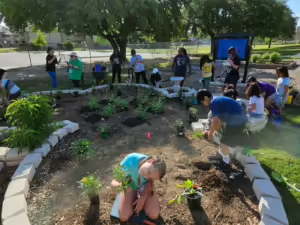
Discover how Northside ISD students and staff are transforming their campuses into vibrant, sustainable landscapes by integrating native plant species.  Our discussion will cover the strategies employed, including site assessments, plant selection, curriculum development, and community involvement. Participants will discover how Northside students learn about the ecological benefits of native plants, such as their role in supporting local wildlife, reducing water usage, and minimizing maintenance needs.  

Speakers:
Amalia Sollars – NISD K-8 Enrichment Programs Coordinator 
Isaac Esquivel – NISD Elementary Environmental Education Instruction
David Oberg – NISD ACORN/Outdoor Programs 

 

View Recording of Lecture

About the Region

2026 Fall Symposium Logo

This low-elevations region of Texas extends inland from the barrier islands, about 60 or so miles, and stretches from Brownsville to Louisiana. In total, it covers about 9.5 million acres, with a high point of 150 feet in elevation. More than 1000 species of plants can be found in this region. On the southern end, species more common in Mexico (such as Sabal mexicana) and Central America occur.

The barrier islands provide us with dune systems, and clay flats to the inland side, which have species found in these areas alone. Many plants here, such as Ipomoea pes-caprae (beach morning glory), can be found throughout tropical regions of the globe. I’ve encountered the same species on the beaches of Guam.

Once inland, vast marshes and wet prairies occur. Occasionally, oak (Quercus fusiformis) groves can be found. Common grasses include species of Bothriochloa, Paspalum, and Sporobolus; eastern gamagrass (Tripsacum dactyloides); and switchgrass (Panicum species). Many rivers and creeks cut through the Gulf Prairies, and along these riparian areas various species of trees, Sabal minor, and other plants adapted to clay soils can be found. Due to overgrazing, farming, and fire suppression, woody species such as mesquite (Prosopis glandulosa) and huisache (Acacia farnesiana), and invasive species such as chinaberry (Melia azedarach), Brazilian pepper (Schinus terebinthifolius), and Chinese tallow (Sapium sebiferum) have increased and displaced our native flora.

Source: Wildflowers of Texas by Michael Eason