

“Texas” could be another word for “diversity.” If anything characterizes the state, it is diversity.
The Texas climate ranges from subhumid to arid. Texas topography and geology vary from place to place around the state. And who could ever know all the soil types of Texas?
All this physical diversity, as well as the very location of Texas, ensures a huge biotic diversity, both in animals and plants., It would seem to me that no botanist could ever get bored working on Texas plants. There are nearly 5,000 native species.
Texas is where Eastern U.S. vegetation intermingles with Western U.S. vegetation, and it has the northern limits of a lot of the Mexican flora.
Understandably no field guide on Texas wildflowers or trees or other plants could deal with all the native species. Many, many species are too rare to show up in the books we commonly use to identify plants.
Now there is a new book with 461 pages of color photos and descriptions of the rare plants of Texas.
In addition, there are 179 more pages covering topics such as natural regions of Texas, history of plant conservation in Texas, federal and state status categories and ranks for rare and threatened Texas species and management and restoration of rare plants.
“Rare Plants of Texas” is authored by Jackie Poole, Dana Price and Jason Singhurst of the Wildlife Diversity Program of Texas Parks and Wildlife Department along with Bill Carr of the Texas Nature Conservancy.
This comprehensive and authoritative book on the lesser-known plants of this state is a one-of-a-kind publication.
Some of the rare plants included in the book occur in Kendall County. For example, Texas’ largest wild populations of big red sage (Salvia pentstemonoides) are growing in the Cibolo Creek drainage basin near Boerne. This salvia is known only in Kendall, Bandera and Real counties.
Another rare plant found near Boerne is the canyon mockorange (Philadelphus ernestii). According to the range map shown in “Rare Plants of Texas,” this species grows only in Kendall, Blanco, Comal, Hayes and Travis Counties.
In Kendall County the range of the canyon mockorange overlaps with that of the Texas mockorange (Philadelphus texensis), which is restricted to the southern portion of the Edwards Plateau.
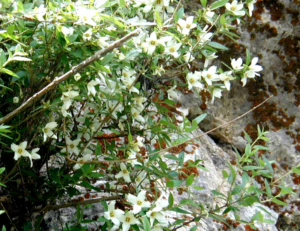
(Photo by Bill Ward)
Hill Country wild-mercury (Argythamnia aphoroides) is another rare Edwards Plateau endemic found in Kendall County. This forb grows mostly in bluestem-grama grasslands.
Jackie Poole and Jason Singhurst, two of the authors of “Rare Plants of Texas,” will be in Boerne on Tuesday, March 4, to talk about these uncommon plants of Texas at the March meeting of the Boerne chapter, Native Plant Society of Texas.
Jackie and Jason will bring some of their hot-off-the press books to sell and autograph. The meeting is at 7 p.m. at the Cibolo Nature Center.
Bill Carr, another coauthor of “Rare Plants of Texas,” will lead some Cibolo Nature Center field trips to see various native-plant communities in the Boerne area. These trips will be April 7 and 21 and May 5 from 9 a.m. to 1 p.m. For reservations, call the Cibolo Nature Center at 830-249-4616. Enrollment is limited.
