

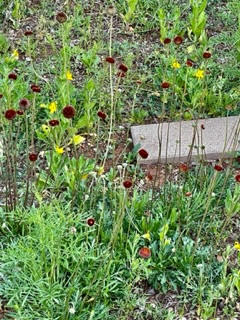
This month I decided to highlight another native plant that is not well known to most people. I wonder why, because it has become one of my favorites. Last year I bought a variety of native seeds from Native American Seed (www.seedsource.com). ‘Pincushion Daisy’ was one of them for only $6 a packet. One packet was plenty to get started, and I have quite a stand now in an area that is about 5’x5’. (Photo 1). They are joined by ‘TX Yellow Stars’ (Lindheimera texana) and ‘Mexican Hats’ (Ratibida columnifera).
Pincushion daisy is a native throughout Texas except the far eastern or western portions. Its range is from Northern Mexico to the Great Southern Plains. The Asteraceae Family (Sunflowers) is its classification, but this plant is also called ‘Rayless Gaillardia’ due to the fact that most have no ray petals. If they do, there will be 10-12 of them. It is one of the few rare plants in the Daisy family lacking petal-like ray flowers.
‘Perfume Balls’ is most commonly found in dense stands in meadows, grasslands, prairies, or open areas. The plants prefer well-drained limestone or sandy soils, with full sun to part shade. That’s why it does so well in Hill Country. It takes average water and has a medium growth rate. Because the long tap root over winters in the ground, it can be grown in Zones 6B-10A. However, it does not like high humidity.
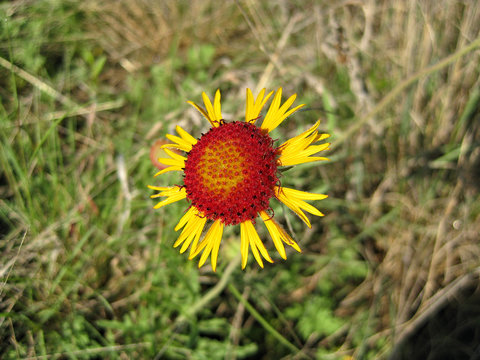
It is an erect, clumping perennial herb that grows to 26” tall and starts out as a dense, basal rosette. The shallow-toothed leaves are 2-6” long with brown, hollow stems rising from the center. These stems are leafless and unbranched. (Photo 2). At the ends of the stems are 1” maroon/brown balls which turn white when going to seed. These balls have numerous disk flowers with yellow pollen tops. People say on a warm day a group of these will exude a fragrance that is similar to Gardenias. Let the seeds dry on the plant. When they’ve tuned white, it’s time to collect them. I didn’t get to mine in time once, and it looked like snow on the soil. The plants reseed quite readily, and bloom from spring through summer. After going to seed, dead-heading will keep the blooms coming. The stems with the brown seed balls will make a great addition to an flower arrangement where you need some height and accents.
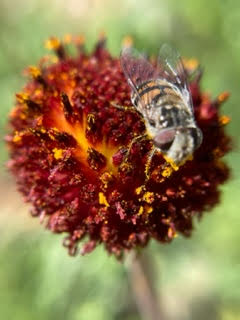
The best part of the ‘Pincushion Daisy’ is how much the balls are loved by pollinators. Mine are constantly covered by bees and butterflies. (Photo 3). Last, but not least, is the way the stems and balls dance in the wind. It’s like having your own kinetic, living wind sculpture in your flower garden!
