


A good friend of mine asked me to please write about pond plants, because in this summer heat, she wanted to think about something connected with bodies of cool water.
I can write about the various Texas natives that do okay in our long, shallow pond, but I wouldn’t presume to give advice on the proper way to grow aquatic plants.
There are many books available on planting in ponds. In addition, the Boerne chapter of the Native Plant Society of Texas has a few members, such as Jimmy and Ann Black, who can give expert advice on raising pond plants. Perhaps they should be writing this column.
Most plants in our pond were given to us by other pond owners, and a few were transplanted from the wild. They are native to Texas, but not necessarily to the Hill Country.
Our pond plants take care of themselves. They are never fertilized nor manicured, but sometimes they do have to be thinned out. Nearly all of these aquatic plants freeze down in the winter and always come back to life in the spring.
My two favorites in our pond are pickerelweed and water-primrose. Pickerelweed (Pontederia cordata) has a long blooming season. Off and on from late spring to fall, this plant sends up multiple spikes with small blue flowers that bloom in succession from the bottom up.
Dark-green elongate heart-shaped leaves are on long stalks that rise out of the water. The whole plant can be two or three feet high and will spread laterally about as much as it is allowed to.
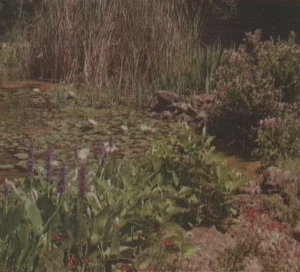
Pickerelweed is native to East Texas and eastern Central Texas. In the wild it grows in shallow water along sluggish streams on the edges of marshes, bogs or lakes. This makes it an ideal pond plant. Butterflies like it a lot, too.
Water-primrose (Ludwigia octovalvis) is a multi-branched plant that grows as high as five feet. The thick branches are reddish-brown with narrow lancе-shaped leaves less than four inches long. What makes this plant desirable for a backyard pond are the inch-wide bright-yellow primrose-like flowers.
In our pond, its bloom period is from early summer to fall, but mostly during June and July. Water-primrose is found in East Texas and westward to the Del Rio area. It is native to Kendall County, growing on the edge of slow streams and marshes.
Another interesting aquatic plant that blooms every year in our pond is the lizard’s-tail (Saururus cernuus). It gets two or three feet high with light-green leaves that are thicker in the upper part of the plant.
The numerous tiny white flowers are densely clustered on a slender, tail-like spike. In the wild, lizard’s-tail grows in muddy soils in ditches, marshes, bogs, and stream banks of East Texas.
Water lilies are our most prolific bloomers. We have white, yellow, and pink ones. None of these are native to the Hill Country. I think the white one we have is an East Texas species (probably Nymphaea odorata). Water lilies, like yellow iris and elephant ears, are thick in some Hill Country streams, but all of these are invasive exotic plants.
Our pond is long enough that we can have a patch of cattails at one end. I got a start from a nearby creek. There are two species of cattails that are native to much of Texas, including the Hill Country. I think the one we have is narrow-leaf cattail (Tyhpa domingensis). The only problem with cattails is that they spread rapidly, and it is a lot of work to constrain their growth.
In the shallowest end of our pond, I planted the first cattails in a little mound of soil. As time went on, the motte of cattails expanded and created a small area of soggy “land.” In this I planted horsetails (Equisetum sp.), whitetop sedge (Rhynchospora colorata) and a few other native sedges, water-primrose, and bushy bluestem grass (Andropogon glomeratus).
The only one of our pond plants in Enquist’s “Wildflowers of the Texas Hill Country” is the water-primrose. Most of the others are pictured in “Wildflowers of Texas” by Geyata Ajilvsgi.
