

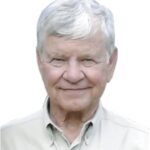
By Bill Ward
Published in The Boerne Star on July 27, 2007
Lying in an obscure weed patch just south of the Guadalupe River in Kerrville is a big block of limestone affixed with a bronze plaque that has an important-looking inscription: “In Memory of Carroll Abbott – ‘Mister Texas Wildflower’ – December 16, 1927 – July 5, 1984.” I’m sure most people driving along Francisco Lemos Street have no idea they are passing close to this memorial to one of the most influential pioneers in the modern native-plant movement.
Among many other things, Abbott was responsible for starting the Native Plant Society of Texas (NPSOT) and for persuading the legislature to declare the fourth Saturday of April as Texas Wildflower Day. When Carroll Abbott was honored by a joint session of the 1983 Texas legislature for his efforts in conservation of wildflowers, Lady Bird Johnson requested the honor of reading the resolution herself. He truly deserves the title “Mister Texas Wildflower.”
Why is this monument to such a prestigious person hidden away on a little dirt road just off of Francisco Lemos Street? I have heard various stories, and I’m uncertain of the true facts. It seems that this site once was destined to be a city park and so the local NPSOT chapter had the commemorative rock placed there after Abbott’s death. Later the area apparently became an RV park, but now it seems left to the wild.
Other rumors have it that Abbott’s widow hated the monument, because his name was misspelled. The name is spelled correctly; I checked. There must be another reason Mrs. Abbott could not accept the monument …. if it is indeed true that she disliked it. Maybe the dates are incorrect. His biographer, the late Ernest Tremayne, wrote that he was born in 1926 and died on July 6, 1984, not the dates on the inscription.
According to Tremayne, Carroll Abbott was raised in Houston, where his father was a handyman and Baptist preacher. Apparently, Abbott was interested in plants all his life, even as a toddler. As an adult, Carroll Abbott wrote for newspapers and worked as a political consultant.
Abbott’s parents moved to Kerrville in 1948 and purchased four acres at Lemos and Thompson Boulevard, not far from the present Riverside Nature Center. During 1951, Abbott took a job with the Kerrville Times and moved his growing family to Kerrville. Eventually he and his wife raised a family of three boys and one girl. All were named Carroll Abbott, but each had a different middle name.
In 1970 he quit the political public relations work and went into the wildflower business. He started Green Horizon, a seed company, but was barely able to make ends meet. He was ahead of his time.
During 1976, Abbott started a quarterly newsletter for people interested in native plants. Through this newsletter he instigated the creation of NPSOT in 1981. He published a soft-cover book entitled “How to Know and Grow Texas Wildflowers” in 1978. Again, he was ahead of his time, and book sales were slow. Today it would be a best seller. I wish it could be republished.
To read Ernest Tremayne’s fascinating story on the life of Carroll Abbott (first published in a 1997 NPSOT newsletter), go to www.npsot.org, then to the Boerne Chapter home page, scroll to the bottom, and look under Featured Articles. You’ll be glad you did.
Back to that big block of limestone with the bronze plaque – it would seem fitting for it to be moved up the hill to the Riverside Nature Center, where it could be brought to public attention. Carroll Abbott was too important to the modern appreciation and conservation of native plants for his monument to be hidden away in the brush on a seldom-visited site.
