San Antonio Chapter

San Antonio Chapter Meeting March 2026

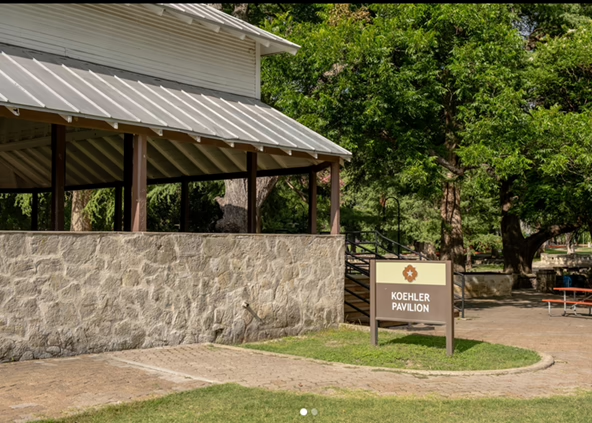
Koehler Pavilion in Brackenridge Park

When: March 24, 2026
Time: 5:30-7:30pm
Where: Koehler Pavilion at Brackenridge Park

Instead of our usual meeting and program at Hardberger Park, please join us at the Koehler Pavilion on the San Antonio River at Brackenridge Park for a social gathering and opportunity to adopt or exchange native Texas plants.

All members and friends are welcome!

What to bring: If you’ve got Texas native plants in your yard needing thinning or removal, please pot them up soon, label them with both common and latin name (if possible!) and then bring them with you to exchange for something new, or simply bring your excess to share with others. Also, don’t forget to package and bring any native seeds that you have collected.

This is going to be an ideal time for you to acquire some new native plants for your yard and to show your support for the San Antonio Chapter of the Native Plant Society of Texas. It will also be a great time to visit with your native plant friends and to make some new plant loving friends.

Finding Koehler Pavillion: Koehler Pavilion is just up the river from the San Antonio Zoo Train Depot. It is just off the circle where Tuleta and N. St. Mary’s Street intersect near Kiddie Park. Parking can be found in front of pavilion across from the SA Zoo Education Center or at the Brackenridge Eagle Train Station.

Click for a Map.

About the Region

2026 Fall Symposium Logo

This low-elevations region of Texas extends inland from the barrier islands, about 60 or so miles, and stretches from Brownsville to Louisiana. In total, it covers about 9.5 million acres, with a high point of 150 feet in elevation. More than 1000 species of plants can be found in this region. On the southern end, species more common in Mexico (such as Sabal mexicana) and Central America occur.

The barrier islands provide us with dune systems, and clay flats to the inland side, which have species found in these areas alone. Many plants here, such as Ipomoea pes-caprae (beach morning glory), can be found throughout tropical regions of the globe. I’ve encountered the same species on the beaches of Guam.

Once inland, vast marshes and wet prairies occur. Occasionally, oak (Quercus fusiformis) groves can be found. Common grasses include species of Bothriochloa, Paspalum, and Sporobolus; eastern gamagrass (Tripsacum dactyloides); and switchgrass (Panicum species). Many rivers and creeks cut through the Gulf Prairies, and along these riparian areas various species of trees, Sabal minor, and other plants adapted to clay soils can be found. Due to overgrazing, farming, and fire suppression, woody species such as mesquite (Prosopis glandulosa) and huisache (Acacia farnesiana), and invasive species such as chinaberry (Melia azedarach), Brazilian pepper (Schinus terebinthifolius), and Chinese tallow (Sapium sebiferum) have increased and displaced our native flora.

Source: Wildflowers of Texas by Michael Eason