


The end of September this year could well be called “Native-Plant Days in Boerne.” The Boerne Chapter of the Native Plant Society will team with the Cibolo Nature Center to bring this community a couple of easy and fun ways to learn more about the beauty and value of our native vegetation.
On the evening of Friday, September 28, there will be the Sign On Harvest Moon event presenting authors of popular books on native plants and artists whose works feature native wildflowers and other Texas plants.
The next day, September 29, the Boerne Chapter NPSOT and the Cibolo Nature Center will sponsor an all-day tour of yards landscaped with native plants. The Sign On Harvest Moon authors, who were discussed in our last column, will be Geyata Ajilsgi (“Wildflowers of Texas”), David Bamberger for Jeffery Green (“Water from Stone”), Paul Cox and Patty Leslie Pasztor (“Texas Trees, a Friendly Guide”), Brian and Shirley Loflin (“Grasses of the Texas Hill Country”), Jackie Poole and Jason Singhurst (“Rare Plants of Texas: a Field Guide”), and Jan Wrede (“Trees, Shrubs, and Vines of the Texas Hill Country”).
Among the prestigious artists who will be on hand is Charles Allen of Salado, Texas. He will bring his unique botanical metal sculptures. Allen, a pharmacist turned professional artist, produces his realistic pieces after detailed studies of the botanical structure and cycle of each flower.
Every piece is hand cut from a variety of metals, shaped, and soldered together. Multiple stages of painting complete the work. These award-winning sculptures range in size from small life-size clumps of wildflowers to tall floor pieces.
Margaret Bamberger illustrated Jeffery Green’s “Water from Stone, Bamberger Ranch Preserve,” one of the featured books at this event. Margaret and her husband J. David Bamberger are pioneers in restoration and good stewardship of Hill Country land. Their Selah Ranch north of Blanco has gained wide-recognition for ecological restoration and is the subject of “Water from Stone.” Margaret’s beautiful sketches from nature are rendered through the eye and heart of a consummate naturalist. Personally, I am impressed by how she captures the essence of those limestone bluffs that are so typical of the Hill Country. I hope the work she brings includes sketches of limestone outcrops.
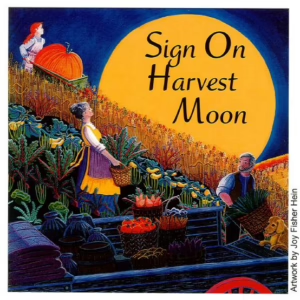
Joy Fisher Hein, illustrator of Kathi Appelt’s award-winning “Miss Ladybird’s Wildflowers,” is another prominent artist participating in Sign On Harvest Moon. She has illustrated several other children’s books and hundreds of pages for children’s magazines and textbooks.
Joy kindly provided the beautiful illustration for the Sign On Harvest Moon posters and advertisements, which will be popping up around this area in the next few days. Besides being an accomplished illustrator, Joy also is a Texas Master Naturalist, a new member of NPSOT, and an avid gardener.
Botanical artist Lotus McElfish will show her delicate watercolors of rare and endangered plants of the Texas Hill Country. Her work on this group of native plants is being encouraged by a grant from the American Society of Botanical Artists.
Among the endangered plants she painted is big red sage from the recently discovered population on Cibolo Creek southeast of Boerne. I’m happy to say we have the very nice prints of her big red sage watercolors hanging in our house.
Lotus’ other botanical illustrations include Texas wild rice, Texas snowbells, and Tobusch fishhook cactus.
I’m looking forward to the art at Sign On Harvest Moon. Don’t tell my wife, but her birthday present this year will be bought at the artists’ tables.
