


By Bill Ward
Published in The Boerne Star in November 2006
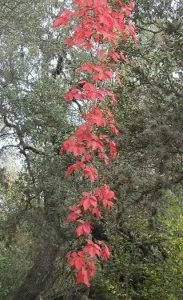
When I went out to pick up the newspaper one sunny morning about three weeks ago, I was a little startled to see some of our big liveoaks decorated with “strings of red and orange lights.” These were the bright autumn leaves of our Virginia creeper vines. Those vines go almost forgotten until suddenly they are the first colors of fall. It’s always a pleasant surprise.
Virginia creeper (Parthenocissus quinquefolia) comes up naturally in several spots of our yard. Some of these vines look old. They are two inches wide and reach to the very tops of the oaks. These Virginia creeper vines complement our informal landscape, and as far as I can tell, they do no harm to the trees they decorate. We are especially glad to have these vines when their leaves turn dark red in the fall.
I suspect a lot of other yards in our neighborhood are cleared of Virginia creeper because it is confused with poison ivy (Toxicodendron radicans). Both plants have fairly large compound leaves with leaflets that are pointed and have toothed margins. Virginia creeper is a harmless member of the grape family and usually has five or six leaflets projecting from the leaf stem. Poison ivy, a member of the sumac family, typically has three leaflets. Incidentally, poison ivy produces some fairly spectacular fall color, too.
The Boerne area has several other native vines that shouldn’t be forgotten as landscape plants, especially where there are fences and small trellises. We are lucky to have a number of these native vines growing naturally in our yard, and we have introduced a few more. Excellent photos and descriptions of native vines are in “Trees, Shrubs, and Vines of the Texas Hill Country” by Boerne’s own Jan Wrede. You can buy it at any local bookstore or at the Cibolo Nature Center.
Perhaps some of the most inconspicuous of our vines are two species of passion-flower. A few low-growing vines of yellow passion-flower (Passiflora lutea) and spreadlobe passion-flower (P. tenuiloba) come up under our oak trees. During the summer, they both produce tiny yellow-green versions of the well-known passion flower. Another little passion-flower that grows in this area is the bracted passion-flower (P. affinis), which is endemic to the Edwards Plateau and southern Lampasas Cut Plain.
A happy surprise to find in our backyard was a Lindheimer’s morning glory (Ipomoea lindheimeri), the large-flowered blue morning glory found in the Hill Country and Trans Pecos region. Luckily just before I discovered this vine coming up where I was stacking wood, I had seen Lindheimer’s morning glory for the first time in the wild at Government Canyon State Natural Area. I recognized the deeply lobed leaves and promptly moved the wood pile to another place. Now we are planting more Lindheimer’s morning glories grown from seed of the first one. A nice thing about these vines is that they are not invasive and can be contained in one area of a garden.
Another morning glory that grows a little too well in our yard is wild morning glory or purple bindweed (Ipomea cordatotrilobia). It is an excellent bloomer from late spring to early fall and is very drought-tolerant. However, it is aggressive and tends to engulf any nearby flowers and bushes. It’s almost uncontrollable in a flower bed, but on a sunny fence or trellis it is a pretty vine.
Texas bindweed (Convolvulus equitans) also grows naturally in some sunny parts of our backyard. This low-climbing vine has small morning-glory-like white flowers with purple centers. It blooms from late spring to early fall.
Some native vines we have introduced to our backyard are pearl milkweed (Matelea reticulata), scarlet leatherflower (Clematis texensis), coral honeysuckle (Lonicera sempervirens), and white honeysuckle (Lonicera albiflora).
Speaking of vines that grow wild in our yard, does anyone need any greenbrier (Smilax bona-nox)? It remains unscathed by any attempts I make to control where it grows.
