

By Delmar Cain
Bill Ward introduced seven trees that are being promoted in 2011 by the Boerne chapter of NPSOT in Operation NICE (Natives Instead of Common Exotics). The cedar elm (Ulmus crassifolia) or perhaps a less confusing common name, Texas fall elm, is the third tree and the March Plant of the Month.
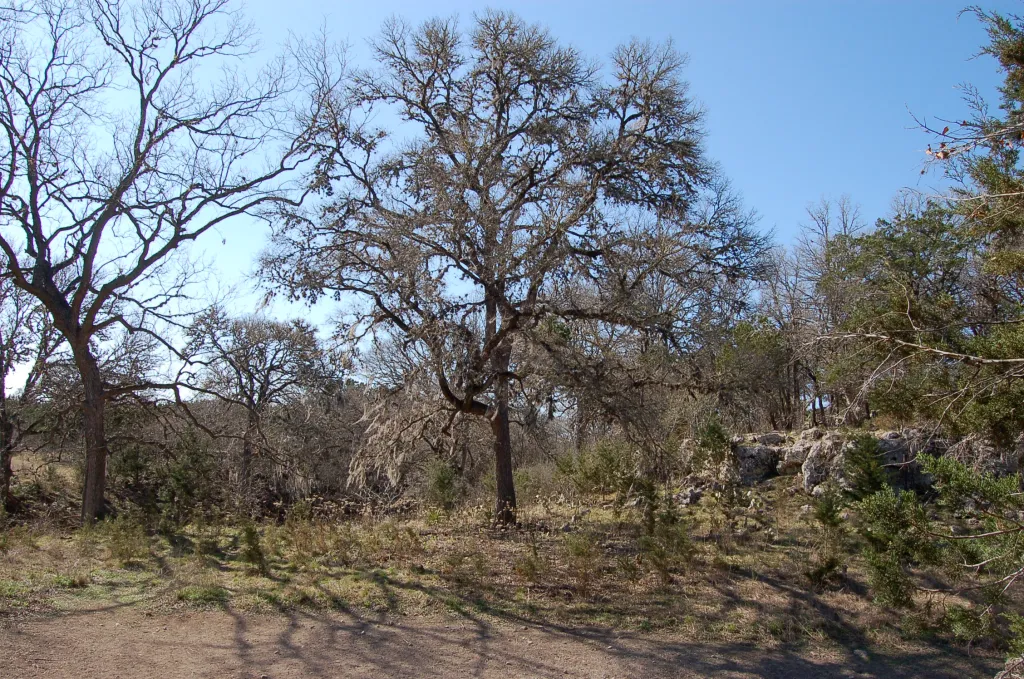
The Texas fall elm, the most common elm in Texas, has a natural habitat that extends from Okalahoma to Central and South Texas and east to Arkansas and Mississippi. It can grow to a height of 80 feet and a diameter of 24 inches in optimum conditions, which just happen to be in the bottomlands of the Guadalupe and Trinity rivers. Here in our area with its dry, limestone hills and where the soil is not so deep, a more realistic height is 30-60 feet.
Because of its draught hardiness and its ability for good growth in many types of soils, the Texas fall elm is widely used as a tree to line our streets and shade our yards. It doesn’t hurt that in the fall its golden yellow leaves make a colorful contrast to the red of the Spanish oak. In the late summer to early fall small inconspicuous green flowers will appear at the leaf bases with a generous helping of small brown winged seeds soon to follow. The seeds are eaten by a variety of birds and small animals. Squirrels will actually leave your feeders alone during the time when the seeds mature.
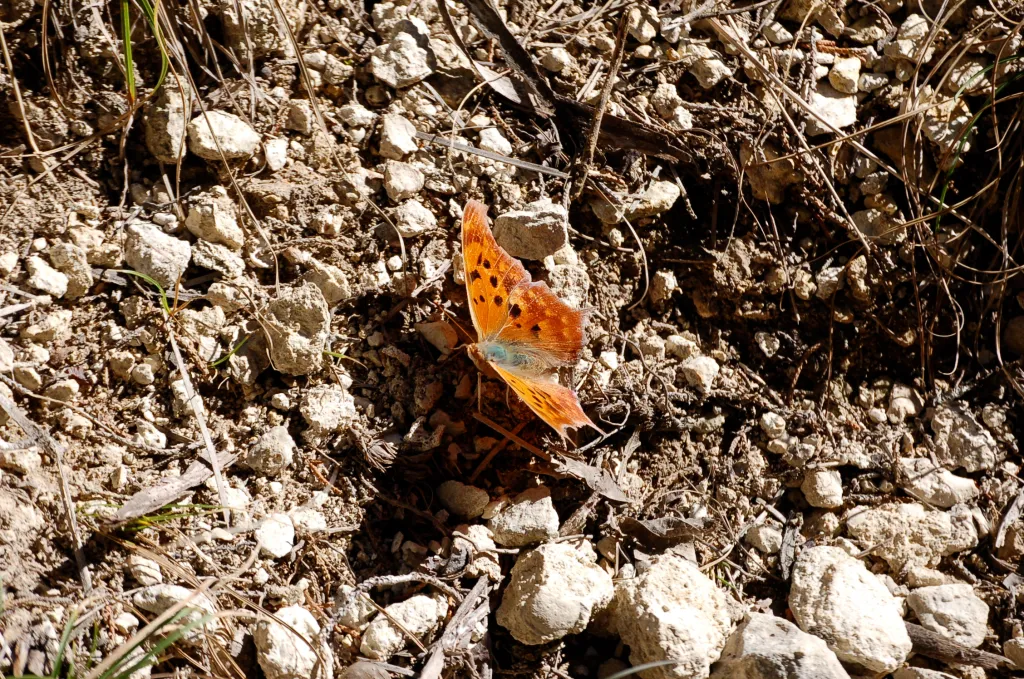
Even with our well-drained calcareous soils the Texas fall elm grows moderately fast, preferring full sun to part shade. If your spot also includes other woodland, a ravine or open slope, this tree will feel right at home. It will even tolerate a short duration of flooding. If deer are a problem in your area protect the younger tree because they will browse its leaves and will also use its trunk as an antler rub. You might not notice them but butterflies such as the Mourning Cloak and the Question Mark will use the tree as a host plant. A host plant is one on which eggs are deposited and which then serves as food for the developing larvae.
We have other species of elm here in the Hill Country (or “ellum” as my Dad, who was from Arkansas, pronounced it.) The American elm (Ulmus Americana) is a classic shade tree, which can on rare occasions reach a height of 120 with a width of 50 to 90 feet. But the American elm population was almost eliminated by Dutch elm disease, a fungus related to oak wilt, which destroyed as many as 40 million elms. The fungus, which came to the United States from Europe arrived here in 1930 and was confirmed in Texas in 1970. The American elms at the state capitol in Austin were replaced in 1987 with trees from a species from New Jersey, which is resistant to the fungus. The Texas fall elm is less susceptible to the fungus than other species.

Another species of elm, the slippery elm (Ulmus rubra) is sometimes confused with the American elm, but generally grows in deep moist soils of riverbanks or on shaded hillsides. Its range is not as great as the Texas fall elm nor is it as prevalent within its range. Its dark green leaf is much larger than the Texas fall elm and is very rough on the upper side. It name came from the fact that the pioneers would chew its white inner bark to quench thirst. Jan Wrede writes in her book, Trees, Shrubs, and Vines of the Texas Hill Country, that the inner bark can be steeped in water to make a “healthful, soothing tea.”
So what’s the story behind the name and what is less confusing about using the common name, “Texas fall elm”, as opposed to cedar elm, Olmo, basket elm, scrub elm, lime elm, or southern rock elm. I can’t answer both of those questions. It didn’t take much research on my part to find that the word “elm” is both ancient and elusive. Go there at your peril. But from Mark Duff of the Texas Forest Service I gather that “cedar elm” apparently carries a heavy burden, i.e. “cedar”. He said that, “ every time you try to give away a cedar elm tree to someone, they say they are allergic to it.”
So the moral of this story is beware of a Forester bearing cedar in any form. But if he or she gives you an Ulmus crassifolia take that ellum and plant it. If you need more instructions on planting you can find them on the website of the Boerne chapter of the Native Plant Society (http://www.npsot.org/wp/boerne/).
