Loading Events

This event has passed.

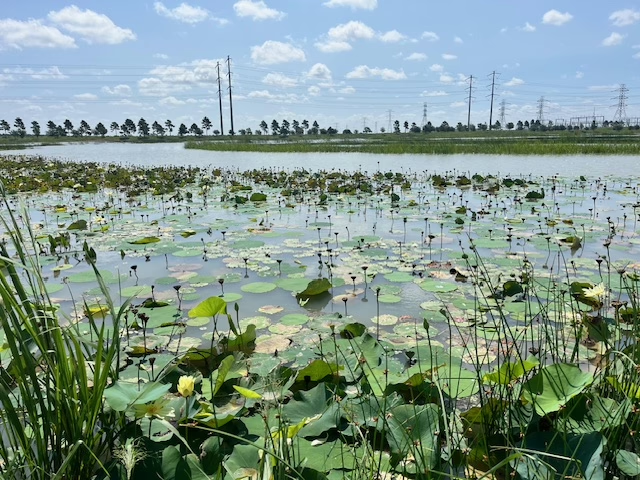
Three years, 75 acres and 100,000 wetland plants: Creating a wetland at John Paul Landing Park in Katy – October 16

October 16 @ 7:00 pm 8:00 pm

The very large John Paul Landing park on the far west side of Harris County is at the epicenter of rapid neighborhood development, and the Harris County Engineering Department planned an expansion of the lake in the park to absorb stormwater runoff. Remarkably, wetlands were designed into the plans from the outset. Mary Carol Edwards’ company Green Star Wetland Plant Farm was subcontracted to source, propagate, and deliver the plants for each of the three phases of lake excavation and planting. She will discuss the results, adventures, and lessons learned along the way, as well as introduce some of the key native species that found a new home in the project.

About the Speaker

Mary Carol founded Green Star Wetland Plant Farm in 2018 to meet a need for native aquatic species for all kinds of projects, from backyard raingardens to large acreage restorations. She previously worked as the stormwater wetland specialist for Texas A&M AgriLife Extension Service’s Texas Community Watershed Partners, as well as TCWP’s freshwater wetland restoration program, at landscape design and landscape architecture firms, and also in genetics research labs at Baylor College of Medicine and Rice University. Mary Carol is a Houston native, raised on Galveston Bay. She has a BS in Biology and an MA in Architecture from the University of Houston and enjoys bringing both disciplines together to create wonderful natural settings.

Our monthly chapter meetings are held on every 3rd Thursday, January – November. Our meetings are free and open to the public thanks to our members and sponsors.

The presentation will start at 7:00 pm, but come at 6:45 pm for a meet and greet with snacks.

Houston Arboretum and Nature Center

610 Entrance (preferred)
120 W Loop N Fwy
Houston, TX 77024

Woodway Entrance
4501 Woodway Drive
Houston, TX 77024

Meetings will also be live-streamed and recorded for later viewing.

Return to Houston Chapter Page
About the Region

Fall Symposium 2025 Logo - Teach for the Future

Salado, the location of our Fall 2025 Symposium, lies at the intersection of two ecoregions: the Edwards Plateau (Limestone Cut Plain) and Blackland Prairie (Northern Blackland Prairie).

The Edwards Plateau area is also called the Hill Country; however, this general term covers a much larger area extending farther north. Spring-fed creeks are found throughout the region; deep limestone canyons, rivers, and lakes (reservoirs) are common. Ashe juniper is perhaps the most common woody species found throughout the region. Additional woody species include various species of oak, with live oak (Quercus fusiformis) being the most common. Sycamores (Platanus occidentalis) and bald cypress (Taxodium distichum) border waterways. This area is well known for its spring wildflower displays, though they may be viewed in spring, late summer, and fall, as well. According to Texas Parks and Wildlife, average annual rainfall in the Edwards Plateau ranges from 15 to 34 inches.

The Blackland Prairie extends from the Red River south to San Antonio, bordered on the west by the Edwards Plateau and the Cross Timbers, and on the east by the Post Oak Savannah. Annual rainfall averages 30 to 40 inches, with higher averages to the east. This region is dominated by prairie species. The most common grass species include little bluestem (Schizachyrium scoparium) and Indian grass (Sorghastrum nutans) in the uplands and switchgrass (Panicum virgatum) in the riparian areas and drainages. Common herbaceous flowering plants include salvias, penstemons, and silphiums. This area has suffered greatly from overgrazing and agricultural use. Few intact areas remain, though many of the plants can be found along county roadsides throughout the region.

Our fall Symposium host chapter, the Tonkawa Chapter, includes both of these ecoregions.

Source: Wildflowers of Texas by Michael Eason