News and Events

News and announcements from our committee chairs, board members, and chapter leaders. Subscribe to our mailing list to stay up to date. For chapter news, visit Chapters. If you are looking for a calendar of events, see our Events Calendar.

  • Chapter or Committee

Our Society’s home in Fredericksburg

The core of the house was built in the early 1880’s by the Staudt family and used as a Sunday House. At that time families that lived in the country often built a small two-story two-room house in town where they could stay on weekends when they shopped for supplies on Saturday and attended church on Sunday.

Read More »
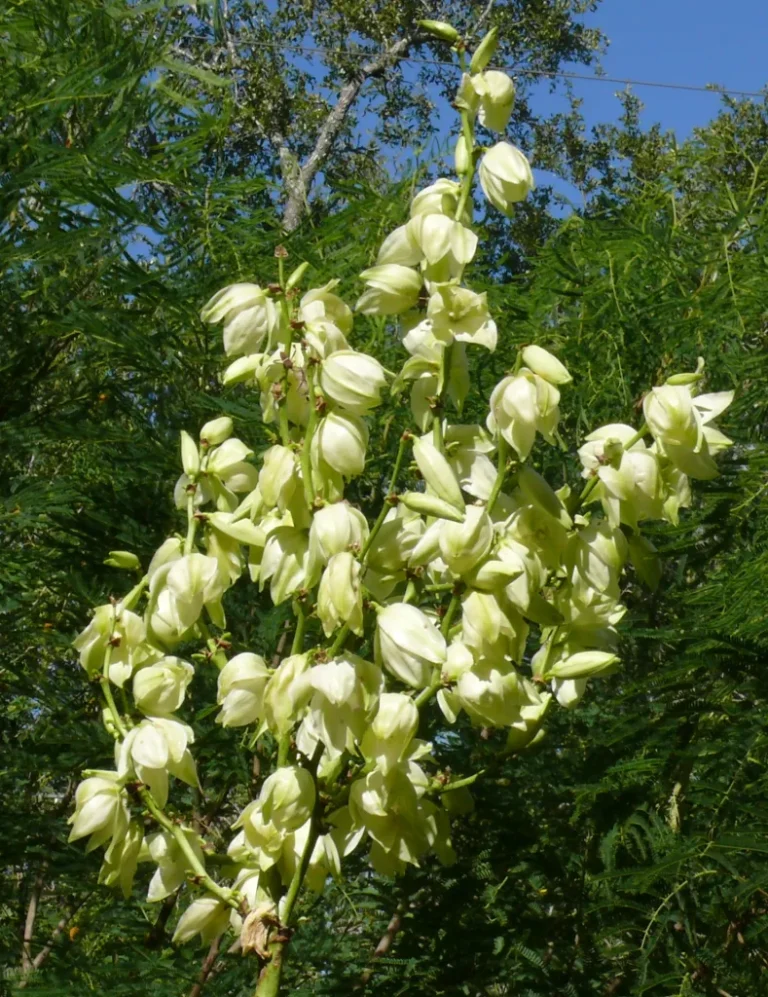
Yucca plant in bloom (white)
Boerne

July-August 2005

NICE! Plant of the Month (Yucca rupicola) Description:Endemic to the Edwards Plateau, Twist-leaf yucca gets its name from its wonderful twisting leaves. It is a low-growing yucca without a visible stem with single or clustered heads of twisted, arching blue-green leaves 8-24 inches long. Flowers are held on stalks as

Read More »
Stand of red blooms in a bed, people walking by in background.
Boerne

May 2005

NICE! Plant of the Month (Stachys coccinea) Description:Texas Betony, is a flowering and evergreen perennial, 12 to 18 inches tall or more. It naturally grows in moist crevices of the mountains of West Texas, west to Arizona, and northern Mexico. It produces red or pink tubular flowers and has a

Read More »
Bright yellow cluster of three flowers
Boerne

April 2005

NICE! Plant of the Month (Gelsemium sempervirens) Description:Carolina Jessamine is an evergreen, perennial, flowering vine. Its natural range includes East Texas and much of the southeastern U.S. It produces fragrant, yellow, funnel-shaped flowers and is often one of the first plants to bloom in the spring. Gelsemium sempervirens has glossy

Read More »
Tree with bright orange autumn leaves in contrast to a background of green foliage.
Boerne

March 2005

NICE! Plant of the Month (Acer grandidentatum) Description:Bigtooth maple is a relic from the last ice age, 10,000 years ago. It is a native hardwood shrub or medium sized-tree of 20-30 feet, but under optimal conditions it can reach up to 50 feet tall. It has an open, rounded crown

Read More »
Close up of cupped, red flower
Boerne

February 2005

NICE! Plant of the Month (Opuntia engelmannii variety lindheimeri) Description:Texas Prickly Pear Cactus belongs to the Opuntia genus or group of cacti and is the most prevalent species of Opuntia found in Texas. Its natural range is from the Western Cross-Timbers, Rolling and High Plains, Edward’s Plateau, Rio Grande Plains,

Read More »
Tiny orange-red bud and several gnew, reen buds on a plant.
Boerne

June 2004

NICE! Plant of the Month (Capsicum annuum var. aviculare) Description:Chile Pequin is the native chile pepper from which many edible chilies have been derived. The natural range extends from tropical America through the southernmost tip of Texas north to Waco, east to Florida and west to Arizona. In the Hill

Read More »
Green foliage with small red clusters of berry-like fruit
Boerne

October 2003

NICE! Plant of the Month (Rhus lanceolata) Description:Flameleaf sumac, a thicket-forming, deciduous ornamental shrub or single-trunked tree, can be found on limestone and calcareous soils in the Edwards Plateau, Trans-Pecos, North and Central Texas, and New Mexico. It can reach a height of 10-20 feet tall. The plant’s common name

Read More »
Tuft of yellow-gold bunch grass
Boerne

September 2003

NICE! Plant of the Month (Muhlenbergia spp.) Description:Gulf muhly is a native, perennial bunchgrass that usually reaches a height of 1 ½ to 3 feet. It grows in tall clumps and has glossy deep-green leaves. During the mid-fall blooming season, purplish pink flowers arise from tall stems. The tiny flowers

Read More »
Pink flowers with gray bark in the background
Boerne

June 2003

NICE! Plant of the Month (Gaura lindheimeri) Description:Gaura lindheimeri is an interesting native perennial that grows 2-3 feet tall, but can get much taller in rich soils. It produces tall, slender and almost leafless flower stems above the body or basal leaves of the plant. When blown by the wind,

Read More »
Bright red cluster of flowers atop a stem, gray rock in the background.
Boerne

May 2003

NICE! Plant of the Month (Salvia roemeriana) Description:A great shade plant, named because it can also be found growing in the dense shade of Ashe junipers (mountain cedars). It also grows under oaks and mountain laurels. A small plant and well behaved, with little furry round or heart-shaped leaves with

Read More »
Small, purple, many-petaled flowers with a yellow center
Boerne

October 2002

NICE! Plant of the Month (Aster spp.) Description:There are several species of blue-flowered asters growing wild in the Hill Country. Asters sold in nurseries may be one of these natives (difficult to tell apart), or may be a cultivated hybrid. They are usually identified as Aster spp., and their origin

Read More »

About the Region

Fall Symposium 2025 Logo - Teach for the Future

Salado, the location of our Fall 2025 Symposium, lies at the intersection of two ecoregions: the Edwards Plateau (Limestone Cut Plain) and Blackland Prairie (Northern Blackland Prairie).

The Edwards Plateau area is also called the Hill Country; however, this general term covers a much larger area extending farther north. Spring-fed creeks are found throughout the region; deep limestone canyons, rivers, and lakes (reservoirs) are common. Ashe juniper is perhaps the most common woody species found throughout the region. Additional woody species include various species of oak, with live oak (Quercus fusiformis) being the most common. Sycamores (Platanus occidentalis) and bald cypress (Taxodium distichum) border waterways. This area is well known for its spring wildflower displays, though they may be viewed in spring, late summer, and fall, as well. According to Texas Parks and Wildlife, average annual rainfall in the Edwards Plateau ranges from 15 to 34 inches.

The Blackland Prairie extends from the Red River south to San Antonio, bordered on the west by the Edwards Plateau and the Cross Timbers, and on the east by the Post Oak Savannah. Annual rainfall averages 30 to 40 inches, with higher averages to the east. This region is dominated by prairie species. The most common grass species include little bluestem (Schizachyrium scoparium) and Indian grass (Sorghastrum nutans) in the uplands and switchgrass (Panicum virgatum) in the riparian areas and drainages. Common herbaceous flowering plants include salvias, penstemons, and silphiums. This area has suffered greatly from overgrazing and agricultural use. Few intact areas remain, though many of the plants can be found along county roadsides throughout the region.

Our fall Symposium host chapter, the Tonkawa Chapter, includes both of these ecoregions.

Source: Wildflowers of Texas by Michael Eason