

Join us at our Tuesday, April 1st chapter meeting!
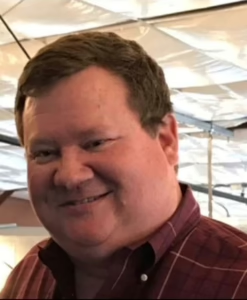 We are excited to host Michael “Mike” Mitchell, Texas Game Warden, Assistant Commander, Retired, who is visiting us from Austin, Texas. Retired from state service in 2020, he is currently involved with teaching ethics, international wildlife trafficking, and other topics for the Texas Master Naturalist Program. Passionate about conservation and education, Mike will share with us his knowledge and insights about “Conservation Law and Ethics“.
Mike grew up in Houston. He attended Texas A&M University, obtaining a Bachelors of Science degree in Geography. Upon graduation, he was commissioned as a Naval Officer and served aboard a forward deployed destroyer during OPERATION DESERT STORM.
After completing military service, he attended Cornell University, obtaining a Masters of Management degree in 1999. After several years in the technology business world, he moved into conservation.
He started his career at the Texas Parks & Wildlife Department in 2004. Commissioned there as a Texas Game Warden, he served in positions in traditional deer country and the Texas Gulf Coast. In 2014 he was appointed a Lieutenant and moved into the agency headquarters. In the newly-created position, he sought to bring effective technology into the hands of Texas Game Wardens. Mike became highly involved with social media, public affairs, mobile applications, big data, and extensive teaching. In his capacity he brought the 551 sworn Texas Game Wardens into the 21st century, including winning a best of state award and being promoted to Assistant Commander.
He is a graduate of, lecturer to, and coach for the National Association Law Enforcement Leadership Academy at the US Fish & Wildlife’s National Conservation Training Center. He has also been both a cohort student and coach at the International Conservation Chiefs Academy, a program funded by the US Department of State, Bureau of International Narcotics & Law Enforcement Affairs. He has graduated from the US Department of Justice, Institute of Justice Technology Program and the US Department of Homeland Security, Marine Law Enforcement Training Program.
He retired from state service in 2020. He is currently involved with teaching ethics, international wildlife trafficking, and other topics for the Texas Master Naturalist Program.
